Code Jobs Today: Bookkeeping for Contractors Using Field Capture

Code Jobs Today: Bookkeeping for Contractors Using Field Capture

Start coding every receipt, timesheet, and invoice to a specific job today, then run a weekly work-in-progress (WIP) check against your estimate. The U.S. Small Business Administration recommends treating bookkeeping as a core business function, not an afterthought, and IRS rules on contractor status make accurate records a tax requirement, not just a best practice.
TL;DR:
- Code every receipt, timesheet, and invoice to its job when it occurs, then compare costs with estimates weekly while adjustments remain possible.
- Review each active job monthly for percent complete, projected profitability, and billing position; investigate a downward trend after two consecutive monthly reviews.
- Cash basis can conceal completed work that remains unbilled, while lenders and bonding companies favor accrual or percentage of completion reporting for current project status.
- Keep payroll, tax reserves, operating funds, and retainage separate, and forecast cash weekly against billing schedules because monthly forecasts can miss timing pressures.
- Crews relying on paper receipts and memory should pilot mobile voice and photo capture; teams with reliable systems can wait for a slower season.
Hechitohechito.comCapture Job Details As Work HappensHechito turns voice notes and images into organized job records, helping contractors reduce paperwork and move from quoting to invoicing.Explore Hechito
Table of Contents
- Why contractor bookkeeping is unique and what problems it solves
- Core bookkeeping practices every contractor must run
- How to set up project-based accounting and a construction COA that actually works
- WIP schedules, retainage, and revenue recognition: how to run and interpret them
- Payroll, subcontractors, and compliance: bookkeeping workflows that reduce risk
- Cash flow and bank-account structures contractors should use
- Field workflows and what to require from software
- How on-job automation reduces bookkeeping work: a practical application
- Practitioner perspective: habits leaders must set for bookkeeping to stick
- Hechito: an example automation that captures job details and speeds invoicing
- FAQ
- Sources
Why contractor bookkeeping is unique and what problems it solves
Contractor bookkeeping behaves nothing like retail or service-business bookkeeping because the money does not move in sync with the work.
Job-level visibility is what separates a contractor who catches margin fade in week three from one who finds out at closeout, when it’s too late to fix pricing or crew allocation. Without cost codes tied to each project, you’re guessing at which jobs make money and which ones quietly drain cash from the ones that do.
The accounting method you choose changes what your financial reports actually tell you:
- Cash-basis accounting shows what hit your bank account, which is simple but hides work you’ve done and not yet billed.
- Accrual accounting recognizes revenue and expenses when they occur, giving a truer picture of job performance.
- Percentage-of-completion method (PCM) recognizes revenue as work progresses, matching income to the labor and materials actually consumed.
- Completed-contract method (CCM) defers all revenue recognition until the job finishes, which can work for short jobs but hides long-term project health.
Lenders and bonding companies lean on accrual or PCM reporting because it reflects real job status, so the method you pick affects your financing options down the road.
Core bookkeeping practices every contractor must run
Most bookkeeping problems in construction trace back to a handful of habits that get skipped under deadline pressure. Here’s the sequence that stops the leaks before they start:
- Build a construction-specific chart of accounts with cost codes for labor, materials, subcontractors, and equipment, then assign every job a unique number.
- Code each transaction, receipt, and timesheet entry to its job code on the day it happens, not at month-end when details are forgotten.
- Run a job-cost-to-estimate comparison every week so you catch overruns while there’s still time to adjust scope or crew hours.
- Track retainage as a separate line item and align progress billing to your schedule of values so you’re never guessing what’s owed.
- Maintain separate bank accounts for operating funds, payroll, tax reserves, and retainage, and reconcile each one on a fixed schedule.
- Automate data capture wherever the workflow allows it, and write down an exception process for the odd invoice or receipt that doesn’t fit the pattern.
Pro Tip: Set a recurring 30-minute Friday block to code the week’s receipts and compare job costs to budget. It’s the single habit that prevents end-of-month scrambles.
The SBA’s guidance on business finances lists accounts receivable, accounts payable, bank reconciliation, and payroll as the functions every small business, including contracting firms, needs to keep current. Skipping any one of these for a few weeks tends to create a backlog that takes days to untangle later.
How to set up project-based accounting and a construction COA that actually works
A generic chart of accounts built for a retail shop won’t tell you anything useful about a construction job. You need cost code buckets structured around how work actually breaks down on site:
- Direct labor, split by trade or crew where it helps with bidding accuracy.
- Materials, tracked separately from labor so you can spot price creep on specific items.
- Subcontractor costs, coded to the sub and the job simultaneously.
- Equipment costs, whether owned or rented, allocated to the job using it.
- Overhead and general conditions, kept distinct from direct job costs.
Assign every project a job number the moment you sign the contract, and apply that number to every timesheet entry, purchase order, and invoice tied to the work. Change orders get their own sub-code under the original job number so you can see how scope changes affect the original estimate without losing the baseline comparison.
Subcontractor invoices should be coded to the job and cost category before they’re approved for payment, not after. The same goes for equipment rentals and material purchase orders: tie them to the job at the point of purchase, not during reconciliation.
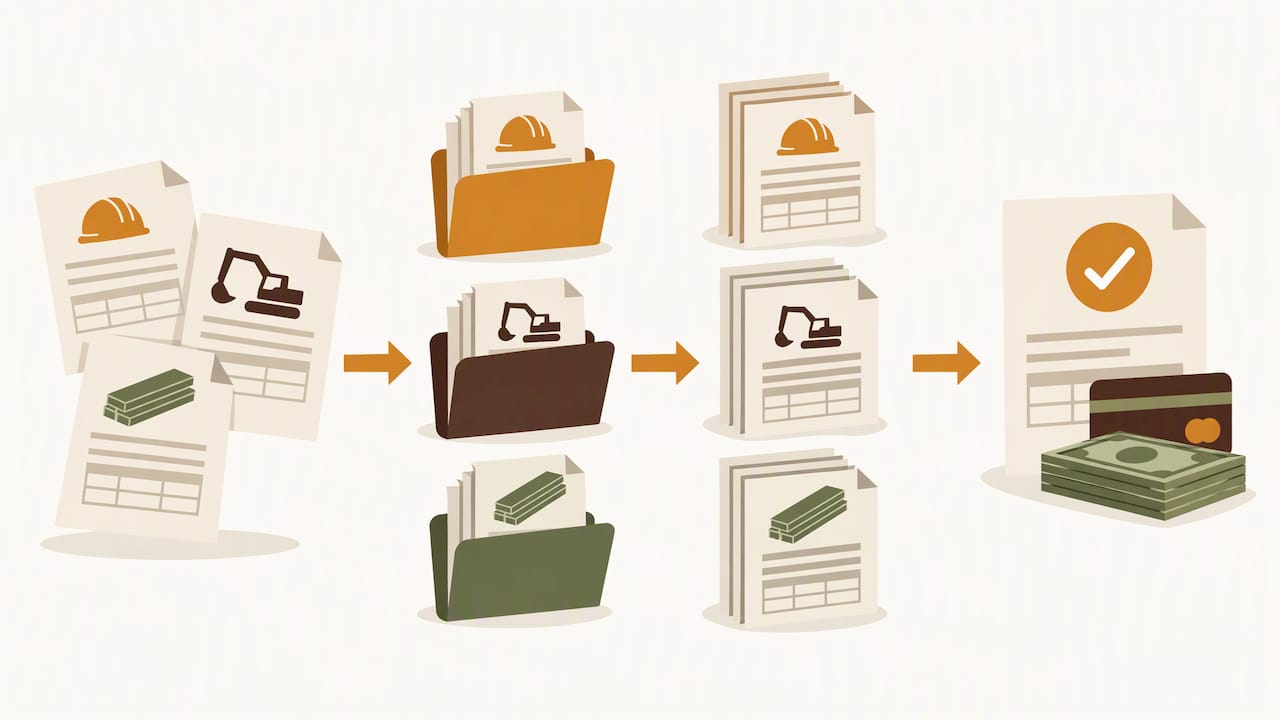
Run a monthly audit where you pull a sample of job-cost entries and trace them back to source documents. This catches miscoded transactions before they distort your WIP numbers and estimate comparisons.
WIP schedules, retainage, and revenue recognition: how to run and interpret them
A work-in-progress schedule tells you whether a job is actually profitable right now, not just whether cash is coming in. CFMA’s guidance on reading WIP schedules frames the WIP as the earliest operational warning system a contractor has, well before year-end financials would show the same problem.
The calculation starts with percent complete, usually figured as cost-to-cost: costs incurred divided by total estimated costs. Multiply that percentage by the total contract value to get earned revenue, then compare earned revenue to what you’ve actually billed. The gap between the two is your over- or underbilling position, and it shows up directly on the balance sheet.
Practitioners run a three-line monthly check on every active job: percent complete, estimated margin, and billing position, according to CFMA. Watching these three numbers move together, or diverge, over consecutive months is how margin fade gets caught early instead of at closeout.
- Percent complete should track roughly with your labor and material burn rate; a mismatch usually means a coding error or a scope problem.
- Estimated margin that drops two months in a row is a signal to review the job budget immediately, not at the next scheduled review.
- Billing position (over or underbilled) affects cash flow directly: being underbilled means you’ve done more work than you’ve invoiced for.
Retainage and uninstalled materials complicate this picture further, since IRS practice guidance notes that held-back amounts and stored materials require careful treatment under revenue recognition rules. When method elections get complicated, or you’re working toward bonding capacity, that’s the point to bring in a construction-focused CPA rather than guessing.
Payroll, subcontractors, and compliance: bookkeeping workflows that reduce risk
Misclassifying a worker as a subcontractor when they function as an employee is one of the costliest bookkeeping mistakes in the trades, since the correction often costs more than running payroll correctly from day one.
- Review worker classification against IRS behavioral and financial control tests before assuming 1099 status is safe.
- Set up certified payroll reporting early if you bid public jobs, including fringe and benefit tracking that satisfies prevailing wage requirements.
- Track subcontractor retainage separately and collect lien-release documentation before releasing final payment to avoid clouded title issues.
- Reconcile payroll liabilities and subcontractor payables on a fixed monthly cadence so nothing drifts into a surprise at tax time.
Getting these workflows right from the start avoids the kind of back-pay and penalty exposure that can erase a quarter’s profit in one correction.
Cash flow and bank-account structures contractors should use
Separating your money by purpose is one of the simplest changes that prevents payroll shortfalls and vendor disputes.
- Keep an operating account for day-to-day job expenses and incoming progress payments.
- Maintain a dedicated payroll account funded ahead of each pay period, never pulled from operating cash at the last minute.
- Set aside a tax reserve account and fund it with a percentage of every payment received.
- Hold retainage receivables visible in a separate ledger line so you don’t mistake it for available cash.
Run a weekly cash-flow forecast tied to your job billing schedule and accounts receivable aging, since monthly forecasting moves too slowly to catch the volatility that retainage and front-loaded material costs create. Follow up on invoices the moment they’re overdue rather than waiting for a monthly statement run, and offer early-payment terms on larger jobs where the cash timing matters most. A reconciled WIP schedule becomes the document a bank or bonding company asks for first, so keeping it current isn’t just an internal exercise.
Field workflows and what to require from software
The right software choice comes down to whether it keeps job data current without adding a second job of data entry at night. Look for these capabilities regardless of brand:
- Mobile entry that lets crews log hours and materials from the truck or job site.
- Photo receipt capture that attaches directly to the right job code.
- Voice capture for quick job notes without stopping to type.
- Offline mode for sites with no signal, syncing once connectivity returns.
- Progress-billing support tied to a schedule of values.
Prioritize tools that sync cleanly to your ledger, payroll system, and bank feeds, and that export job-cost reports without manual reformatting. Broadly, you’re choosing between entry-level field apps, full contractor accounting platforms, and integrated project-accounting suites. Before committing, run a trial with your actual crew: test whether job-cost coding stays accurate, whether retainage is handled correctly, and whether the mobile interface is something your team will actually use on a cold morning with gloves on.
How on-job automation reduces bookkeeping work: a practical application
Field capture tools that turn voice notes and photos into organized job records solve the exact leak points described above: missed charges, late invoicing, and double entry from re-typing field notes at the office.
- Voice and photo capture at the point of work means job notes, quotes, and receipts get recorded while details are still fresh, not reconstructed from memory at day’s end.
- Converting a verbal note directly into a coded job entry removes the step where a contractor has to remember to log it later, which is where most missed charges originate.
- Faster capture translates into faster invoicing, since the documentation needed to bill is already organized by the time the job wraps.
A contractor running mostly on paper receipts and end-of-day memory is a strong candidate to pilot an on-job capture tool. A contractor with a tight manual system that’s already working well might wait until a slow season to test a switch, since any new workflow needs a few weeks to become habit.
Practitioner perspective: habits leaders must set for bookkeeping to stick
Bookkeeping systems fail not because the templates are wrong but because nobody enforces them once the job gets busy. Make job coding mandatory, audit it weekly, and tie at least one performance metric to how accurately a crew lead codes their own time and materials.
Treat the WIP schedule as an early warning system and require project managers to sit in on the monthly review, not just the bookkeeper. Train field crews on mobile entry using the simplest workflow available, since a system nobody uses on site produces worse data than no system at all. When method elections, bonding capacity, or multi-year contract questions come up, bring in a construction CPA rather than guessing at the right call.
— Francisco
Hechito: an example automation that captures job details and speeds invoicing
We built Hechito around the exact gap this playbook describes: the lag between finishing a job conversation on site and getting that information into a system where it can be invoiced. We capture quotes, job notes, and receipts through voice and photos in real time, then convert those inputs into organized, job-coded records without extra typing.
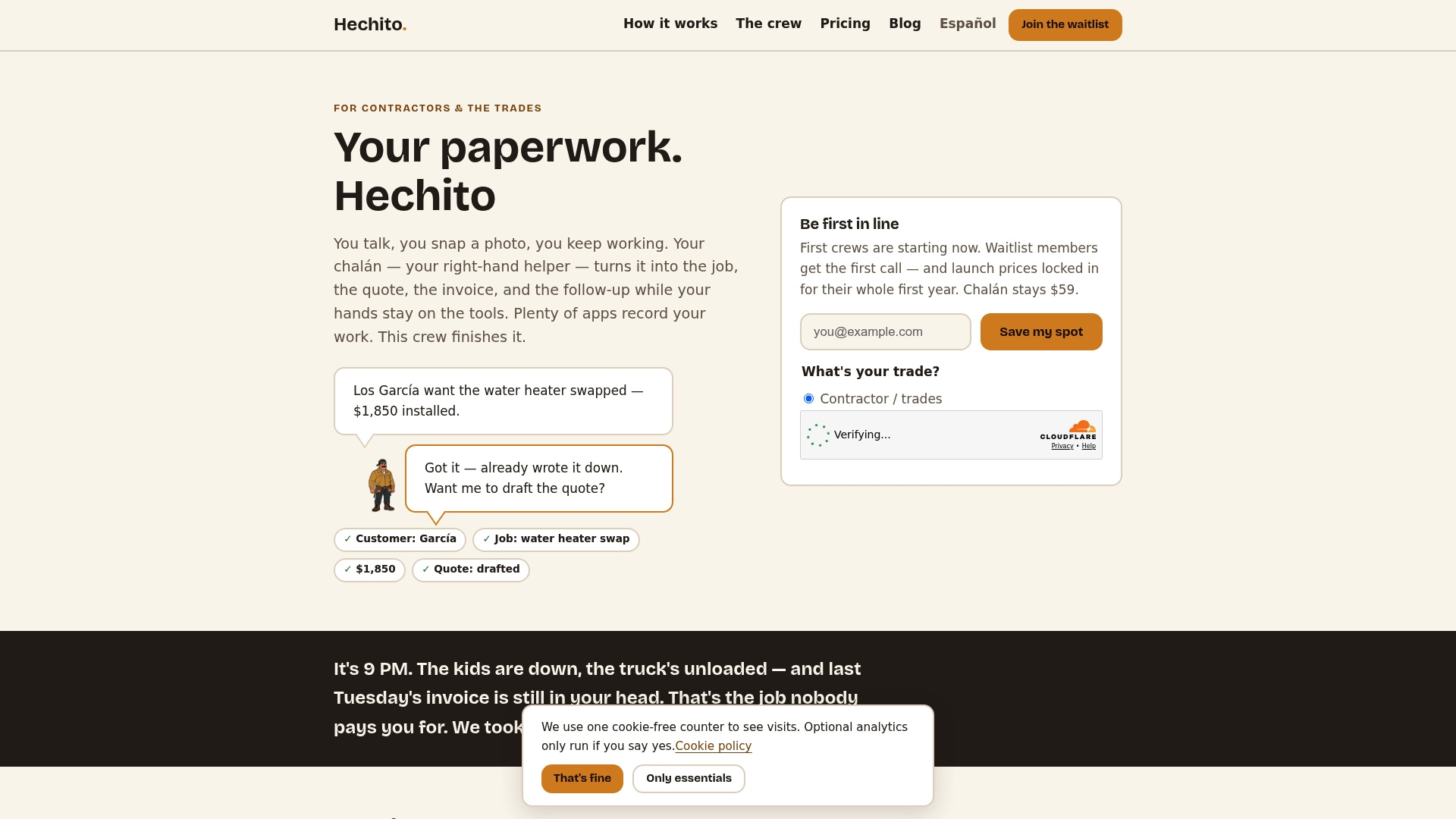
That removes the missed charges, delayed invoices, and double entry that come from reconstructing a day’s work from memory at the office. The platform runs bilingually, so notes and documents come out clean in whichever language the job calls for. If you want to see how the capture and invoicing flow works end to end, check how Hechito works or review pricing for the Chalán, Lupita, and Godínez plans.
FAQ
What is the best bookkeeping software for contractors?
The best choice depends on job complexity: smaller crews often do well with entry-level field apps that handle mobile receipts and invoicing, while larger operations need integrated project-accounting suites with payroll and WIP reporting built in. Prioritize software that codes every entry to a specific job and syncs cleanly to your bank feeds and ledger.
How much should you pay someone to do your bookkeeping?
Pricing varies widely by scope, whether you need basic reconciliation or full job-cost reporting and WIP schedules, and there’s no single published rate that applies to every contractor. The SBA recommends evaluating whether a bookkeeper or CPA fits your needs based on the complexity of your accounts receivable, payable, and payroll functions.
Can ChatGPT do my bookkeeping?
A general AI chat tool can help explain concepts or draft templates, but it can’t reliably code transactions to job numbers, reconcile bank feeds, or track retainage without a connected system behind it. Purpose-built field capture tools that log data at the point of work tend to close more of the actual bookkeeping gap than a general-purpose chat assistant.
What are the four types of bookkeeping?
In construction accounting, the four common methods are cash basis, accrual basis, percentage-of-completion (PCM), and completed-contract (CCM). Each one changes when revenue and expenses show up on your reports, and IRS guidance outlines exceptions tied to contract length and gross receipts that determine which methods are available to a given contractor.
Sources
- Manage your finances | U.S. Small Business Administration
- Publication 334 (draft) / IRS guidance excerpt
- How to actually read a WIP schedule | CFMA
Recommended
This is the paperwork Hechito does for you — while you talk.