Contractor Payment Terms: An Invoice Checklist That Cuts Rejections

Contractor Payment Terms: An Invoice Checklist That Cuts Rejections

The payment terms contractors most often encounter include Net terms such as Net 7, 10, 15, 30, 45, or 60 days, due on receipt, and deposit-plus-milestone or progress billing with retainage held back until the job closes out. On some projects, prompt-payment statutes or federal rules can force faster payment than the contract alone would require. Whatever terms apply, get them in writing before work starts and invoice to the exact standard the contract specifies.
TL;DR:
- Federal rules set 14 days for some progress payments, 30 days for final payments, and seven days for primes to pay subcontractors after receiving government funds.
- Pay if paid clauses can shift nonpayment risk to subcontractors, and state law varies, so seek pay when paid wording before signing.
- Retainage often holds 5% to 10% until substantial completion or final inspection; negotiate its release trigger and limit how long it can remain unpaid.
- If suppliers expect payment within 30 days, negotiate a faster client cycle and attach contract references, completion percentages, photos, and signed change orders to invoices.
- When payment is late, verify the invoice, send a written demand, and check lien deadlines immediately; public jobs may require a bond claim instead.
HechitoKeep Invoice Details OrganizedHechito captures job details through voice and images, helping contractors turn conversations into records without extra typing.Visit Hechito
Table of Contents
- Common Payment Term Types and What Each Means
- Who Sets Contractor Payment Terms and How Negotiation Usually Works
- Legal Backstops: Prompt-Payment Laws, FAR, and State Rules
- Typical Payment Schedules by Project Size and Type
- How to Write Clear Payment Terms and an Invoice Checklist
- If You Don’t Get Paid: Practical Next Steps
- How Automation and Job-Site Capture Speed Invoicing
- Why Clear Payment Terms Are a Contractor’s Best Risk Tool
- Get Your Invoices Out Faster With Hechito
- FAQ
- Sources
Common Payment Term Types and What Each Means
Payment terms set the clock on when you get paid, and each type carries different cash flow risk. Due on receipt means payment is expected the moment the client gets the invoice, common on small residential jobs or service calls. Net terms push payment out a fixed number of days after invoicing: Net 7, Net 10, Net 15, Net 30, Net 45, or Net 60. Net 30 is the most familiar version in commercial and mid-size construction work, according to industry guidance from Levelset.
Some clients offer early-payment discounts like 2/10 Net 30, meaning the client can deduct 2% if they pay within 10 days instead of waiting the full 30. These terms favor whoever has cash on hand: a client willing to pay early gets a discount, while a contractor willing to offer one gets faster cash.
Larger jobs typically move to progress or milestone billing, where you invoice as defined phases of work are completed rather than waiting for the whole project to finish. Retainage, often 5% to 10% of each progress payment, gets withheld until the project reaches substantial completion or passes final inspection. It protects the owner against incomplete or defective work, but it also means a meaningful slice of your billing sits unpaid for months.
Deposits work differently: they are collected before work begins, not after.
- Due on receipt: payment expected immediately upon invoicing, common for small jobs.
- Net terms: payment due a set number of days after the invoice date (Net 15, 30, 45, 60).
- Progress or milestone billing: invoices tied to completed phases of work.
- Retainage: a percentage withheld until project completion or final inspection.
- Deposits: upfront payment collected before work starts, often tied to material costs.
Deposit percentages vary by trade and project size, with many contractors collecting enough upfront to cover materials and mobilization costs before the first day on site.
Pro Tip: Match your invoice frequency to your material and payroll obligations, not just to what the client prefers, so you never carry someone else’s job on your own cash.
Who Sets Contractor Payment Terms and How Negotiation Usually Works
Payment terms generally flow downhill. Owners dictate terms to general contractors, and general contractors pass similar (often stricter) terms down to subcontractors. Whoever controls the money typically controls the schedule, which means subs frequently have the least leverage and the most exposure.
That does not mean terms are fixed. Deposits, retainage percentages, the definition of a “milestone,” and documentation requirements are all negotiable, especially for contractors with a strong track record or scarce specialty skills. Two clauses deserve particular attention: pay-if-paid, where you only get paid if the general contractor gets paid by the owner, and pay-when-paid, which only affects timing, not whether you eventually get paid at all. Pay-if-paid shifts real risk onto subcontractors, and its enforceability varies by state, as legal analysis from the American Bar Association explains.
Before signing, request or push back on these items:
- A fixed invoice due date, not a vague “payment upon completion.”
- A defined retainage percentage and release trigger.
- Clear, written milestone definitions tied to inspectable work.
- Replacement of pay-if-paid language with pay-when-paid where possible.
- A cap on how long retainage can be held after substantial completion.
Legal Backstops: Prompt-Payment Laws, FAR, and State Rules
Contract language is not the only thing standing between you and payment. Federal and state law add real deadlines and real penalties.
- Federal construction contracts must include the FAR prompt-payment clause, which sets 14-day windows for certain progress payments and a 30-day window for final payments, with automatic interest penalties for late payment.
- The same federal clause requires prime contractors to pay subcontractors within seven days of receiving payment from the government, giving subs on federal jobs a specific, enforceable deadline.
- Many states have their own prompt-payment statutes requiring payment within a set window, often with interest or attorney-fee recovery for violations, as summarized in American Bar Association commentary on payment clauses.
- Pay-if-paid clause enforceability differs by state: some states enforce clear, unambiguous conditional-payment language, while others limit or void it to protect subcontractor lien rights.
- Mechanics liens give unpaid contractors and subcontractors a claim against the property itself, but strict notice deadlines and documentation requirements apply, which is why dated photos, signed change orders, and detailed invoices matter from day one.
Knowing which statute or clause governs your contract tells you exactly how much leverage you have if payment stalls.
Typical Payment Schedules by Project Size and Type
Project scale drives billing cadence more than almost anything else.
- Small projects (repairs, single-trade jobs) commonly use a deposit plus a final payment, or short Net terms like Net 10 or Net 15, since the short timeline makes long payment cycles unnecessary.
- Medium projects (remodels, multi-trade jobs) typically move to milestone draws, with progress payments released at defined phases and partial retainage withheld until closeout.
- Large or commercial projects often require certified applications for payment, reviewed and approved by an architect, owner representative, or lender before funds release, which stretches payment cycles to weeks rather than days.
- Your billing cadence should match your own overhead and supplier terms: if your material suppliers expect payment in 30 days, your client’s payment cycle needs to beat that window, not just match it.
Choosing the right cadence is less about convention and more about keeping your own obligations funded while the job is still underway.
How to Write Clear Payment Terms and an Invoice Checklist
A payment clause only works if it is specific. Vague language (“payment due upon satisfactory completion”) invites disputes. A tighter clause spells out the due date, required invoice contents, accepted payment methods, retainage release conditions, late-payment interest and how it is calculated, how disputes get resolved, and when lien waivers are exchanged.
For the invoice itself, include:
- A reference to the contract or purchase order number.
- The schedule of values showing what portion of the total this invoice covers.
- Percent complete for each line item being billed.
- Backup documentation: photos, signed change orders, delivery tickets.
- A conditional or unconditional lien waiver request matching the payment type.
Simple, non-legal clause language works well for smaller contracts: “A deposit of [amount] is due before work begins,” “Progress payment of [amount] is due upon completion of [milestone], verified by photos and a signed completion form,” and “Final payment, including retainage, is due within [X] days of substantial completion and passing final inspection.”
Formatting matters as much as content. Send invoices electronically, use a consistent template every time, and attach backup documentation in the same email rather than making the client request it. Industry guidance from Levelset points out that a consistent template with contract references and proper backup reduces “improper invoice” rejections, one of the most common reasons payment stalls past the agreed term. A ready-made contractor agreement template can help you lock in this language before the first invoice goes out.
Pro Tip: Attach your lien waiver request to the same invoice as your payment application instead of sending it separately. It cuts a full round trip of paperwork out of the payment cycle.
If You Don’t Get Paid: Practical Next Steps
When an invoice goes past due, start with documentation, not confrontation. Confirm the invoice itself was correct and complete, then send a written payment demand referencing the specific contract clause and due date that was missed.
- Check your state’s mechanics lien deadlines immediately. Notice-to-owner requirements and filing windows are often shorter than contractors expect, and missing one can forfeit your claim.
- On bonded public jobs, a bond claim may apply instead of or alongside a lien, since liens generally cannot attach to public property.
- Stop-work rights exist in standard industry contract language, including AIA-based forms, but only when nonpayment persists past a defined notice period, so check your specific clause before pausing work.
- For resolving the dispute itself, interest collection under a prompt-payment statute is often the fastest path, with mediation and arbitration as middle steps and litigation as the last resort.
Acting on the first missed deadline, rather than waiting out a second or third late invoice, preserves the most options.
How Automation and Job-Site Capture Speed Invoicing
Clear terms only help if your invoices are accurate and sent on time. On-site documentation, dated photos, detailed notes, and completed scopes of work, reduces disputes and improper-invoice rejections before they happen. We developed a system where a crew member can talk through a job or snap a photo on site, and the conversation or image converts into organized job records, invoices, and estimates without extra typing. Because it works in multiple languages, crews can capture job details in whichever language is natural for them, with clean documents generated in the language the client needs.
Why Clear Payment Terms Are a Contractor’s Best Risk Tool
I keep coming back to the same lesson: a contractor’s biggest cash flow risk is rarely a bad client, it is an unclear contract. Written terms force both sides to agree on the due date, the documentation, and the consequence for missing it, before the relationship gets tested. Negotiating hard on retainage or milestones matters, but it only protects you if the resulting language actually ends up in the contract.
— Francisco
Get Your Invoices Out Faster With Hechito
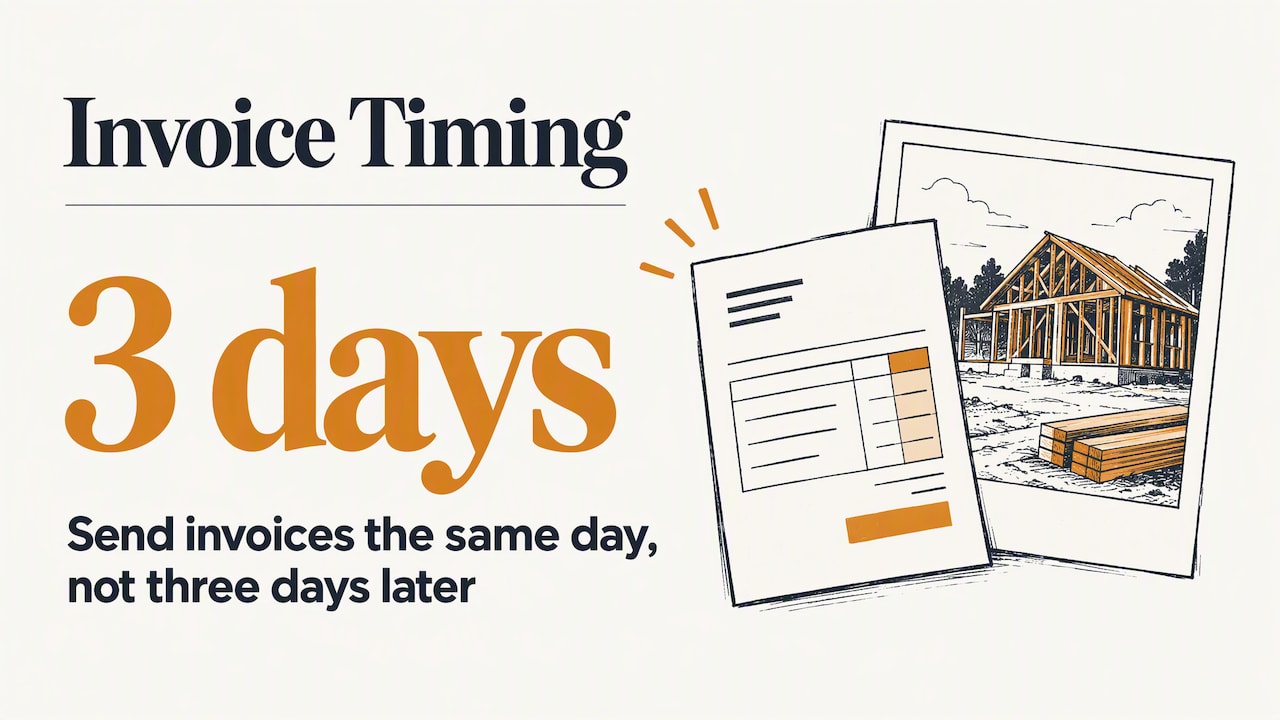
Chasing payment starts with getting a clean invoice out the door the same day the work happens, not three days later when memory and receipts have scattered. The system turns a voice note or a job-site photo into an organized invoice or estimate automatically, in multiple languages, so the paperwork keeps pace with the work itself.
If late or rejected invoices are costing you payment cycles, see how a crew built for contractors handles quoting, invoicing, and bookkeeping without the after-hours admin.
Pro Tip: Send invoices the same day a milestone is reached. The faster the invoice goes out, the sooner the Net clock starts running in your favor.
FAQ
Should I pay a contractor 50% upfront?
Deposit amounts vary widely by trade and job size, and there is no single standard figure for every project. Many contractors request enough upfront to cover materials and mobilization costs, with the balance tied to progress or final completion.
What are some popular payment terms?
The most common terms are Net 30, due on receipt, and deposit-plus-milestone billing with retainage, according to industry data from Levelset. Discount terms like 2/10 Net 30 also appear on some commercial contracts.
What are the different types of contract payment terms?
The main categories are due on receipt, Net terms (Net 15, 30, 45, 60), progress or milestone billing, retainage, and upfront deposits. Government contracts add prompt-payment requirements under FAR 52.232-27 that set fixed invoice and payment windows.
What is a typical payment schedule for a contractor?
Small projects often use a deposit plus a final payment or short Net terms, while medium and large projects typically move to milestone draws or certified payment applications reviewed by an architect or lender. The right cadence depends on project size, overhead, and how quickly suppliers expect to be paid themselves.
Sources
- Acquisition
- Sureties and pay-if-paid clauses: Balancing subcontractor protection with freedom to contract | American Bar Association
- Common Payment Terms for Contractors & Subcontractors | Levelset
Recommended
This is the paperwork Hechito does for you — while you talk.