Construction Progress Billing: Keep Cash Moving With Field Photos

Construction Progress Billing: Keep Cash Moving With Field Photos

Progress billing means invoicing a construction contract in stages, tied to the percent of work completed against a schedule of values, instead of waiting for one lump payment at the end. The main benefit is cash flow: it lets us collect money as we spend it on labor and materials rather than financing the whole job out of pocket. The mechanics rest on two anchors we cover below: the schedule of values and retainage.
TL;DR:
- Use progress billing for jobs that run longer than about a month or require upfront materials, and match invoices to the lender’s inspected draw schedule.
- Calculate each pay application cumulatively for every schedule of values item, then subtract prior billings and retainage instead of billing only current work.
- Submit by the contract cutoff with photos, delivery receipts, payment records, and required lien waivers; missing backup or a late filing can delay payment.
- Federal jobs cap retainage at 10% when progress is satisfactory, but public work and private contracts can follow different rules, so confirm the governing terms.
Hechitohechito.comCapture Job Details as You WorkHechito turns voice notes, images, and customer conversations into organized records to help reduce paperwork around quoting and invoicing.Explore Hechito
Table of Contents
- When does progress billing make sense versus milestone or lump-sum billing?
- How does progress billing work: schedule of values, pay applications, and billing cadence
- How to calculate a progress bill step by step
- What to include on a progress billing pay application
- How progress billing affects cash flow and working capital
- Common challenges and administrative traps that delay progress payments
- Standard forms and federal rules contractors reference
- Best practices for keeping progress billing accurate and fast
- Why mastering progress billing is a competitive advantage
- Let field capture do your progress billing paperwork
- FAQ
- Sources
When does progress billing make sense versus milestone or lump-sum billing?
Progress billing fits long jobs with significant labor and material costs spread over weeks or months, where financing the full project upfront would strain working capital. It also aligns naturally with how owners and lenders release money: construction loans typically fund in draws tied to inspected progress, so our billing cadence needs to match the lender’s draw schedule or payments stall.
Milestone billing invoices at defined completion points (foundation poured, framing done, roof on) rather than by percentage, which works well for projects with clear phase breaks but less well for continuous trades like painting or electrical rough-in. Lump-sum billing collects the full price at completion, which only makes sense for short jobs where the contractor can comfortably carry the cost until the end.
The practical rule: if a job runs longer than about a month or requires upfront material purchases, negotiate progress billing into the contract before signing. Trying to add it after work starts, once the owner has already budgeted for a different payment structure, is a much harder conversation.
How does progress billing work: schedule of values, pay applications, and billing cadence
The schedule of values (SOV) breaks the total contract sum into line items, typically by trade or scope, each assigned a dollar value. It becomes the backbone of every bill we submit, because every invoice measures progress against those specific line items rather than the contract as a whole.
Each billing cycle, we submit a pay application that reports, line by line, how much of each SOV item is complete and stored to date, how much retainage applies, how much was billed previously, and what balance is due now. On private work using the AIA pay application format, the architect reviews and certifies the application, and that signature is often what triggers payment from the owner.
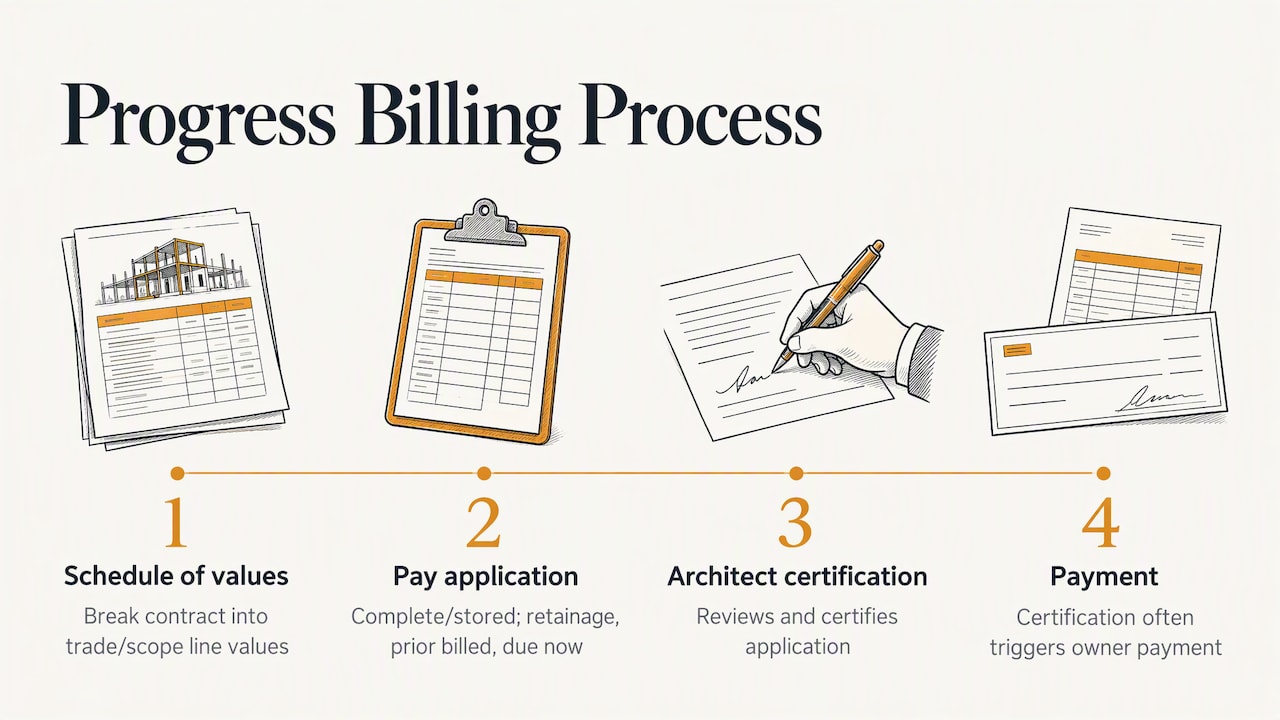
Billing cadence is set by the contract, usually monthly, with a specific cutoff date for work counted in that cycle and a submission deadline a few days later. Missing either date can push an entire payment into the next cycle, which is why the cutoff matters as much as the math.
Stored materials, meaning materials delivered to the site or a secure location but not yet installed, usually count toward percent complete if the contract allows it. That requires documentation: delivery tickets, photos, and sometimes proof of insurance on the stored goods, since owners and lenders want evidence the materials actually exist before releasing money against them.
How to calculate a progress bill step by step
Progress billing math is cumulative, not incremental, which avoids the confusion that comes from trying to bill only “this month’s” work in isolation. The standard sequence, consistent with how progress invoicing works in practice, looks like this:
- For each SOV line item, determine the percent complete based on actual work performed and materials stored to date.
- Multiply that percentage by the line item’s scheduled value to get the cumulative amount earned on that line.
- Sum all line items to get total completed and stored to date across the whole contract.
- Subtract the total amount billed in all prior applications to isolate what is new this period.
- Subtract retainage, calculated as a percentage of the amount earned, which the owner holds until substantial or final completion.
That cumulative approach matters because if a line item’s percent complete gets revised, maybe we initially overestimated progress on drywall, the correction flows naturally through next month’s cumulative total instead of requiring a messy negative line item on a single invoice.
Here’s a simplified example: say a contract line for framing is valued at $50,000, and we’re 60% complete this period. Cumulative earned is $30,000. If $18,000 was billed on that line in prior applications, this period’s new billing on framing is $12,000. Repeat across every SOV line, total them, and that sum becomes the invoice amount.
What to include on a progress billing pay application
A complete pay application reduces the chance an architect or owner kicks it back for missing information. At minimum, include:
- Original contract sum, approved change orders, and the adjusted contract sum to date.
- Total completed and stored to date, by SOV line item.
- Retainage held, shown both as a percentage and a dollar figure.
- Total of previous payments, so the current amount due is clearly isolated.
- Summary of change orders approved or pending, since unresolved change orders are a common rejection trigger.
Backup documentation strengthens the application: site photos tied to specific line items, material delivery receipts, a subcontractor payment listing showing who has been paid, and lien waivers from subs and suppliers for the amounts covered. Certification signatures, ours and often the architect’s or owner’s representative’s, confirm the numbers and are frequently what unlocks payment. Preparing backup documentation before the cutoff date, rather than scrambling after, and pre-checking which waivers are needed cuts a lot of avoidable delay. Our invoice checklist for contractors covers the full set of fields that tend to get checked first.
How progress billing affects cash flow and working capital
Staged invoicing smooths collections considerably compared with billing everything at the end of a project, since we’re not fronting months of payroll and materials before seeing a dollar back. Even so, a timing gap usually remains: payroll runs weekly or biweekly, while billing and owner approval often run on a monthly cycle with its own lag. That gap is where short-term lines of credit, favorable supplier terms, and rolling 13-week cash flow forecasting earn their keep, giving us visibility into exactly when cash will be tight before it happens. It’s also worth separating billing from revenue recognition: when we invoice is not the same question as when the revenue is recognized on the books, and conflating the two causes avoidable confusion in financial reporting.
Common challenges and administrative traps that delay progress payments
The most frequent causes of rejected pay applications are mundane: incomplete backup documentation, late submission past the contract’s cutoff date, and missing lien waivers from a subcontractor or supplier tier that nobody tracked. Retainage and cumulative corrections can also create surprises when a prior period’s percent complete gets revised and the math on the current application doesn’t match what the owner expected.
A few controls prevent most of this. Assign one person as the designated owner of the pay application process so nothing falls between field and office. Keep version control on the SOV itself, since a line item that gets split or renamed mid-project without documentation creates reconciliation headaches later. Track subcontractor payments as they happen rather than reconstructing them at billing time. When a correction does require a negative increment, issue a clear credit memo tied to the specific SOV line rather than burying it in the current period’s totals. Our breakdown of preventing estimate and quote disputes applies the same discipline to the SOV before billing even starts.
Standard forms and federal rules contractors reference
AIA Document G702, paired with its continuation sheet G703, is the industry-standard pay application format on private work. G702 captures the contract sum, retainage, prior payments, change orders, and the amount currently due, while G703 breaks that down by SOV line. Because the architect’s signature on G702 certifies the amount owed, a properly completed application often moves through approval faster than a custom invoice format the owner’s team has to interpret from scratch. ConsensusDocs offers comparable payment application templates, including its 292 form, used on contracts drafted under that family of documents.
On federal construction work, FAR 52.232-5 requires substantiation with every progress payment request and caps retainage at 10% when progress is satisfactory, with refund of unearned retainage once performance catches up. FAR 32.103 reinforces that retainage should not exceed 10% and should be released promptly once contract requirements are met. Public-work retainage rules can differ meaningfully from private contracts, so it’s worth checking which framework governs a given job before assuming the terms carry over.
Best practices for keeping progress billing accurate and fast
Capturing evidence on-site, as the work happens, is the single biggest lever for reducing pay-application rejections. A quick voice note describing what got installed today, paired with a photo of the completed section, becomes backup documentation we don’t have to reconstruct from memory at the end of the month.
Bilingual documentation matters on mixed-language crews and with clients who prefer Spanish, since a miscommunication about scope or completion status on-site often doesn’t surface until the pay application gets questioned. Generating records cleanly in whichever language the conversation happened in avoids that gap entirely.
A simple operational routine helps: capture field notes daily rather than batching them, reconcile against the SOV weekly so nothing drifts unnoticed for a full billing cycle, and check lien waiver status before, not after, the submission deadline. Our guide on bookkeeping tied to field capture walks through connecting daily job notes to the numbers that eventually land on the pay application.
Pro Tip: Keep every day’s field notes and photos tied to a specific SOV line item as you capture them, not sorted after the fact; it builds an auditable trail that heads off owner pushback before it starts.
Why mastering progress billing is a competitive advantage
Billing discipline is an operational habit, not paperwork we tolerate between real work. The contractors who protect their margins best are rarely the ones who do the best work. They’re the ones whose documentation never gives an owner a reason to delay payment. Scrambling for backup the night before a submission deadline is where margin quietly leaks out of a job. The fix is process, built daily, not a better form filled out under pressure.
— Francisco
Let field capture do your progress billing paperwork
We built Hechito so a quick voice note and a photo on the job site becomes organized invoice backup automatically, no typing required at the end of a long day. It supports bilingual operation, so nothing gets lost in translation between crew and client.
See how it fits your billing cycle on our pricing page.
FAQ
How do I calculate WIP in construction?
Work in progress (WIP) is calculated by comparing the amount billed to date against the amount earned, based on percent complete multiplied by each schedule of values line item. The gap between billed and earned is either underbilling or overbilling, both of which matter for job costing and financial reporting.
How do I do progress billing on a construction project?
Set up a schedule of values that breaks the contract into line items, then each billing cycle measure percent complete per line, calculate cumulative earned amounts, subtract prior billings and retainage, and submit the result as a pay application with supporting backup. Most private contracts use the AIA G702/G703 format for this.
How is progress billing calculated?
Progress billing multiplies each schedule of values line item by its percent complete to get cumulative earned value, then subtracts amounts billed in prior periods and any retainage held back. The result is the net amount due for that billing cycle.
How much should a progress payment be?
The payment amount depends entirely on percent complete against the schedule of values for that period, minus prior billings and retainage, so there’s no fixed figure that applies across projects. Retainage is commonly held at a percentage set in the contract, and FAR rules cap it at 10% on federal work.
Sources
Recommended
This is the paperwork Hechito does for you — while you talk.