Job Costing for Contractors: Will Field Data Support Your WIP?

Job Costing for Contractors: Will Field Data Support Your WIP?

Job costing is the practice of tracking labor, materials, equipment, and overhead against a single project rather than your business as a whole, and it is what lets you catch a shrinking margin before the job closes. Done well, it sharpens future estimates, protects cash flow, and surfaces WIP problems early. CFMA’s own guidance on forecasting backs this up, and tools like Hechito now make the field data behind it far easier to capture.
TL;DR:
- Track labor by cost code and include payroll taxes, workers’ compensation, insurance, and union benefits; wage totals alone can hide an unprofitable crew.
- Reconcile delivery logs with posted invoices before each monthly work in progress close, or unposted materials can make costs look low and margins artificially high.
- Review percent complete, estimated margin, and billing position monthly; calculate completion as costs incurred divided by estimated total cost, then compare earned revenue with billings.
- Lump sum jobs place cost risk on contractors, so tight cost codes matter; cost plus and guaranteed maximum price contracts often require open book records.
HechitoCapture Better Job Cost DataHechito captures job details through voice and images, helping contractors turn field notes into organized records without extra typing.Visit Hechito
Table of Contents
- What job costing is and how it differs from business accounting
- The four core cost components: labor, materials, equipment, overhead
- How to set up a job costing system: cost codes, WBS, budgets, approvals
- Field data capture and timekeeping: closing the data gap
- WIP and forecasting: how to read WIP, spot margin fade, and run forecasts
- How automation and field capture improve job-cost accuracy
- Key reports and KPIs to run regularly
- Using job costing to build better estimates and bids
- What I’d fix first if I only had a month
- Closing the gap between the job site and the office books
- FAQ
- Sources
What job costing is and how it differs from business accounting
Regular business accounting measures your company’s performance over a period: a month, a quarter, a year. Job costing measures performance on a single project, from the day you win it to the day you collect final payment. Instead of lumping every payroll run and material purchase into one general ledger, you assign each cost to the job that generated it.
The tool that makes this possible is the job cost sheet, a running record for each project that accumulates direct materials, direct labor, and applied overhead until the job wraps, a structure described in standard job-order costing/04%3A_Job_Order_Costing/4.06%3A_Compute_the_Cost_of_a_Job_Using_Job_Order_Costing) examples from managerial accounting. A typical sheet includes:
- Direct labor hours and rates by cost code
- Material purchases tied to purchase orders
- Equipment usage charged at an hourly or daily rate
- Overhead applied as a percentage of labor or total direct cost
The contract type shapes how you manage this. A lump-sum job puts all cost risk on you, so tight cost codes matter more. Time and materials shifts risk to the owner but still requires clean records to bill correctly. Guaranteed maximum price (GMP) and cost-plus contracts sit in between, often requiring open-book cost reporting that only works if your job costing is accurate from day one.
The four core cost components: labor, materials, equipment, overhead
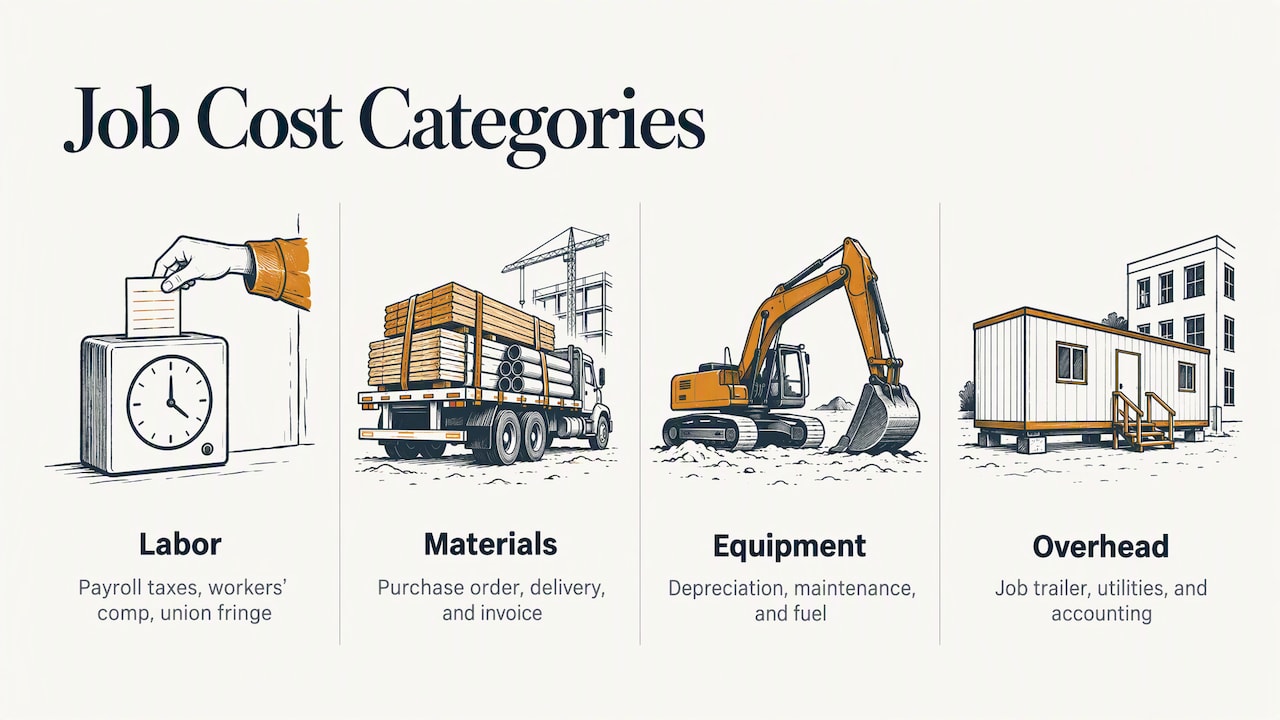
Every job cost system rests on four categories, and each has its own failure points.
Labor is usually the largest and most volatile cost. Track actual hours worked by cost code, not just total hours for the week, and always include labor burden: payroll taxes, workers’ compensation, health insurance, and any union fringe. A crew that looks profitable on wages alone can turn unprofitable once burden is applied. Reliable timekeeping, whether digital time clocks or supervisor-submitted logs, is the foundation; inconsistent timekeeping is one of the fastest ways to lose track of true labor cost.
Materials need a tight link between the purchase order, the delivery, and the invoice. A common trap is counting materials as “received” on site before the invoice is posted, which inflates your perceived budget remaining. Separate direct job materials from general inventory so stock purchases do not get miscoded against a specific project.
Equipment costs are often underestimated because owned equipment does not generate an obvious invoice. Record utilization hours per job and apply an internal rental rate that reflects depreciation, maintenance, and fuel, then compare that rate periodically against actual rental market pricing to decide whether renting makes more sense for a given job.
Overhead splits into site overhead (a job trailer, a site supervisor’s salary, temporary utilities) and home-office overhead (your estimating team, accounting, insurance). Site overhead should be charged directly to the job; home-office overhead is better allocated using a simple formula, such as a percentage of direct labor or total direct cost, applied consistently across every job.
Automating processes provides real-time insight and reduces double-entry risk, which improves forecasting accuracy, since manual, delayed data entry is one of the most common sources of overbilling and underbilling errors.
How to set up a job costing system: cost codes, WBS, budgets, approvals
A job costing system only works if it matches how your crews actually build things. Start with the structure, then layer in approvals.
- Build cost codes around real work units. Align codes to measurable production, such as linear feet of framing or cubic yards of concrete poured, rather than vague categories like “labor” or “misc.” Codes tied to units produce cleaner, more explainable forecasts, a point echoed in CFMA’s guidance on WIP as a conversation between field and finance.
- Create a work breakdown structure (WBS) with budget versioning. Break the project into phases and tasks, assign an original budget to each, and keep a version history so you can see how the budget evolved against change orders.
- Add a contingency line item. Treat contingency as its own cost code rather than folding it into individual tasks, so it stays visible and controllable.
- Link purchase orders and subcontracts to approvals. No material order or subcontract commitment should post to a job without a defined approval step, which keeps your committed costs accurate even before invoices arrive.
- Assign clear ownership. Field supervisors own daily production and labor entries, project managers own budget changes and change order status, and finance owns final cost posting and reconciliation.
Pro Tip: Review your cost code list once a year and retire codes nobody uses, since a bloated code list is almost as bad as none at all.
Field data capture and timekeeping: closing the data gap
Job costing lives or dies on what the field reports, and the biggest risk is a gap between what happened on site and what gets posted in the office.
A workable cadence looks like this: daily production counts from the crew lead, weekly labor and equipment hours reconciled against payroll, and a monthly freeze date after which no new entries affect that period’s WIP calculation. Each cycle should capture:
- Timesheets with hours by cost code, not just by day
- Production units completed, such as feet installed or units framed
- Material receipts matched to purchase orders
- Site photos documenting progress and any disputed conditions
- Change order status, including pending and verbally approved items
The classic failure mode is what practitioners call the “black hole”: materials delivered and used on site, but the vendor invoice has not posted yet, so your cost-to-date looks artificially low and your margin looks artificially high. Closing this gap means reconciling vendor delivery logs against posted invoices before you close WIP for the period, a practice CFMA recommends as part of maintaining an accurate commitment log.
A short handoff checklist helps: confirm timesheets are submitted, confirm material receipts match POs, confirm photos are attached to the right cost code, and confirm any new change order is logged before the freeze date.
WIP and forecasting: how to read WIP, spot margin fade, and run forecasts
Work-in-progress accounting is where job costing turns into a forecasting tool rather than a historical record. The most common method is percent-complete, also called cost-to-cost: you divide costs incurred to date by total estimated costs to get a completion percentage, then apply that percentage to the contract value to calculate earned revenue.
- Calculate percent complete. Costs incurred to date divided by estimated total cost at completion.
- Calculate earned revenue. Percent complete multiplied by total contract value.
- Compare earned revenue to billed amount to find your over or under billing position.
Practitioners use a three-line check to read WIP as a trend rather than a single snapshot: percent complete, estimated margin, and billing position reviewed together each cycle, a habit described in CFMA’s guide to reading a WIP schedule. Watching these three lines move together catches margin fade before it shows up in the income statement.
Forecasting splits into two related figures: forecast to complete (what it will cost to finish the remaining work) and forecast at complete (total estimated cost for the entire job, incurred plus remaining). Comparing your original buyout numbers against current cost-to-complete tells you whether early savings are holding or eroding. Chronic underbilling across a backlog of jobs is often a cash-flow problem before it becomes a profitability problem, since growing underbilled positions strain working capital even on jobs that are still profitable on paper.
Review WIP monthly at minimum, and require a short reason code for any significant forecast swing so the number stays explainable later.
How automation and field capture improve job-cost accuracy
The manual version of job costing fails for a predictable reason: field crews are busy building, and paperwork happens at the end of a long day, if it happens at all. Automation closes that gap by capturing cost data at the moment it happens rather than hours or days later.
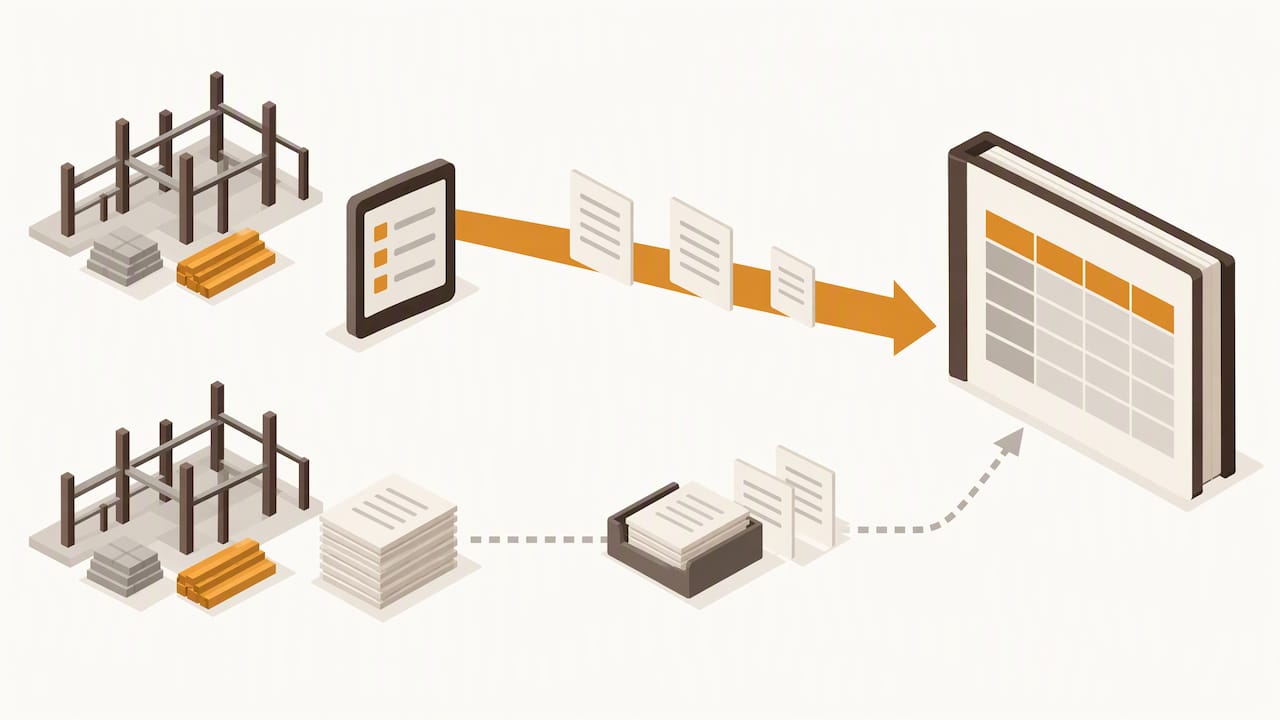
Voice and photo capture are the most practical entry points. A foreman describing a scope change out loud, or snapping a photo of a delivered material pallet, creates a timestamped record without pulling anyone away from the actual work. This is the specific gap we built Hechito to close: our platform turns spoken job details and site photos into organized records in real time, which keeps cost-to-date figures current instead of reconstructed from memory at month end.
When evaluating any job costing or field capture software, check for:
- Support for unit-based progress tracking, not just dollar totals
- Visibility into change order status from submission to approval
- An audit trail showing who entered what and when
- Integration with your accounting or bookkeeping system
Pro Tip: Ask any software vendor to show you a change order moving from “pending” to “approved” in the system before you buy, since that single workflow reveals a lot about how the tool handles real job-site chaos.
Key reports and KPIs to run regularly
A handful of reports, reviewed on a fixed schedule, catch most problems before they become expensive.
- Budget vs. actual by cost code: flags overruns early enough to shift crews or renegotiate scope before the whole job absorbs the damage.
- Cost-to-complete and forecast at complete: signals when it is time to pursue a change order or renegotiate terms with a subcontractor.
- Over/under billing: tracks cash position relative to earned revenue; a growing underbilled balance deserves the same attention as days sales outstanding (DSO).
- Labor productivity and equipment utilization: informs staffing decisions and whether renting equipment beats owning it for upcoming work.
A monthly three-line review of percent complete, estimated margin, and billing position functions as an early-warning system, catching margin fade and cash strain before either shows up in year-end financials.
Using job costing to build better estimates and bids
Historical job cost data is the single best input for sharper bids, but only if it is clean enough to trust.
- Extract unit costs from closed jobs. Pull actual cost per unit (per linear foot, per square foot, per fixture) from completed projects and update your productivity assumptions accordingly.
- Build labor burden and equipment run rates directly into the bid, rather than treating them as afterthoughts applied at the end.
- Set contingency and markup rules based on documented risk, using past margin fade on similar job types as your guide rather than a flat percentage across every bid.
- Run a post-job audit comparing final actuals to the original estimate, and feed the differences back into your cost code library for the next bid.
Contractors who skip the post-job audit tend to repeat the same estimating mistakes project after project, since nothing forces the lesson to surface.
What I’d fix first if I only had a month
If you take one thing from this guide, make it this: clean cost codes, daily field capture, and a monthly WIP huddle fix more margin problems than any new software or spreadsheet template. Start with cost codes that match how your crews actually talk about the work, then get production and material data flowing daily instead of at week’s end. Add a short monthly WIP review where field and finance talk through the numbers together rather than just filing a report. None of this requires a system overhaul on day one. Pick the weakest link in your current process and fix that first.
— Francisco
Closing the gap between the job site and the office books
Everything in this guide depends on field data arriving complete and on time, which is exactly the friction we built Hechito to remove. Instead of typing timesheets and receipts into a system after hours, you describe the job and snap a photo, and that record gets organized and routed into your quotes, invoices, and job files automatically. Our platform works the same way in English or Spanish, so bilingual crews and office staff capture the same detail without translation gaps slowing anything down.
For contractors managing multiple jobs at once, our Godínez bookkeeping plan matches bank transactions to specific jobs automatically, which keeps your cost-to-date numbers aligned with what actually hit your account. If voice-driven quoting and invoicing from the job site is your biggest pain point, our Chalán plan is built for exactly that.
- Convert spoken job notes and photos into organized job records without extra typing
- Operate fully in English, Spanish, or both on the same job
- Reconcile bank activity to jobs through our bookkeeping support
See the full lineup on our pricing page and find the plan that matches how your crew already works.
FAQ
What is job costing in construction?
Job costing is the practice of tracking labor, materials, equipment, and overhead against a specific project instead of your business as a whole. It gives you a real-time picture of whether a job is on budget, which standard accounting periods cannot show on their own.
How do you calculate percent complete for WIP?
You divide total costs incurred to date by the total estimated cost at completion to get a percentage, then apply that percentage to the contract value to calculate earned revenue. This cost-to-cost method is the most widely used approach for long-term construction contracts.
What is the difference between forecast to complete and forecast at complete?
Forecast to complete estimates the remaining cost needed to finish the job from today forward. Forecast at complete is the full-projected cost of the entire job, combining what has already been spent with what remains.
How often should contractors review their WIP schedule?
A monthly review is the common minimum, though many contractors track a three-line check of percent complete, estimated margin, and billing position more frequently to catch margin fade early. Waiting longer than a month between reviews makes it harder to tell a one-time dip from a real trend.
What is the “black hole” problem in job costing?
It refers to materials delivered and used on a job site before the vendor invoice has been posted, which makes cost-to-date numbers look artificially low. Contractors close this gap by reconciling delivery logs against posted invoices before closing WIP for the period.
Sources
- Improving Financial Success: Forecasting, WIP & S Curves - CFMA
- WIP Isn’t Just a Report—It’s a Conversation - CFMA (Cafe)
Recommended
This is the paperwork Hechito does for you — while you talk.