Mechanics Lien Rights: What Contractors Need to Know

Mechanics Lien Rights: What Contractors Need to Know

Mechanics lien rights let a contractor, subcontractor or supplier who improved a property put a legal claim on it when they go unpaid. The right is real, but it is easy to lose. Each state sets its own notices, deadlines and filing steps. Miss one and you keep the debt but lose the claim against the property. This guide covers who can claim a lien, what protects your rights, how liens are filed and released, and how prompt payment laws back them up.
HechitoKeep Job Records TogetherHechito captures customer conversations and job details in real time, helping contractors turn verbal notes into organized records without extra typing.Explore HechitoTL;DR
- A mechanic’s lien is a claim against the property you improved. It secures payment for labor, materials or services, and it clouds the title until it is resolved.
- Direct contractors, subcontractors, suppliers, equipment lessors, laborers and often design professionals can qualify, but state law decides the details.
- Deadlines differ sharply by state. California, Delaware and Virginia, for example, set very different windows, and a late filing generally kills the lien.
- Federal property cannot be liened. Public jobs use payment bond claims and prompt payment statutes instead.
- Good paperwork (signed scopes, dated photos, clean invoices) is what makes a lien claim hold up.
Table of Contents
- What a mechanic’s lien actually is
- Who can claim mechanics lien rights
- Notices and deadlines that preserve your rights
- How a lien is filed, enforced and released
- What a recorded lien does to owners and lenders
- Prompt payment laws: the other lever
- Our perspective: paperwork wins lien claims
- Habits that protect your lien rights on every job
- Where Hechito fits
- FAQ
- Sources
What a mechanic’s lien actually is
A mechanic’s lien is a statutory security interest in property that secures payment for labor, materials or services that improved it. The claim attaches to the property, not to the owner personally. That is why it carries weight: an owner who wants to sell or refinance has to deal with it first.
The lien creates a cloud on the title, so it is highly unlikely that the owner can sell until it is paid off or otherwise dealt with, and lenders are usually unwilling to refinance. The amount is generally limited to the hard costs of the labor, materials and services that improved the property. Punitive damages and attorneys’ fees are not part of it.
Two points trip up contractors who are new to this:
- It is a state-law remedy. There is no national mechanics lien statute. The forms, notice rules and deadlines you used on a job in one state may not work in the next.
- It is a last resort, not a collection shortcut. A lien is for stalled payments when reminders have not worked. It also has a cost in time, filing fees and, often, a strained client relationship.
Who can claim mechanics lien rights
The general rule is that anyone who supplies authorized labor, materials or services to improve real property can qualify. California’s statute is a good illustration. It extends lien eligibility to direct contractors, subcontractors, material suppliers, equipment lessors, laborers and design professionals. Other states draw the line in different places.
In practice, the questions to answer before you count on a lien are:
- Did your work improve the property? Permanent improvements are the core. Routine maintenance, or work on a movable item, may not qualify in your state.
- What tier are you? A prime contractor dealing directly with the owner usually has the simplest path. Subcontractors and suppliers further down the chain often have to send extra notices to preserve their rights.
- Does your license status matter? Many states tie lien rights to proper contractor licensing. Check your state licensing board before you rely on a lien.
- What type of property is it? Residential projects often come with extra consumer protections, disclosures or shorter windows than commercial work.
Public projects work differently
A private party cannot place a lien on federal property. Instead, private parties must use payment bond claims under federal law. Under the Miller Act, someone who supplied labor or material under a contract with a payment bond and remains unpaid in full 90 days after the last supply can sue on the bond no later than one year after that supply. State and local public jobs usually have their own bond claim rules, so check the project’s owner and your state.
Notices and deadlines that preserve your rights
Most lost lien rights come down to timing. The pattern has three parts.
Preliminary or pre-lien notices
Many states require subcontractors and suppliers to send a notice early in the job, or within a set period after first furnishing labor or materials, to tell the owner and the general contractor that they are on the project. Whether you need one, who gets it and how it must be delivered depends on the state. If you are working under someone else’s contract, ask at the start of the job what your state requires and send it on time. Do not wait until you are unpaid.
The filing deadline
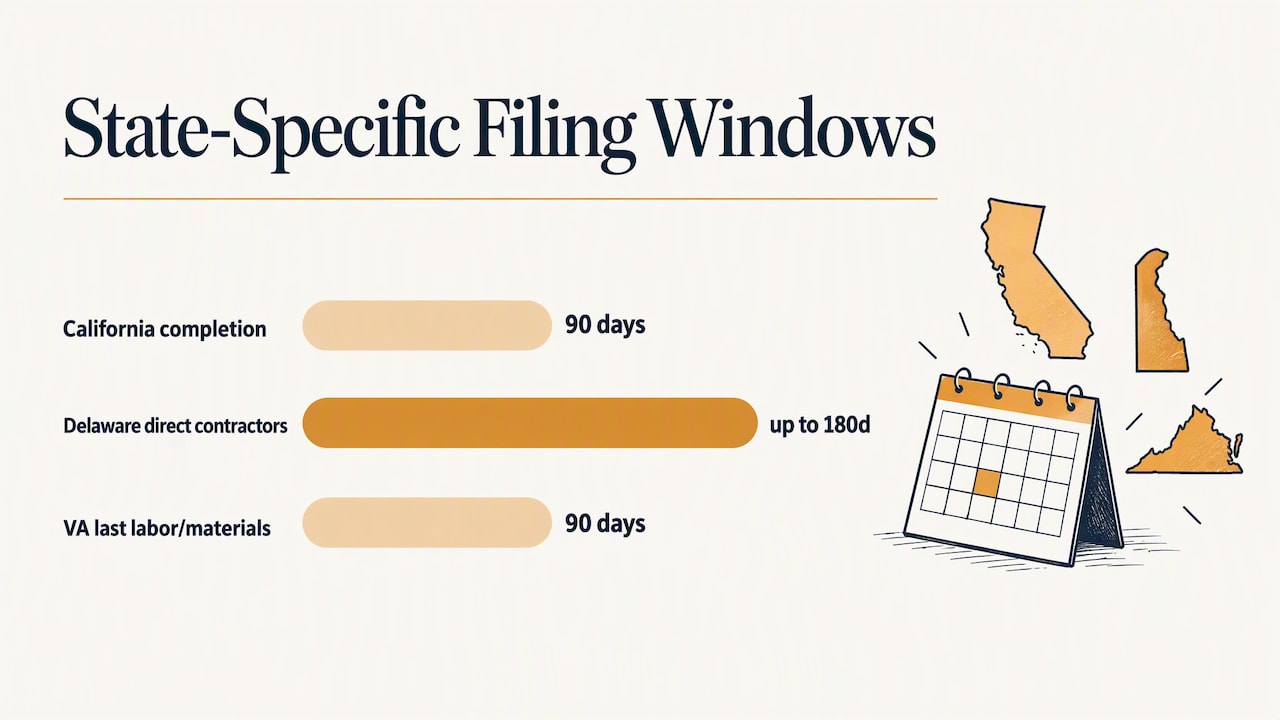
The window for recording the lien runs from a trigger event, such as completion of the work or the last furnishing of labor or materials. Practitioners’ summaries show how far the numbers range. California requires claims within 90 days after completion, Delaware allows up to 180 days for direct contractors, and Virginia requires a memorandum of lien within 90 days of the last month of labor or materials. Those are examples, not a rule for your state, and they can change, so confirm against your state’s current statute.
What counts as “completion” matters too. An Idaho State Bar article explains that the threshold is read as substantial completion, so trivial work done afterward will not extend the filing window. A punch-list touch-up weeks later will not buy you more time.
What happens if you miss it
If you fail to record within the state’s window, you generally lose the lien rights, but you may still pursue a personal collection action for the debt. You can still sue on the contract. You just no longer have the property as security, which changes your leverage a great deal.
How a lien is filed, enforced and released
The details change by state, but the sequence is familiar.
- Confirm your rights. Check licensing, tier, property type and any notices you owe.
- Gather the proof. You need the contract or agreement, change orders, invoices, proof of delivery or completed work, and a record of what has been paid.
- Prepare the lien statement. Most states require a legal description of the property, the owner’s name, the amount owed and a description of the work or materials. Use your state’s required form or content.
- Record it on time with the proper county office, and serve copies on the owner and others if the statute requires.
- Enforce before the lien expires. A lien does not last forever. In Idaho, for example, a claim of lien is effective for six months after filing unless court proceedings to enforce it start within that period. Other states set other periods.
- Release it once paid. After payment, record a release so the owner’s title is clear.
If the amount is large or the owner disputes it, talk to a construction attorney in your state before you record. A defective lien can expose you to a counterclaim in some states.
Lien releases during the job
Releases are the other half of the system. They let owners track who has been paid. The California Contractors State License Board advises that owners can protect themselves by using joint checks and obtaining signed conditional releases before payment and unconditional releases after payment. After payment, the contractor should provide an unconditional release signed by each claimant paid for the portion of work being released.
For you as a contractor, the lesson is to read before you sign. An unconditional release signed before the money clears can waive your lien rights for that amount. Sign conditional releases when you are handing over an invoice, and unconditional ones only after the funds are in your account.
What a recorded lien does to owners and lenders
Understanding the other side of the table helps you decide when to file and how to negotiate. A recorded lien freezes sales and refinancing, which puts the owner under pressure to settle. Lenders also dislike liens on collateral, and a construction lender can stop funding a project when one appears.
Owners who need cash to clear a lien quickly sometimes sell spare machinery. If that is on the table, it helps to know the tradeoffs of trade in or sell privately before choosing speed over price. Either way, a prompt settlement benefits everyone: the owner clears the title, and you are paid without a court fight.
Prompt payment laws: the other lever
Liens are not the only tool. Prompt payment statutes set deadlines for who has to pay whom, and what happens when they do not. They exist at the federal and state levels, set specific payment deadlines and limit how much retention can be withheld. They can apply to public work, private work or both, depending on the state.
Three things to know:
- Coverage varies. Some states have no prompt payment statute at all, so contract terms and general contract law decide. Others, such as North Carolina and Rhode Island, only address public contracts.
- Deadlines are short on paper. In Texas, for private projects, the owner has 35 days to pay the general contractor after a written payment request, and each tier below then has 7 days. The same Texas summary notes that statutory interest accrues once the deadline passes and that, after written notice, you may have the right to stop work.
- Federal and nearby jurisdictions have their own rules. The federal Prompt Payment Act sets deadlines and interest penalties for projects funded by federal agencies. The District of Columbia, Virginia and Maryland also have prompt pay laws that reach private projects.
The practical point: statutory interest and the right to suspend work can get you paid before a lien is ever needed. Always trigger them the way the statute says, usually with a written payment request or notice. A text message saying “where’s my check?” does not start the clock.
Our perspective: paperwork wins lien claims
We build for contractors and tradespeople, and the pattern we see is consistent: people rarely lose lien rights because the law was against them. They lose them because the proof was scattered across a glovebox, a phone camera roll and a half-remembered phone call.
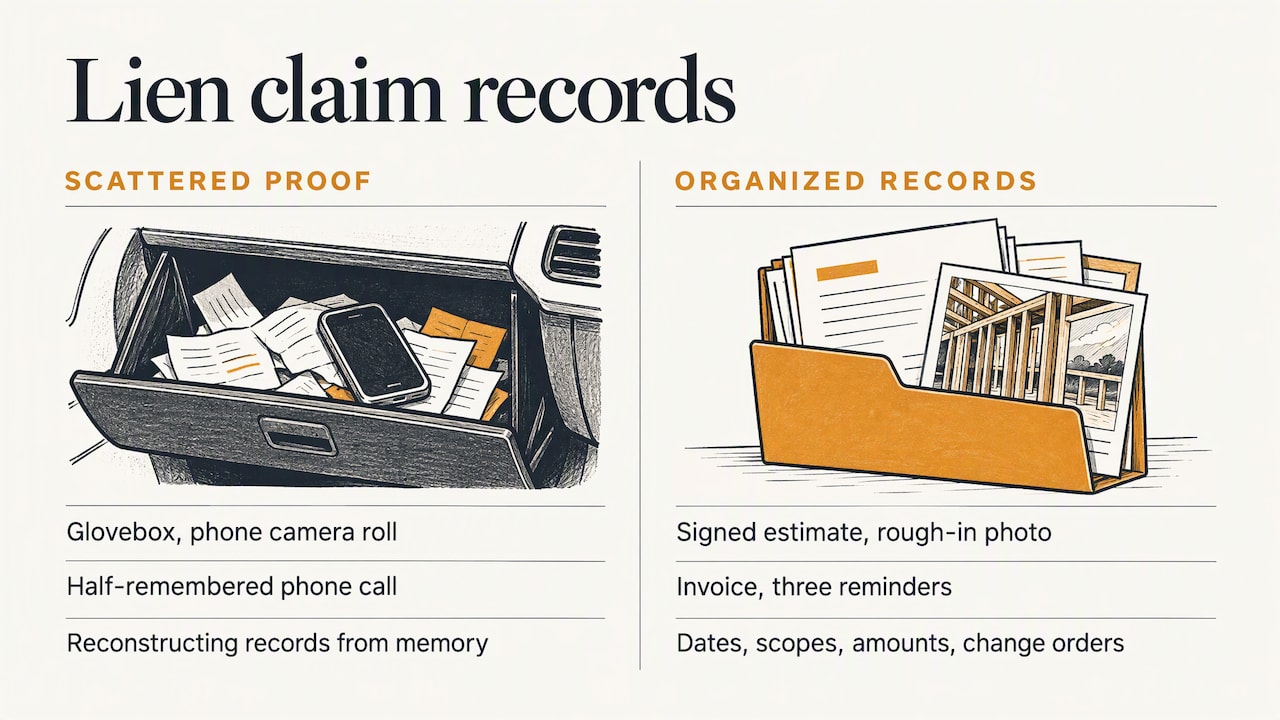
A lien claim needs dates, scopes, amounts, change orders and evidence that the work was done. The contractor who can say “here is the signed estimate, here is the photo from the day we finished the rough-in, here is the invoice we sent and the three reminders after it” is in a much stronger position than the one reconstructing it from memory. The paperwork you do on the job is your insurance.
That is why we built Hechito to capture conversations and job details by voice and photo as the work happens, and turn them into organized records. Nothing here replaces legal advice, and deadlines are state-specific. What we can do is make sure that when a deadline is looming, your records are already complete.
— Francisco
Habits that protect your lien rights on every job
You do not need to be a lawyer to build habits that keep your options open.
- Put it in writing before you start. A signed estimate or contract with scope, price and payment terms is the foundation. Our invoice checklist for payment terms covers what to include so invoices are not rejected.
- Log your start and finish dates. Deadlines run from them. Note the first day you furnish labor or materials and the last.
- Photograph progress. Dated photos support draws and prove the work existed. See how this works with construction payment schedules and field photos and progress billing.
- Invoice promptly and follow up on a schedule. Most late payments are resolved by a polite, persistent reminder. Use our guide to payment reminder emails for timing and wording, and keep the replies as part of your record.
- Calendar your state’s deadlines at job start. Put the notice date and the filing date in your calendar the day you win the work.
- Watch your cash flow. Late payers hurt more when your own bills are due. Our piece on cash flow in construction covers keeping money moving.
Where Hechito fits
If your paperwork is the weak link, Hechito automates quoting and invoicing from voice notes and photos taken on the job site, so estimates, invoices and job records are filed as you work. Chalán handles voice quotes and invoices from the job site, and Godínez matches your bank activity to your jobs. It works in English and Spanish, and documents come out in the language your customer needs. See the pricing page for current plans.
FAQ
Does a lien go away after 10 years?
Not by a universal rule. Each state sets how long a lien lasts and when it must be enforced. Many expire in months or a few years if no suit is filed, as with Idaho’s six-month period after filing. Check your state’s statute.
Can I file a lien if I wasn’t paid by the general contractor?
Often yes, if you are a subcontractor or supplier in a tier your state covers. You may need to have sent a preliminary notice earlier in the job, so confirm the notice requirements for your state and project type.
Can I put a lien on a government building?
No, not on federal property. Private parties use payment bond claims under federal law instead. State and local public projects have their own bond claim rules.
Can I still get paid if I miss the lien deadline?
You may. Missing the window generally ends your lien rights, but you can still pursue a personal collection action for the debt. Prompt payment statutes may also give you interest or other remedies, depending on the state.
Sources
- What Is a Mechanic’s Lien? (Nolo)
- California Civil Code, lien eligibility
- Lien and Bond Claims in the 50 States: 2025 (Kegler Brown)
- 40 USC 3133: Rights of persons furnishing labor or material
- Mechanics’ Liens and the Priority Dilemma (Idaho State Bar)
- How to Prevent a Mechanics Lien (CSLB)
- Prompt payment statutes in construction (Barclay Damon)
- Texas Prompt Payment Act for Construction
- Prompt Pay Laws: Federal, DC, Virginia and Maryland (Fullerton & Knowles)
- Trade in or sell privately
Recommended
This is the paperwork Hechito does for you — while you talk.