Cash Flow in Construction: How Contractors Keep Money Moving

Cash Flow in Construction: How Contractors Keep Money Moving

Cash flow in construction is the timing gap between money going out (payroll, materials, subs, insurance, fuel) and money coming in (deposits, progress payments, final invoices, retainage). You can run a profitable job and still miss Friday’s payroll if the money arrives 45 days after it leaves. The fix is rarely one big move. It is a handful of habits: bill on milestones, send clean invoices fast, plan the next 13 weeks, and treat financing as a cost of doing business.
This guide covers how cash actually moves through a contracting business, where it gets stuck, and what you can do about it this month.
HechitoSpend Less Time Chasing PaperworkHechito captures job details through voice and images, then automates the process from quoting to invoicing for contractors and tradespeople.Visit HechitoTL;DR
- Profit and cash are different things. Slow pay, retainage and rejected invoices can leave a profitable contractor short.
- Subcontractors wait an average of 56 days to be paid, so you need working capital or a plan that shortens the gap.
- Tie billing to project milestones, not calendar dates, and keep a rolling 13-week forecast you update weekly.
- Most late payments start with paperwork: missing lien waivers, unclear terms, no photo proof. Fix those and you get paid sooner.
- If you use factoring or a credit line, build its cost into your bids instead of absorbing it.
Table of Contents
- Why profitable contractors still run out of cash
- Where the cash gets stuck
- Build a 13-week cash flow forecast
- Bill faster and bill cleaner
- Understand your accounting method
- Treat financing as a cost of doing business
- Protect yourself in the contract
- Our perspective: the paperwork is the cash flow problem
- How Hechito helps with the paperwork side
- A 30-day cash flow plan
- FAQ
- Sources
Why profitable contractors still run out of cash
A bid says you will make 15% on a job. Your bank balance says something else. Construction is built on spending first and collecting later: you buy lumber, pay the crew and rent the lift before the owner or general contractor (GC) pays a dime for that work.
The Construction Financial Management Association describes inadequate working capital as almost an essential part of the contracting business model. That is the starting point. You are not doing something wrong because cash is tight. But you can do a lot to make it less tight.
The numbers back this up:
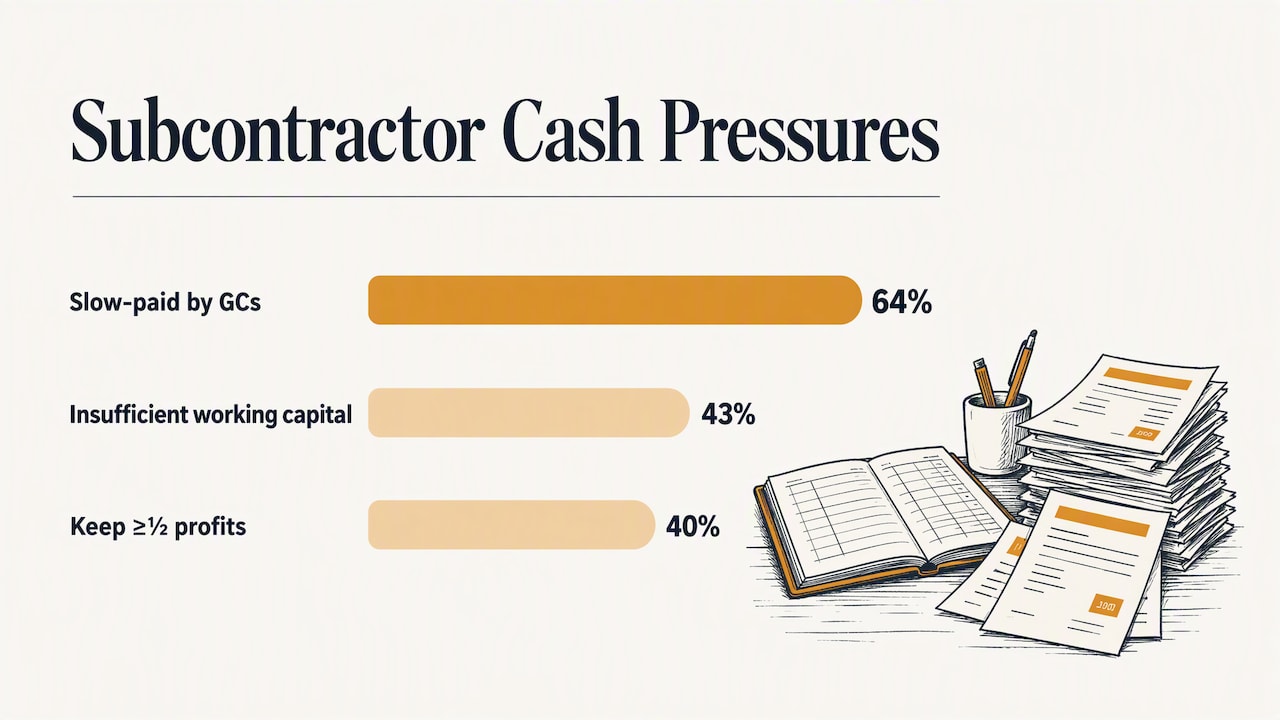
- A 2025 Rabbet report puts the cost of slow and inconsistent payment at $299 billion for U.S. construction firms, and finds 43% of subcontractors report not having enough working capital to cover unexpected delays or expenses.
- The same report finds 40% of subcontractors keep half or more of their profits in the business to fund operations. In other words, your “profit” is often stuck in the next job’s materials.
- Billd’s 2025 subcontractor report found 64% of subcontractors are slow-paid by general contractors.
Late money also slows the work itself. A 2025 Mobilization Funding report found that one in four construction professionals named late payments as a major cause of project delay. Among those projects, 47% lost one to two weeks and 30% lost three to six weeks. When you can’t pay suppliers or crew, the job stalls, and a stalled job pays later still.
Where the cash gets stuck
Before you fix anything, find the leak. In most small contracting businesses, money gets trapped in five places.
Slow billing
The job is done Thursday. The invoice goes out the following Wednesday because you were on another site, then did paperwork on a Sunday night. Every day between finished work and a sent invoice is a day added to your payment clock. This is the cheapest leak to fix, because it is entirely in your control.
Rejected or disputed invoices
An invoice with a vague description, a wrong amount, or no proof of work gets bounced back. Then the clock restarts. Missing paperwork is a recurring theme: Construction Executive’s accounting insights point to missing lien waivers as a primary cause of pay application rejections and the delays that follow.
Retainage
Owners typically hold back 5% to 10% of each payment until the job closes out, according to the same Construction Executive piece. On a $400,000 job at 10%, that is $40,000 you have earned and cannot spend, often for months after your crew has left. Retainage is why many contractors feel profitable on paper and broke in practice.
Change orders nobody priced
The customer asks for “one more outlet” or a different tile. You do it, intending to sort out the price later. Later never comes, or the customer remembers it differently. Unbilled extra work is cash you spent and may never collect.
Pay-if-paid and pay-when-paid clauses
If you are a sub, your contract’s payment clause decides whether you wait on the GC’s own cash. Contractors can often negotiate pay-when-paid language instead of pay-if-paid, a point also raised in the Construction Executive article. Read this clause before you sign, not when a payment is 90 days late. Have a construction attorney in your state review contract language you are unsure about, since enforceability of these clauses varies by state.
Build a 13-week cash flow forecast
Most contractors manage cash by putting out fires. Industry financial experts quoted by CFMA say the contractors who do better treat the cash plan as a living document, updated as site conditions and material costs change, and tie billing to project milestones instead of arbitrary calendar dates.
A 13-week forecast covers one quarter, which is long enough to see a crunch coming and short enough to stay realistic. You can build it in a spreadsheet.
Step 1: List money coming in, by week
For each job, list when you expect cash, not when you invoice. Use the realistic date the payment clears, based on how that customer actually pays. Include:
- Deposits on signed work
- Progress payments
- Approved change orders
- Final invoices
- Retainage releases (put these at the realistic closeout date, not the optimistic one)
Step 2: List money going out, by week
Payroll is the fixed one. Then add materials, sub payments, equipment rentals, insurance premiums, vehicle costs, loan payments and quarterly taxes. Owner draws belong here too.
Step 3: Calculate the weekly balance
Start with your opening cash, add inflows, subtract outflows, and carry the result forward. Any week that goes negative is a problem you now have time to solve.
Step 4: Update it every week
This is where most forecasts die. Spend 20 minutes each Monday replacing guesses with actuals and pushing slipped payments out. The point is not a perfect number. It is early warning.
For a deeper reference on how forecasts are built and used to track progress on site, the RICS cash flow forecasting guidance is a useful read, though it is written from a UK surveying perspective.
A worked example
Say you are a remodeler with three jobs. In week 2 you owe $9,000 in payroll and $6,500 in materials. You expect a $12,000 progress payment in week 3 and another $10,000 in week 5. Opening cash is $4,000.
| Week | Opening | In | Out | Closing |
|---|---|---|---|---|
| 1 | $4,000 | $0 | $3,000 | $1,000 |
| 2 | $1,000 | $0 | $15,500 | -$14,500 |
| 3 | -$14,500 | $12,000 | $3,000 | -$5,500 |
Week 2 goes $14,500 negative even though you are owed $22,000. You see it a month ahead. Now you can ask for a deposit on the next job, split a materials order, ask a supplier for net-30 terms, or line up short-term financing before you need it. Without the forecast, you find out when a check bounces.
Bill faster and bill cleaner
This is where small contractors gain the most. Collecting 10 days sooner on every job is the same as a permanent cash injection, and it costs you nothing in interest.
Ask for money up front
Deposits and mobilization payments cover your first materials order and keep you from financing the customer’s project. For residential work, a deposit tied to a signed estimate is standard. For commercial, negotiate mobilization as a line item in the schedule of values.
Bill on milestones
Write the payment schedule into the contract: a percentage at signing, at rough-in, at drywall, at punch list, at completion. Milestone billing makes payment predictable because both sides know what triggers it. Our guides on progress billing with field photos and construction payment schedules walk through how to set those up and back each draw with proof.
Send invoices the day the work is done
Invoice from the truck, not on Sunday. The longer you wait, the more details you forget, and the more likely you are to underbill. Daily records help here: seven fields in a daily construction log give you the hours, materials and notes you need to build an invoice that holds up.
Make the invoice hard to reject
A rejected invoice is a payment delay you caused. Before sending, check that:
- The job name, address and PO or contract number are correct.
- The description matches the scope in the contract.
- Change orders are listed separately with the approval date.
- Photos or documentation show the work completed.
- Required lien waivers are attached.
- Payment terms and accepted methods are clear.
We built a full invoice checklist for contractor payment terms around exactly this problem. If your scope language is loose, tighten it first: see our scope of work checks, and settle the estimate versus quote question before the customer does it for you in a dispute.
Follow up on a schedule
Don’t wait until an invoice is 60 days old to call. Set a rhythm: a friendly reminder at due date, another at 7 days past, a phone call at 14. Most late payments are not hostile. They are forgotten. A consistent, polite follow-up gets them paid.
Understand your accounting method
How you record income affects how you see your cash and when you owe tax. Under the cash method you record income when you receive it and expenses when you pay them. Under accrual you record them when earned or incurred. The IRS explains both in Publication 538.
For long-term contracts, IRS Section 460 generally calls for the percentage-of-completion method, though small contractors with average annual gross receipts of $1 million or less may qualify for exceptions that allow the cash method. Which method fits you, and whether you qualify, is a question for your CPA. Don’t switch methods without one.
Whatever the method, job costing matters. If you don’t know what each job actually cost, you can’t tell which ones are draining cash. Our piece on job costing for contractors covers how field data supports your work-in-progress numbers, and coding jobs daily keeps the books from becoming a monthly pile.
Treat financing as a cost of doing business
Sometimes billing discipline isn’t enough. A big mobilization, a slow GC or a seasonal dip can leave a gap. Short-term tools include a line of credit, invoice factoring and supplier terms.
Industry experts cited by LoanHQ note that factoring can provide 70% to 90% of an invoice’s value within 48 hours, and that contractors often fail to see financing fees as an ordinary operating expense. If you use it, price it in. A 3% fee that you didn’t bid for comes straight out of your margin. A 3% fee built into the bid comes out of the customer’s price.
A few rules of thumb:
- Arrange a credit line when you are healthy, not when you are desperate.
- Use financing to bridge a known gap on a forecast, not to cover a structural loss.
- Compare the real cost, including fees, over the period you will actually use the money.
Protect yourself in the contract
Cash flow is decided long before the first shovel. The IECI’s cash flow tips for subcontractors start with the same idea: review your contract with a forensic eye and identify financial risk in payment terms and change order requirements before signing.
Check these items:
- Payment timing: How many days after invoice, and after what approval?
- Retainage: What percentage, and when is it released? Try negotiating it down or asking for release at substantial completion.
- Change orders: Who approves, in writing, and how fast?
- Lien waivers: Which type, and when are they due?
- Pay-if-paid or pay-when-paid: Which one are you signing?
- Late-payment remedies: Is there interest, or a right to stop work?
On federally funded projects, the federal Prompt Payment Act requires interest on late payments. State rules for private work vary widely, so check your state’s prompt payment and lien statutes or ask a local construction attorney.
Our perspective: the paperwork is the cash flow problem
We talk to a lot of tradespeople, and the pattern is consistent. Nobody gets into plumbing, framing or tile to manage receivables. So the paperwork waits until night, details get lost, and invoices go out late and light. That is not a discipline problem. It is a design problem: the tools ask you to type up your day after you have already worked it.
We think the cash flow gap often starts in the gap between the job site and the invoice. If a conversation with the customer, a change they asked for, or a photo of finished rough-in gets captured at the moment it happens, the invoice almost writes itself, and it is much harder to dispute. That is why we built Hechito around voice and photos rather than forms.
Three things we have seen matter most for small crews:
- Capture at the source. Talk through the job or snap a photo when it happens, not at 9 p.m.
- Bill the same day. Shorter distance between work and invoice means shorter distance to payment.
- Work in the customer’s language. On many crews, the team speaks Spanish and the customer reads English, or the reverse. Documents should come out clean in whichever language the customer needs. Our dual language estimates guide shows how that works.
None of this replaces a forecast or a good contract. But it removes the most avoidable delay: the one between finishing the work and asking to be paid.
— Francisco
How Hechito helps with the paperwork side
Hechito is built for contractors and tradespeople who would rather be working than typing. Chalán turns voice notes and photos into quotes and invoices from the job site. Godínez handles bookkeeping that matches the bank to your jobs, and Lupita answers the phone bilingually so you don’t miss new work while you are on a ladder. Everything works in English and Spanish. You can see how the crew fits together on the crew page and check current plans on the pricing page.
A 30-day cash flow plan
You don’t need to do everything at once. Here is a sequence that works for a small contractor.
Week 1: Build your first 13-week forecast. Be honest about retainage and slow payers. Identify the first negative week.
Week 2: List every unpaid invoice and every finished job not yet billed. Send the unbilled ones now. Call anything over 30 days old.
Week 3: Rewrite your invoice template and your estimate terms using the checklist above. Add deposit and milestone language.
Week 4: Review your contract template and your top three customers’ payment history. Decide who gets a deposit requirement, who gets shorter terms, and who needs a different arrangement. Set up a Monday forecast update.
After a month you will know your numbers, your slow payers and your next crunch, and you will have shortened the gap on every job going forward.
FAQ
What is cash flow in construction?
It is the movement of money into and out of your business and each project over time. Inflows are deposits, progress payments and retainage releases. Outflows are labor, materials, subs, equipment and overhead. Because you usually pay before you get paid, timing matters as much as profit.
How do you prepare a cash flow forecast for a construction project?
List expected payments by week, using realistic clearing dates, then list expected costs by week. Subtract to get a weekly balance and carry it forward, usually over 13 weeks. Update it every week with actuals so it reflects what is really happening on site.
Why do contractors like to be paid in cash?
Cash removes the wait. It clears immediately, avoids invoice disputes and processing delays, and lets a small contractor pay crew and suppliers right away. It also carries risks: weaker records, tax and licensing problems, and no paper trail if a customer disputes the work. Invoicing with proof of work and offering quick payment options is safer.
What is the biggest cause of construction cash flow problems?
Slow payment is the main one. Billd’s 2025 report found most subcontractors are slow-paid by general contractors. Retainage, rejected invoices and unbilled change orders add to it, which is why fast, accurate billing helps so much.
Sources
- 2025 Construction Payments Report, Rabbet
- 2025 Construction Delays and Payment Timing Report, Mobilization Funding
- 2025 National Subcontractor Report, Billd
- Inadequate Working Capital, CFMA
- 2019 Executive Insights: Construction Accounting, Construction Executive
- Cash flow forecasting, RICS
- Publication 538, Accounting Periods and Methods, IRS
- Methods of accounting regulations, IRS
- Construction financing, LoanHQ
- Five Secrets to Healthier Cash Flow, IECI
Recommended
This is the paperwork Hechito does for you — while you talk.