Payment Reminder Scripts in Spanish for Contractors
Payment Reminder Scripts in Spanish for Contractors
If a Spanish-speaking customer owes you money, the best reminder is short, formal and specific: use usted, name the invoice, the amount and the due date, give a way to pay, and ask for a date if it is overdue. Below you will find ready-to-send Spanish scripts for text, email and phone, in the order you would use them, plus the mistakes that turn a friendly nudge into a fight. With Hechito, you can speak the job details in English, Spanish or both, and the invoice and the chase come out in the language your customer needs, so you are not translating at the kitchen table at 9 p.m.
HechitoKeep Spanish Job Details OrganizedHechito captures job details in English and Spanish, then turns verbal notes into organized records without extra typing.VisitTL;DR
- Write to the customer with usted, and always include the invoice number, the amount in dollars, the due date and a payment link or instructions.
- Send the first reminder a few days before the due date, then again on the due date, then at 1 to 3 days, 7 days, 14 days and about 30 days overdue, getting firmer each time.
- Once an invoice is overdue, ask for a specific date. “La próxima semana” is not a date; “el viernes 21 de noviembre” is.
- Threaten only what your contract and your state’s law allow, and only what you will actually do.
- If you handle a lot of jobs, automate the schedule so the reminders go out on time without you writing each one.
Table of Contents
- What every Spanish payment reminder needs
- Before the due date: the friendly heads-up
- After the due date: a schedule that escalates
- Follow-up when the customer answers back
- Keep it professional and legal
- Making the schedule run on its own
- A real-life example
- Perspective
- Put the reminders on autopilot with Hechito
- FAQ
- Sources
What every Spanish payment reminder needs
A reminder fails when the customer has to work to understand it. They do not remember which invoice, they are not sure of the amount, or they cannot find where to pay. Fix those three things and most reminders do their job.
Include these in every message:
- The customer’s name, with Sr. or Sra. if you are writing formally, or just their first name if you already have a warm relationship. Keep usted either way.
- The invoice number (factura número) and a short description of the job: “la reparación del techo”, “la instalación del piso”.
- The amount, with the dollar sign or the word dólares. Many of your customers also send money to family in Mexico or Central America, so the currency is worth stating plainly.
- The due date, written out: “15 de noviembre de 2026”. Most Spanish-speaking countries write the day before the month, so “11/12” can mean 11 December or 12 November.
- How to pay: a payment link, a Zelle number, a check address, whatever you actually accept.
- A next step: pay by a date, or tell you when they will.
Attach or link the invoice itself so the customer can see the line items. If you add a late fee, show it separately from the original balance so nobody can claim you changed the price.
Why usted matters
Usted is the respectful form you use with a customer you are not close friends with, and it is the safe default in business. Tú can read as too casual or even pushy when you are asking for money. Use “Le recuerdo”, “Puede pagar”, “¿Me podría confirmar?”, not “Te recuerdo” or “Puedes pagar”. If the customer writes to you with tú and clearly wants it that way, you can follow, but you never lose by starting formal.
Keep it in their language
A reminder in the customer’s own language gets read and answered faster than a half-translated one. Machine-translated messages often sound stiff or wrong, and a stiff message about money sounds like a threat. If you do not write Spanish with confidence, work from the scripts below and change only the bracketed parts.
Before the due date: the friendly heads-up
The cheapest reminder is the one you send before anyone is late. It is not an accusation, it is service. Send it three to seven days before the due date by text or WhatsApp. If you want to see how timing and tone work for a first, polite reminder in another trade, this look at timing and channels for polite first reminders shows the same logic: short, clear, and sent where the person actually reads messages.
Text or WhatsApp, 3 to 7 days before:
Buen día, [Nombre]. Le escribo de [Empresa] para recordarle que la factura n.º [número] por [monto] dólares, correspondiente a [trabajo], vence el [fecha]. Puede pagar aquí: [enlace]. Muchas gracias.
On the due date:
Buenos días, [Nombre]. Hoy vence la factura n.º [número] por [monto] dólares. Puede pagarla en este enlace: [enlace]. Si ya la pagó, muchas gracias y disculpe la molestia.
The last sentence matters. It gives the customer a graceful way out if they paid and you have not noticed yet, and it keeps the relationship intact.
After the due date: a schedule that escalates
The pattern is the same in nearly every collections routine: start by assuming an oversight, then get more specific and more formal, and add a date and a consequence at each step. Here is a schedule you can follow, with a script for each stage.
| Timing | Channel | Tone | Goal |
|---|---|---|---|
| 3 to 7 days before | Text or WhatsApp | Friendly | Prevent lateness |
| Due date | Text | Clear | Make payment easy |
| 1 to 3 days overdue | Text | Polite, assumes oversight | Get a quick payment |
| 7 days overdue | Phone call, then email | Neutral, direct | Get a specific date |
| 14 days overdue | Email with invoice attached | Firm | Offer options, set a deadline |
| About 30 days overdue | Written letter or email | Formal | State the next step |
Adjust it to your payment terms. A “net 30” invoice and a deposit due at the start of a job do not follow the same clock. If you are unsure how to set terms in the first place, our guide on contractor payment terms covers the invoice details that prevent disputes.
1 to 3 days overdue: assume it slipped
Hola, [Nombre]. Un recordatorio amable de que la factura n.º [número] por [monto] dólares venció el [fecha]. Puede pagar aquí: [enlace]. ¡Gracias!
Keep it to a few lines. Most late payments at this point are forgetfulness, not refusal.
7 days overdue: ask for a date
A week late is when you call. A call in Spanish feels more personal, and it is harder to ignore than a text. Stay neutral and aim for one outcome: a specific date.
Phone script:
Buen día, ¿hablo con [Nombre]? Le llamo de [Empresa]. Le llamo por la factura n.º [número] por [monto] dólares, que venció el [fecha]. ¿Ya tuvo oportunidad de revisarla? … ¿Qué día podría quedar pagada? Perfecto, entonces quedamos para el [fecha concreta]. Le envío un mensaje con el enlace de pago ahora mismo. Gracias por su tiempo.
If they do not answer, leave a short voicemail and send an email the same day so there is a written record:
Estimado/a [Nombre]: Le escribo de nuevo en relación con la factura n.º [número] por [monto] dólares, vencida desde el [fecha]. Le pido por favor que realice el pago antes del [nueva fecha] en este enlace: [enlace], o que me indique una fecha concreta de pago. Adjunto la factura. Quedo atento/a a su respuesta. Saludos cordiales, [Su nombre]
14 days overdue: firm, with options
At two weeks, you are no longer assuming a slip. You are still courteous, but you give clear choices and a deadline.
Estimado/a [Nombre]: La factura n.º [número] por [monto] dólares lleva 14 días vencida. Para resolverlo, tiene tres opciones: (1) pagar el total antes del [fecha], (2) pagar la mitad ahora y el resto el [fecha], o (3) comunicarse conmigo hoy para acordar otra fecha. Si necesita un plan de pagos, avíseme y lo vemos. Le agradezco su pronta respuesta.
Offering a payment plan is often the fastest route to being paid. A customer who is embarrassed about cash flow will stop answering; one who is offered a way out will often reply.
About 30 days overdue: the formal notice
At a month, put it in writing and state the next step plainly. Say only what is in your agreement and what the law allows.
Estimado/a [Nombre]: Esta es una comunicación formal sobre la factura n.º [número] por [monto] dólares, vencida desde el [fecha]. Si para el [fecha límite, 5 a 7 días] no hemos recibido el pago ni noticias suyas, [pausaremos el trabajo adicional / aplicaremos el recargo previsto en nuestro acuerdo / daremos el siguiente paso previsto en el contrato]. Preferimos resolverlo directamente con usted. Puede comunicarse conmigo al [teléfono].
Follow-up when the customer answers back
The harder part is not the first message. It is what you say when the customer replies. Three situations come up again and again.
“Ya pagué” (I already paid)
Do not argue. Ask when and how, then check your records.
Gracias por avisarme. ¿Me podría decir en qué fecha y por qué medio hizo el pago (Zelle, cheque, transferencia)? Lo reviso de inmediato y le confirmo.
If you find the payment, thank them and apologize briefly. If you do not, ask for a screenshot or a check number.
“No estoy de acuerdo con esta partida” (I dispute a line)
Acknowledge the concern, ask them to put it in writing, and move the conversation to email so you have a record. Arguing by phone rarely helps.
Entiendo su preocupación. ¿Podría indicarme por escrito qué partida le parece incorrecta? Con gusto la reviso. Si hay una diferencia en las horas o en el material, la ajusto y le envío la factura corregida.
Where the dispute is about scope, photos from the job site settle most of it. That is why capturing the work as you go is worth the habit.
“No puedo pagar todo ahora” (I can’t pay it all now)
Gracias por avisarme. Podemos dividirlo en pagos. ¿Qué le parece [monto] el [fecha] y el resto el [fecha]? Se lo confirmo por escrito para que ambos lo tengamos claro.
Put the plan in writing, with amounts and dates, and ask the customer to confirm it by reply.
Find where the invoice is stuck
With commercial customers such as a general contractor or property manager, the problem is often internal: the invoice is waiting on an approval. Ask about it rather than repeating that it is overdue:
¿La factura ya entró a programación de pagos o sigue en aprobación? ¿Con quién debo hablar para saber qué falta? Si necesita algún documento adicional, se lo envío hoy.
Always offer to fix something on your side, such as resending the invoice or a missing document. It removes the customer’s excuse and moves things forward.
Keep it professional and legal
Three rules keep a reminder from becoming a problem.
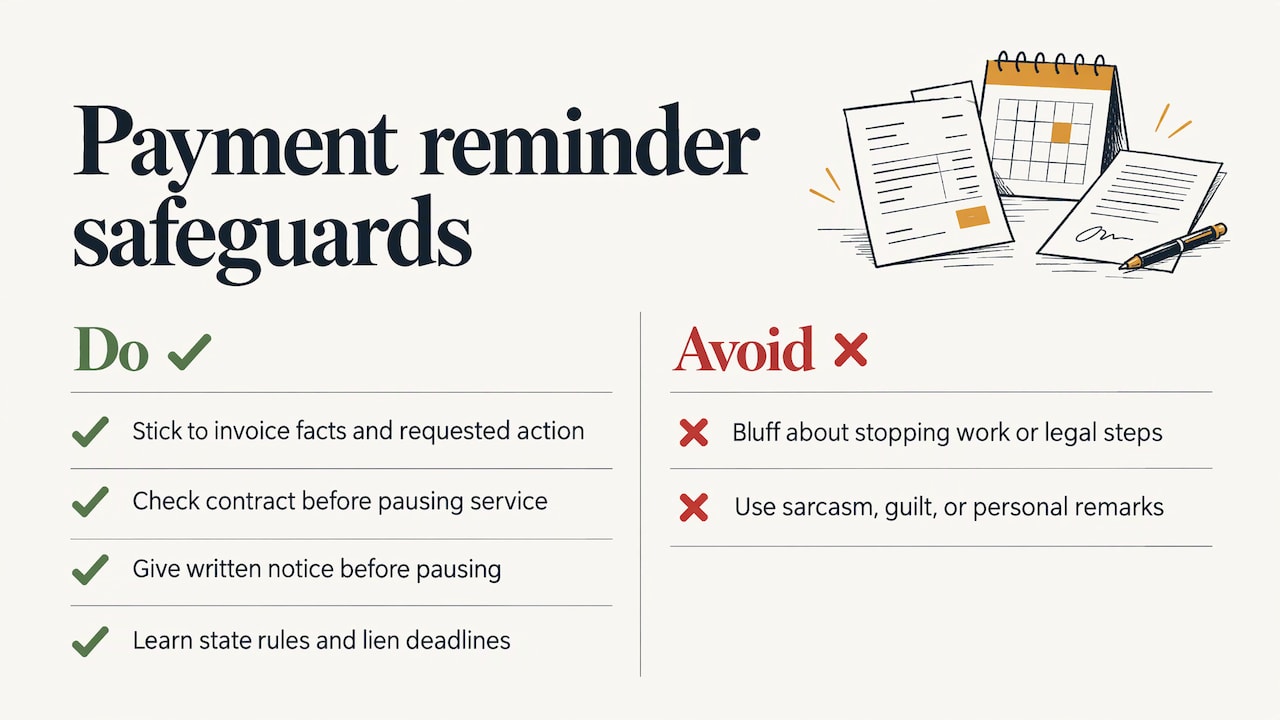
Stick to facts. Invoice number, amount, date, what you need. No sarcasm, no guilt, no comments about the customer’s character.
Do not bluff. If you write that you will stop work or take legal steps, you must be willing and permitted to do it. Threats you never carry out teach customers to ignore you. Check your contract before pausing service and give notice in writing first.
Know the rules that apply. When you collect your own invoices, the federal Fair Debt Collection Practices Act generally targets third-party collectors, not creditors collecting their own debts, though the FTC notes there are situations that can still bring a creditor under it, such as using another name when collecting. States have their own rules on late fees, interest and collection conduct. If a customer stays silent and the amount is large, talk to a local attorney about your state’s options before sending any letter that mentions legal action.
For construction work, also learn your state’s mechanic’s lien deadline. It runs from a date tied to your last work on the job, and a missed deadline can cost you that tool. An attorney licensed in your state can tell you the exact notice and filing rules, and our guide to collecting final payment on a construction job shows where those moments fall in a typical job.
Making the schedule run on its own
The scripts work. The problem is that nobody has time to send them. You finish a roof, you drive home, you are tired, and a text that takes ninety seconds waits until Sunday. By then the invoice is two weeks old.
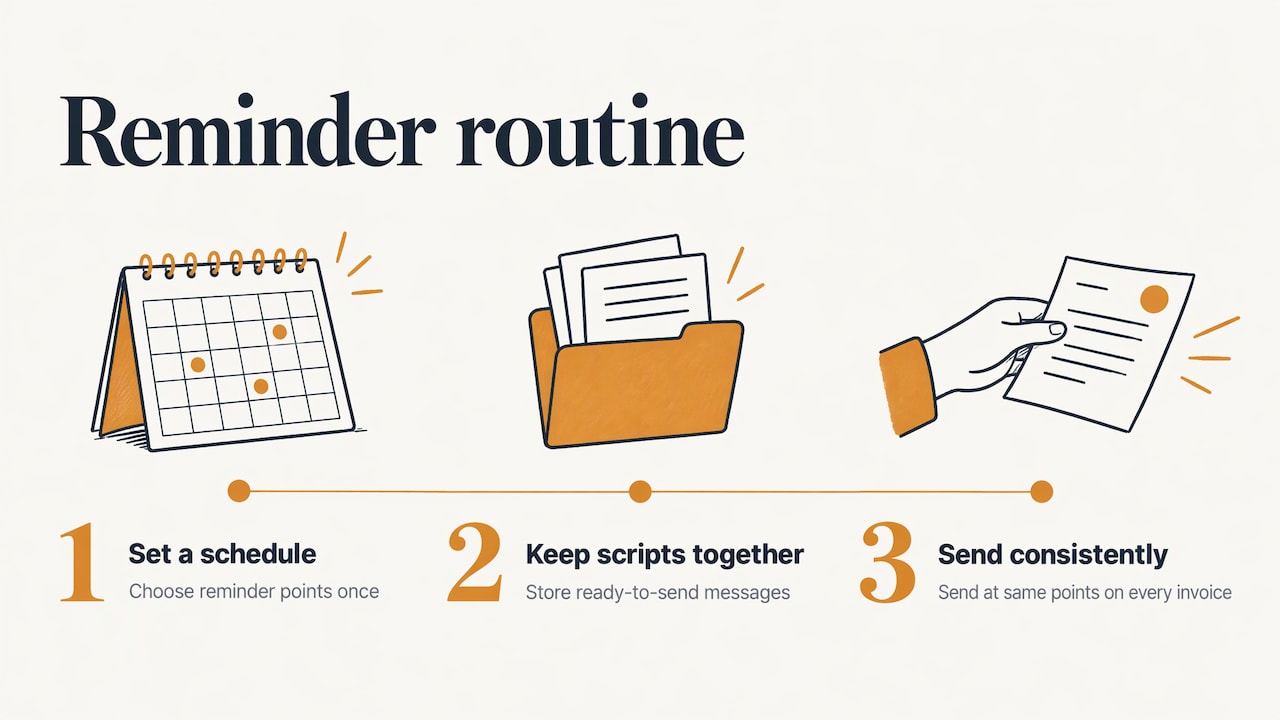
The fix is a routine, not willpower. Decide your schedule once, keep your scripts in one place, and send reminders at the same points on every invoice. If you want to go further, read how invoice chase automation works, how invoice aging tells you which jobs to call first, and our payment reminder email guide for the English versions. If your problem is deeper than a few late invoices, our overdue invoice collection plan lays out the full ladder.
A real-life example
Say you finish a bathroom remodel for Mrs. Ramírez and send invoice 1042 for $3,800, due on 15 November 2026.
- 12 November: a short text, “Le recuerdo que la factura n.º 1042 por 3,800 dólares vence el 15 de noviembre”, with a pay link.
- 15 November: a due-date text.
- 18 November: a gentle text, since nothing has arrived.
- 22 November: you call and ask for a date. She says she is waiting for a check from her relative. You agree on 28 November and text her to confirm.
- 29 November: no payment. A formal email goes out asking for payment by 5 December and offering to split the balance.
Every step is short, dated and written down. If it ever goes further, you have the record.
Perspective
We built Hechito because tradespeople told us the same thing: the work is fine, the paperwork is what eats the evening. Chasing money is the worst part of it, and it gets worse when the customer speaks Spanish and you are translating on the fly.
Our view is that a reminder should be a routine, not a mood. It goes out on time, in the customer’s language, with the right invoice and the right amount, whether you had a good day or not. That is why Hechito works in English and Spanish, lets you speak in either or both, and generates documents cleanly in the language the job requires.
The same goes for the rest of the paperwork. When your quotes, job notes and invoices come from what you said and photographed on site, the reminder already has the facts it needs. Nothing to retype, nothing to dig up. Getting paid faster comes from doing small things on time, every time.
Francisco
Put the reminders on autopilot with Hechito
Hechito is a service for contractors and tradespeople that turns what you say and photograph on the job into quotes, invoices and organized records, and chases payments for you. It works in both English and Spanish, and you can speak either language or both. Its virtual co-workers cover field, phone and bookkeeping tasks, including receipts and bank reconciliation, so the end-of-day paperwork stops landing on you. See how it works on the Hechito How It Works page, or look at the Chalán, Lupita and Godínez plans.
If you mainly want to see the invoicing side, start with the invoicing and estimate app for contractors.
FAQ
How do I politely remind a customer to pay in Spanish?
Use usted, name the invoice, amount and due date, add a payment link, and close with thanks. A line such as “Si ya la pagó, muchas gracias” keeps it kind and avoids embarrassment if the payment is already on its way.
Should I send reminders by text, email or phone?
Use text or WhatsApp for early and due-date reminders because they get read quickly. Call at about seven days overdue to ask for a date, and use email for formal notices so you have a written record with the invoice attached.
How firm can I be before taking further steps?
Each message should add a date and a consequence, but only one that your contract and state law permit and that you will carry out. For large unpaid balances or lien questions, talk to an attorney in your state before you write about legal action.
Should I write the date as 11/12 or in words?
Write it in words, for example “15 de noviembre de 2026”. Numeric dates are read day first in many Spanish-speaking countries, so “11/12” can be misread by your customer.
Sources
Recommended
This is the paperwork Hechito does for you — while you talk.