Overdue Invoice Collection for Contractors: A Step-by-Step Plan
Overdue Invoice Collection for Contractors: A Step-by-Step Plan
The way to collect an overdue invoice is to confirm it is correct, contact the customer the day after it falls due, follow a fixed schedule of reminders, and escalate to a demand letter, lien or attorney only when the schedule runs out. Most contractors lose money on late payments because they follow up too late and without proof of the work. This guide gives you the schedule, the wording and the paper trail.
HechitoKeep Job Details Ready for InvoicingHechito captures customer conversations and job details in real time, helping contractors turn field notes into organized records without extra typing.Visit HechitoTL;DR
- An invoice is overdue the day after the agreed due date. Start following up then, not at 60 days.
- Use a fixed ladder: friendly reminder, firm reminder, phone call, written demand, then lien or attorney.
- Your paper trail wins disputes: dated photos, texts confirming scope changes, signed change orders and a logged final day of work.
- Interest and lien rights depend on your contract and your state. Deadlines can be as short as 60 to 90 days after your last day on the job.
- Demand payment for undisputed work even when a punch-list item is still open.
Table of Contents
- Why contractor invoices go overdue
- Step 1: Confirm the invoice is right before you chase it
- Step 2: Follow a dated schedule
- Step 3: Use polite wording that still gets answered
- Step 4: Build the paper trail as you work
- Step 5: Know your leverage on interest, timing and liens
- Step 6: Handle disputes without freezing the whole payment
- Step 7: When to escalate
- Our perspective: collection is mostly a paperwork problem
- How Hechito helps you stay ahead of late payments
- A 10-minute weekly collections routine
- FAQ
- Sources
Why contractor invoices go overdue
A late invoice is rarely a refusal to pay. More often it is one of five things:
- The invoice never reached the right person, or it sat in a general inbox.
- It is missing something the customer needs to release payment: a PO number, a lien waiver, a project code.
- The customer disputes one line and holds back the whole amount.
- A general contractor is waiting to be paid by the owner.
- The customer is short on cash and paying whoever pushes hardest.
The first three are fixed by your paperwork. The last two are fixed by your follow-up. Both are your job, so build a system rather than relying on memory at the end of a long day. Our guide to contractor payment terms and an invoice checklist covers what an invoice should contain so it isn’t kicked back in the first place.
Step 1: Confirm the invoice is right before you chase it
Before you send anything, check four things:
- The amount matches the signed estimate plus any approved change orders.
- The invoice went to the person who approves payment, at the address on file.
- The due date and terms match what the customer agreed to.
- Nobody has raised a complaint you haven’t answered.
If the customer has paid and you haven’t matched it yet, a reminder makes you look careless. Checking the bank first takes two minutes. If you reconcile deposits against jobs as you go, this check is instant; if you don’t, it is a good reason to start. See our piece on bookkeeping for contractors using field capture.
Step 2: Follow a dated schedule
A written schedule removes the awkwardness. You aren’t picking a fight, you are running a process the customer was told about up front. Chase’s small business guidance recommends a customized payment collection system with consistent timelines, so customers know what to expect and fewer payments land after the due date.
Here is a ladder that suits most trade jobs. Adjust the days to your payment terms.
| When | Action | Tone |
|---|---|---|
| 3 days before due | Short reminder with invoice and payment link | Helpful |
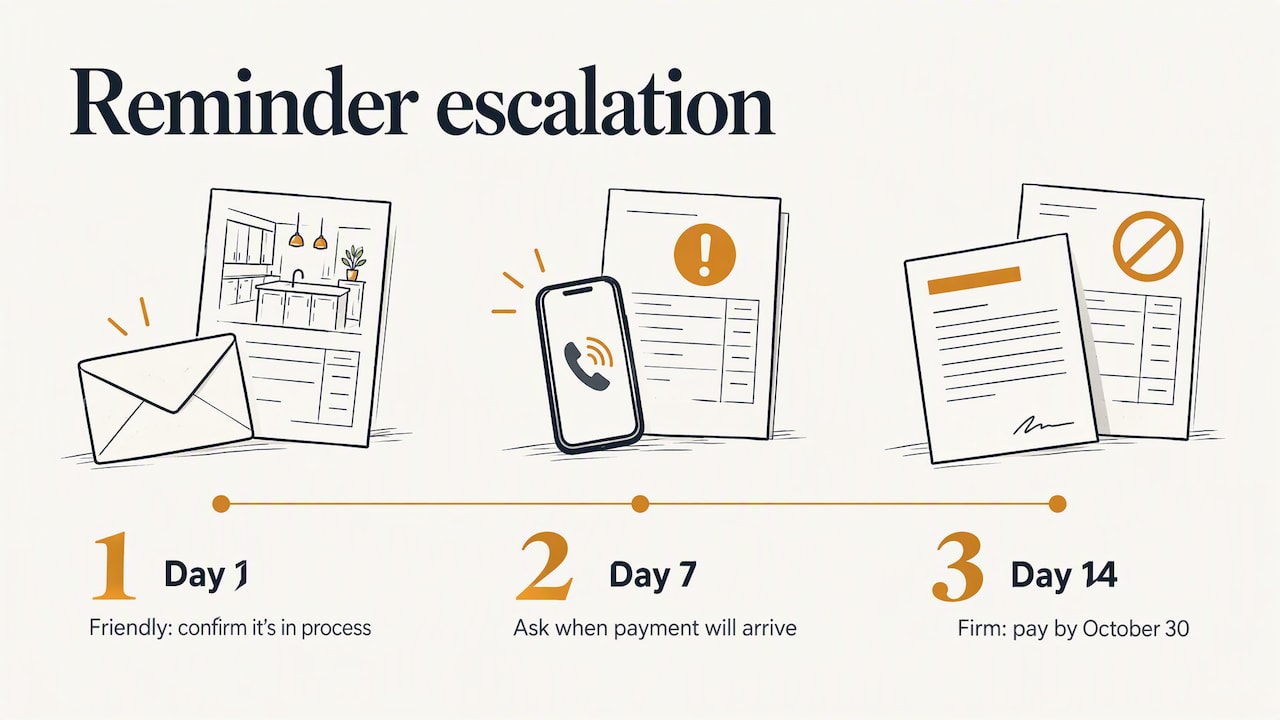
| Day 1 overdue | Email or text asking to confirm receipt | Friendly |
| Day 7 | Second email plus a phone call | Direct |
| Day 14 | Written notice: amount, due date, what happens next | Firm |
| Day 30 | Formal demand letter summarizing every contact | Formal |
| Day 45 to 60 | Lien notice or attorney letter, depending on state | Legal |
The days are a working suggestion, not a legal standard. Lien and statutory deadlines (below) can override them, so check yours at the start of every job.
For timing, subject lines and full templates, see our guide to payment reminder emails for contractors.
Step 3: Use polite wording that still gets answered
Polite does not mean vague. A good reminder names the invoice, the amount, the date and the one action you want. Here are three versions.
Day 1, friendly:
Hi Maria, quick check on invoice 1042 for the kitchen remodel, $4,800, which was due on October 15. Can you confirm it’s in process? Here’s the payment link in case it’s easier. Thanks again for the work.
Day 7, direct:
Hi Maria, invoice 1042 is now a week past due. Please let me know today when I can expect payment. If something on the invoice needs fixing, tell me what and I’ll correct it right away.
Day 14, firm:
Maria, invoice 1042 for $4,800 was due October 15 and remains unpaid. Please pay by October 30. If I don’t hear from you by then, I will have to move to the next steps in our agreement.
Two habits make these work. Ask a question that has a date in the answer, and offer a way out: “if something needs fixing, tell me what.” That second line often surfaces the real reason for the delay.
The phone call matters as much as the email. Say the same thing you wrote, then send a short text or email right after confirming what was said. That written summary is part of your record.
Step 4: Build the paper trail as you work
Collection gets easier or harder based on what you can prove. Construction debt recovery guidance consistently stresses documenting the what, when and where of every conversation. If a dispute reaches court or arbitration, emails, texts confirming scope changes and photos of completed work carry far more weight than verbal agreements, as Chase’s collection guidance also points toward with its emphasis on clear, consistent records.
A practical minimum for every job:
- Signed estimate and signed change orders, before the extra work starts.
- Dated before, during and after photos of each phase.
- A daily log noting who was on site, what was done and any customer instructions.
- Written confirmation of any verbal change (“Per our talk today, we’ll move the panel to the garage wall, +$650”).
- The date of your final day of work, recorded every time.
If you want to go deeper on photo evidence, this guide to jobsite photo documentation covers phases, contract rules and a checklist. We also cover photo documentation rules for construction and seven fields for daily construction logs.
Step 5: Know your leverage on interest, timing and liens
This is where US rules differ by state, so treat the examples below as illustrations and check your own state’s statute or ask a construction attorney.
Late fees and interest
You can add interest to an overdue invoice if your contract says so, or if a state statute provides for it. Some states set interest on late construction payments by law. Ohio’s Revised Code 4113.61 provides for 18% annual interest on overdue subcontractor payments, and Montana law sets 1.5% monthly interest on payments delayed beyond 30 days. These figures vary widely from state to state, so don’t copy them into your own terms without checking. If you want late fees to hold up, put the rate in the signed estimate, and print it on every invoice.
Prompt payment laws for subs
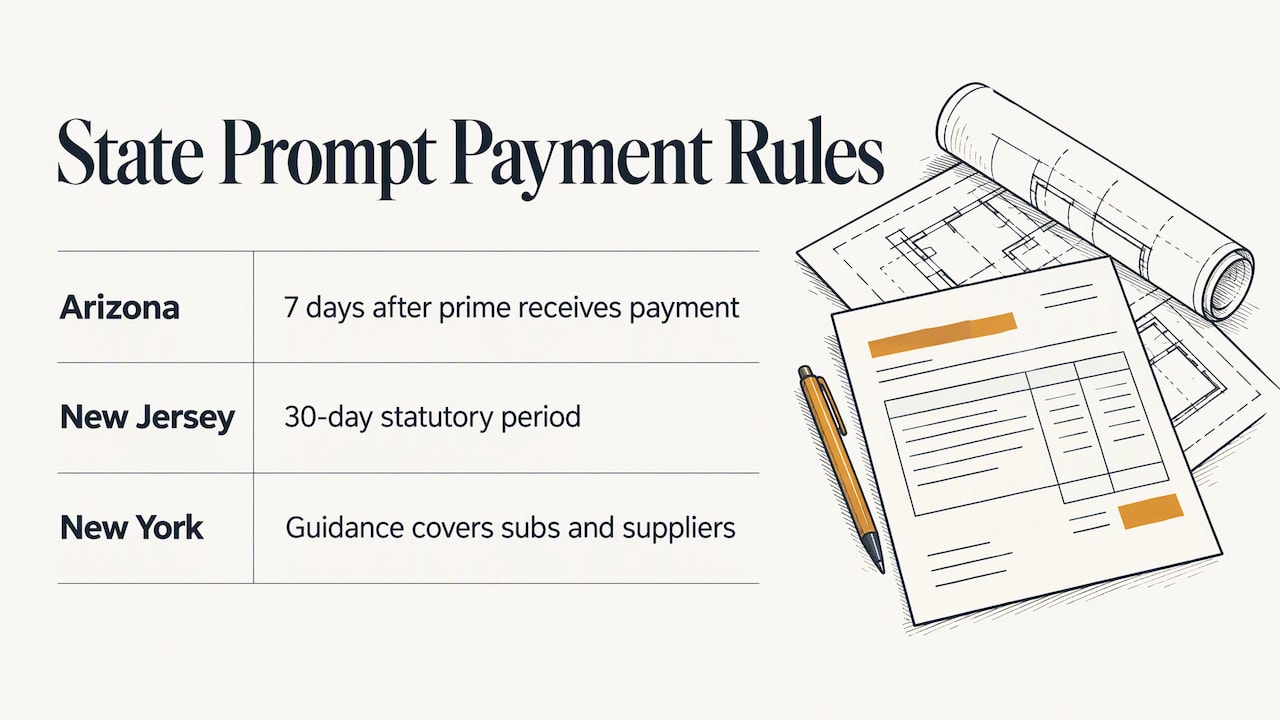
If you are a subcontractor, your state may set a payment deadline that doesn’t depend on whether the owner has paid the whole job. Arizona’s statute sets payment to subcontractors within 7 days of the prime contractor receiving payment for that work, and New Jersey’s statute sits at the other end with 30 days. Public works have their own rules too; for example, New York’s prompt payment guidance for state contracts covers subcontractors and material suppliers.
“Pay-if-paid” clauses
Many subs assume they must wait until the GC is paid. Such clauses exist in many subcontracts, but courts scrutinize them, and in some jurisdictions they are restricted or unenforceable. Before you accept “we haven’t been paid yet” as a final answer, have an attorney read your subcontract.
Lien deadlines
Mechanic’s liens are powerful but unforgiving. Deadlines are often just 60 to 90 days after you finish work, and missing them can turn a secured debt into an unsecured one, which makes recovery far harder if the owner or contractor goes bankrupt, per the BBB’s business tip on unpaid invoices. That is why you log the final day of work on every job. If a lien is possible on the job, calendar the deadline the day you finish, not the day you get frustrated.
Conditional waivers on progress payments
On larger jobs, a signed conditional waiver with each progress payment protects your lien rights while ensuring you are paid for the work in that billing cycle. It also stops you waiting until the very end of a long project to collect the bulk of the money, a trap the BBB’s guidance warns about. Our posts on progress billing and construction payment schedules show how to tie draws to field photos.
Step 6: Handle disputes without freezing the whole payment
A complaint about one punch-list item doesn’t cancel the invoice. You are still entitled to payment for undisputed work. A practical response:
- Write down the value of the work nobody disputes.
- Demand payment of that part in writing, with the date.
- Offer a date to fix the remaining items, and keep that offer in writing.
- Photograph the finished items after you fix them.
This approach, which public-works payment guidance in New York’s contract administration material reflects, shows you were willing to resolve the issue and leaves the customer with less to argue about.
Step 7: When to escalate
Many experts suggest waiting about 90 days past the due date before sending a debt to collections, but for contractors that is often too long because lien clocks run out. Use this order:
- Written demand letter. Summarize every previous contact, the date, the amount and a final payment date. Send it in a way you can prove was delivered.
- Preserve lien rights. Check your state’s notice and filing deadlines before anything else.
- Attorney letter. A letter on law firm letterhead often changes behavior and costs less than a lawsuit.
- Small claims or civil court. Small claims courts have dollar limits that differ by state, so confirm yours.
- Collection agency. Usually a fee share of what is recovered; reasonable for older, smaller balances.
At each stage, weigh the cost against the balance. A $900 invoice may not justify a lawyer, but a clear paper trail and a sharp letter often do the job.
Our perspective: collection is mostly a paperwork problem
We build Hechito for contractors and tradespeople, and the pattern we see is consistent: the jobs that turn into collection fights are the ones with the thinnest records. The work was done, but the change order was a handshake, the photos are in someone’s camera roll, and the invoice went out a week late because the paperwork waited until Friday night.
That is why we don’t think of collection as something that starts when an invoice is late. It starts on the job site. When you capture voice notes and photos while the work is happening, the estimate, the change orders and the invoice come from the same record, and the evidence is already filed when you need it. Chasing is then a short, polite message rather than a reconstruction project.
Our customers also work in both English and Spanish, and a reminder or invoice in the customer’s language is paid faster than one they have to translate. Clean documents, sent the same day, in the language the customer reads: that does more for your cash flow than any collections script.
— Francisco
How Hechito helps you stay ahead of late payments
Hechito turns what you say and photograph on the job into quotes, invoices and job records, then sends them and follows up on payment. Chalán handles voice quotes and invoices from the job site, and Godínez matches the bank to your jobs so you know what is still open. You can see the full crew on the Hechito crew page, or read how the invoicing and estimate app for contractors works.
Broader cash flow habits matter too. Our guide to cash flow in construction shows how deposits, draws and invoice timing keep money moving.
A 10-minute weekly collections routine
If you do nothing else, do this every Friday:
- Open your list of unpaid invoices, oldest first.
- Check the bank for payments that arrived but weren’t matched.
- Send the next step on the ladder to anyone overdue.
- Call any invoice past 14 days.
- Mark lien and notice deadlines for jobs finished in the last 90 days.
- Write one line of notes on every conversation, with the date.
Ten minutes a week beats three hours of chasing at the end of a quarter.
FAQ
What does it mean when an invoice is overdue?
An invoice is overdue once the agreed due date has passed without full payment. The due date comes from your signed terms, such as net 15 or due on completion. If you never set terms, the customer has a much easier argument that nothing was late.
Can I add interest to an unpaid invoice?
Yes, if your contract allows it or a state statute does. Ohio and Montana, for example, set interest rates on late construction payments, but rules differ widely by state. Put the rate in your signed estimate and on the invoice, and check your state’s law or ask an attorney before charging it.
How long should I wait before sending an invoice to collections?
General advice is often around 90 days past due, but contractors should not wait that long without checking lien deadlines, which can be 60 to 90 days after your last day of work. Send a written demand before then, and talk to an attorney about preserving lien rights.
How do I write a polite reminder that still works?
Name the invoice number, amount and due date, ask for one specific action and give a date. Offer to fix anything wrong on the invoice. Keep the first message friendly and make each later one a little firmer.
Sources
- Chase: Collect Efficiently on Sales With These Best Practices
- BBB Business Tip: How to collect (and avoid) unpaid invoices
- Arizona Revised Statutes 32-1183
- New Jersey Revised Statutes 2A:30A-2
- Ohio Revised Code 4113.61
- New York State DOT: Prompt payment of subcontractors, CAM 109-07
Recommended
This is the paperwork Hechito does for you — while you talk.