Invoice Aging Process: A Contractor's Step-by-Step Guide

Invoice Aging Process: A Contractor’s Step-by-Step Guide

The invoice aging process sorts every unpaid invoice by how long it has been outstanding, so you know who to call first. You list open invoices, calculate days past due, drop each one into a bucket (current, 1-30, 31-60, 61-90, 90+), total each column and act on the oldest, largest balances first. Do it weekly and late money stops surprising you. This guide walks through each step with a contractor’s aging schedule, a follow-up cadence and invoice email subject lines you can copy.
HechitoSpend Less Time on Invoice AdminHechito captures job details through voice and images, then automates the process from quoting to invoicing for contractors and tradespeople.Visit HechitoTL;DR
- Invoice aging means grouping unpaid invoices by how long they have gone unpaid, usually in 30-day buckets.
- Days past due equal today’s date minus the due date. Invoices not yet due go in a “current” bucket.
- Read the schedule from the right-hand columns first: the 61-90 and 90+ buckets need a call, not another email.
- Match your tone to the bucket: friendly early, firm in the middle, formal at the far end.
- The process only works if invoices go out fast with clear due dates, which is where most contractors lose the most time.
Table of Contents
- What invoice aging means
- The invoice aging process, step by step
- An invoice aging schedule example for a contractor
- A follow-up cadence by bucket
- Invoice email subject lines that get opened
- Common problems the aging report reveals
- Tools: spreadsheet, accounting software or automation
- Perspective: why aging fails on the job site
- How Hechito fits into the process
- FAQ
- Sources
What invoice aging means
Invoice aging is an accounting method that categorizes unpaid invoices by how long they have been outstanding. The report that comes out of it is called an accounts receivable (AR) aging schedule or aging report. It lists each customer, itemizes their open invoices and shows how old each one is.
For a contractor, think of it as a to-do list sorted by urgency. A $400 invoice that is five days old is a normal part of doing business. A $9,000 invoice that is 70 days old is a problem that needs a phone call this week. Without aging, both just sit in the same pile called “unpaid.”
A few terms you will see:
- Receivables: money customers owe you for work already done.
- Due date: the date your payment terms say the invoice must be paid, for example Net 15 or Net 30.
- Days past due: how many days have passed since the due date.
- Bucket: a date range used to group invoices, such as 31-60 days.
Aging can be measured from the invoice date or from the due date. Measuring from the due date is more useful for follow-up, because it tells you how late a customer actually is. Pick one method and stay with it so your reports compare month to month.
The invoice aging process, step by step
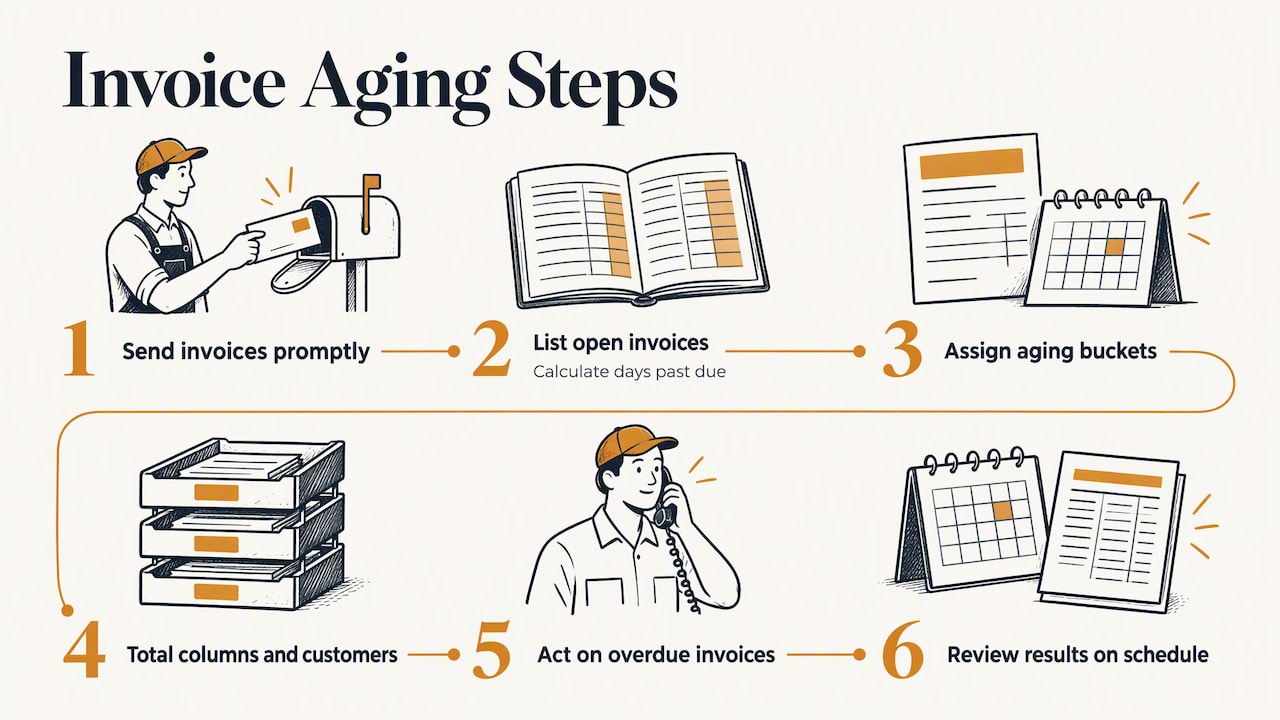
Step 1: Get every invoice out fast, with a clear due date
Aging only works on invoices that exist. If you finish a job on Tuesday and invoice on Friday of next week, the clock on your cash starts late and the aging report cannot see the delay. Send the invoice the day the work is done, with the due date printed where the customer cannot miss it. Our contractor payment terms checklist covers what an invoice needs so it is not bounced back for missing details.
Step 2: List every open invoice in one place
Pull together each unpaid invoice with four fields: customer name, invoice number, invoice amount and due date. Include partial payments by recording the remaining balance, not the original total. If you progress bill, list each draw as its own invoice so a late draw does not hide inside a big job. See progress billing with field photos for how to structure draws.
Step 3: Calculate days past due
The formula is simple: today’s date minus the due date. A positive number is the days past due. A negative number or zero means the invoice is current.
Example, using an as-of date of October 30:
- Invoice due October 15: 15 days past due.
- Invoice due September 20: 40 days past due.
- Invoice due November 10: not yet due, so current.
A spreadsheet handles this with one formula, and invoicing software does it automatically. What matters is that you pick an as-of date, such as every Monday, and calculate everything against it.
Step 4: Assign each invoice to a bucket
The usual buckets run across the top of the report as column headers: Current, 1-30, 31-60, 61-90 and 90+ days. Some businesses use 0-30 as the first bucket and fold “current” in. Either works. Contractors who bill on short terms, like Net 7 or due on receipt, often tighten the early buckets to 1-7, 8-14 and 15-30 days so problems show up sooner.
Step 5: Total each column and each customer
Add up each bucket to see how much money sits at each age. Add up each customer’s row to see who owes the most. The grand total should match the receivables balance in your books. If it does not, you have a payment that was never applied or an invoice missing from the list. That reconciliation step is half the value of the exercise.
Step 6: Act on it by bucket
This is where the report earns its keep. Every bucket has a standard response, covered in the follow-up section below. Write the action next to each overdue invoice: who will contact the customer, how and by when.
Step 7: Review on a schedule and record results
Run the report weekly if you invoice often, or at minimum twice a month. Compare it to the last one. Are the old buckets shrinking? Did a particular customer move from 31-60 to 61-90 without a conversation? Month-end is also the time to review your average days to get paid.
An invoice aging schedule example for a contractor
Here is a sample as of October 30 for a small remodeling and repair business. The figures are illustrative, not real client data.
| Customer | Current | 1-30 days | 31-60 days | 61-90 days | 90+ days | Total |
|---|---|---|---|---|---|---|
| Ramirez Family (kitchen) | $3,200 | $0 | $0 | $0 | $0 | $3,200 |
| Oak Street Dental (buildout) | $0 | $6,500 | $0 | $0 | $0 | $6,500 |
| Delgado Properties | $0 | $1,200 | $2,800 | $0 | $0 | $4,000 |
| Mike’s Roofing (sub work) | $0 | $0 | $0 | $4,100 | $0 | $4,100 |
| Henderson (deck) | $0 | $0 | $0 | $0 | $950 | $950 |
| Total | $3,200 | $7,700 | $2,800 | $4,100 | $950 | $18,750 |
How to read it:
- Start at the right. Henderson at 90+ and the 61-90 balance are the oldest money, and older debts get harder to collect. The standard way to read the schedule is to scan for concentrations of overdue debt, beginning with the far-right columns.
- Then look at size. The $6,500 Oak Street invoice is only in the 1-30 bucket, but it is the biggest balance on the page. A quick, friendly check this week is cheap insurance.
- Look for patterns by customer. Delgado has invoices in two buckets. That suggests a customer who pays some bills and ignores others, which is usually a dispute or a process problem on their side, not forgetfulness.
- Check the proportions. Here, about 27% of the total sits past 60 days ($5,050 of $18,750). If that share keeps growing, your collection routine is too passive or your payment terms are too loose.
You can add a column for “next action and date” so the schedule doubles as your call list.
A follow-up cadence by bucket
The aging report tells you who is late. The cadence tells you what to do about it. This is a practical schedule we suggest for contractors on Net 15 or Net 30 terms. Adjust the timing to your own contract.
| Timing | Action | Tone |
|---|---|---|
| 2-3 days before due | Short reminder with a payment link | Helpful |
| Due date | “Due today” note, same link | Neutral |
| 1-3 days past due | Email or text asking if they received it | Assumes a simple oversight |
| 7-10 days past due | Phone call, then a confirming email | Direct and friendly |
| 14-30 days past due | Firmer written notice with the balance and a payment deadline | Firm |
| 31-60 days past due | Call the decision maker, propose a payment plan if needed, pause non-urgent new work | Serious |
| 60+ days past due | Formal demand letter; talk with your attorney or a collections agency | Formal |
The early stage is about friction removal. Most late payments in the 1-30 bucket are not refusals. The invoice got buried, the owner is traveling or the person who approves payments is out. A text with the invoice attached and a link to pay fixes a surprising share of these. For wording, see our guide to payment reminder emails for contractors.
The middle stage is about a person-to-person conversation. A call is harder to ignore than the fifth email. When you reach the customer, ask a question rather than make an accusation: “Is there anything holding up approval on the invoice?” You will often learn about a missing document, a punch list item or a lender holding funds.
The late stage is about protecting yourself. Pausing new work on a customer who owes you for the last job is a normal business decision. Check your contract and your state’s rules before sending a formal demand or taking steps against the property, because notice requirements and deadlines for liens differ by state. Our overdue invoice collection plan goes through the escalation in more detail, and the guide to collecting final payment on a construction job covers the most common spot where money gets stuck.
Invoice email subject lines that get opened
Subject lines should say what the email is and make it easy to find later. Keep the invoice number in there: it helps the customer’s bookkeeper search their inbox and helps you find the thread. Match the tone to the aging bucket.
When you first send the invoice
- Invoice #1042 for kitchen remodel, due November 15
- Your invoice from [Your Company], #1042
- Job complete: invoice #1042 enclosed
Before the due date
- Friendly reminder: invoice #1042 is due Friday
- Invoice #1042 due in 3 days (pay link inside)
Just past due (1-10 days)
- Question on invoice #1042
- Did invoice #1042 reach you?
- Quick check on #1042
A collaborative line like “Question on Invoice [Number]” invites a reply and does not put the customer on the defensive, which matters when you want to work for them again.
Firmer follow-up (11-30 days)
- Second notice: overdue invoice #1042
- Invoice #1042 is now 15 days past due
- Action needed: payment for #1042
Serious stage (31+ days)
- Final notice before account review: invoice #1042
- Payment plan for invoice #1042
- Overdue balance of $4,100: please call me today
Some habits help across the board. Put the amount or the due date in the subject when the invoice is late. Use the same company name and sending address every time so messages do not land in spam. Skip all caps and exclamation points. Attach the invoice as a PDF and include a payment link in the body, so the customer never has to ask how to pay. If you are texting invoices or estimates instead, these text templates work the same way.
Common problems the aging report reveals
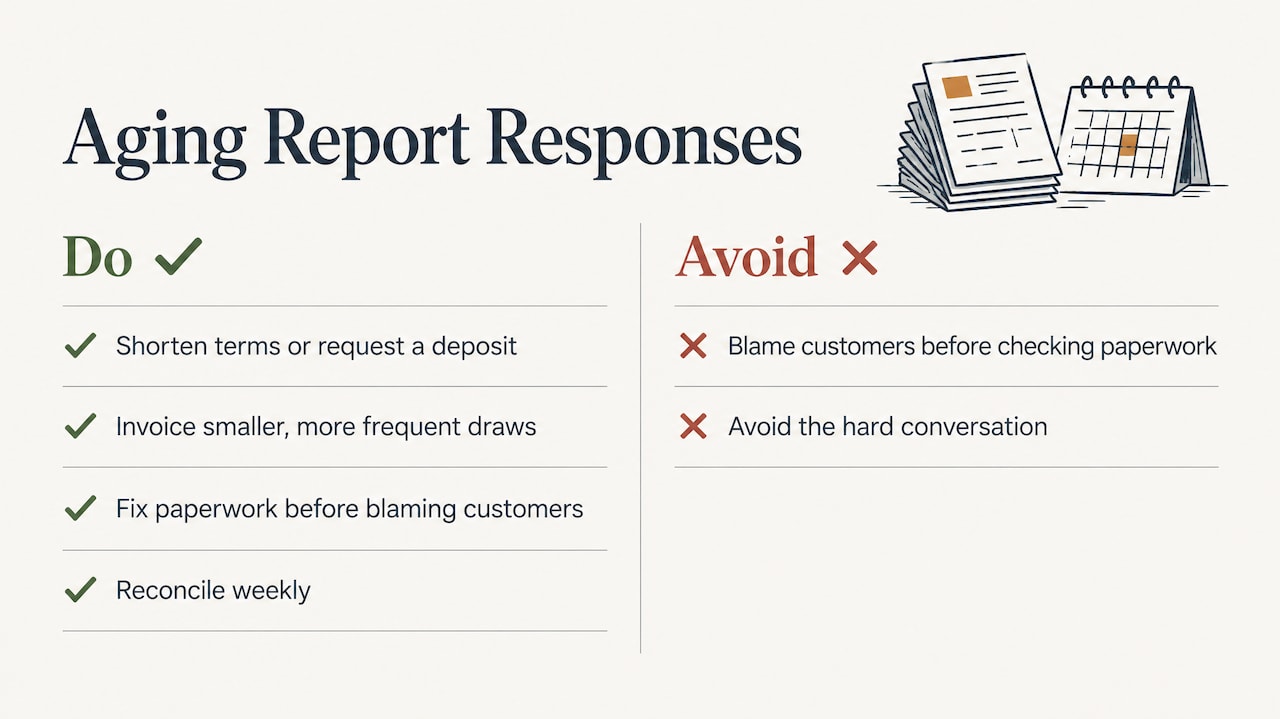
One customer is always in the 31-60 bucket. That customer treats your terms as a suggestion. Shorten their terms, ask for a deposit, or invoice them in smaller, more frequent draws.
Everyone is slow at the same time. If many customers are late at once, look at your side. Were invoices sent late? Were they missing a PO number, a lien waiver or a photo of the finished work? Fix the paperwork before blaming the customers. A construction payment schedule tied to field photos gives customers and lenders the proof they need to release a draw.
Totals do not match the books. A payment was deposited but not matched to an invoice. Reconcile weekly so the aging report is something you can trust.
The old bucket never gets smaller. You may be avoiding a hard conversation. Set a rule: anything past 60 days gets a call from the owner, not the office, within three business days.
Cash is tight even though sales are up. Aging shows you are profitable on paper but waiting on money. This is the classic squeeze covered in our guide to cash flow in construction.
Tools: spreadsheet, accounting software or automation
A spreadsheet is fine to start. You need columns for customer, invoice number, amount, due date and a formula for days past due, plus a filter or pivot table for the buckets. The weakness is that someone has to update it, and in a busy season that someone is you, at 9 p.m.
Accounting software generates the aging report on demand from the invoices already in the system. That is better, provided every invoice and payment really is entered. Bookkeeping that happens on the job, not at the end of the week, keeps the data honest.
The third level is automation, where the system tracks due dates, sends reminders on a schedule and flags the invoices that need a human call. For a crew in the field, this is the point: the reminder goes out even when you are on a roof.
Perspective: why aging fails on the job site
We talk to tradespeople who know exactly what an aging report is and still do not run one. The reason is rarely knowledge. It is that the report depends on invoices being created, sent and recorded on time, and that work happens after a ten-hour day, in a truck, from memory.
Our view is that the aging process should be a byproduct of doing the job, not an extra job. If you describe the work out loud and snap a few photos while you are on site, the quote and the invoice can be built from that record. The due date is set at the moment of invoicing, the reminders follow from it, and the aging picture is always current, because the paperwork was never behind.
That is what we built Hechito to do: act as a helper that finishes the task, in English or Spanish, so your crew and your customers can each work in the language they prefer. Fewer evening hours on paperwork, and an earlier start on the money clock.
Francisco
How Hechito fits into the process
Aging is only as good as what feeds it. Hechito captures your voice notes and job photos in real time and turns them into organized records, estimates and invoices, then sends them, chases payments, and handles receipts and bank reconciliation through virtual co-workers for the field, the phone and bookkeeping. You can speak English, Spanish or both, and documents come out in the language the customer needs. See how Hechito works or look at the Chalán, Lupita and Godínez co-workers to pick the help you need.
If you want to see the whole flow built for your trade, start at the contractor invoicing page. If your crew works in the field, our piece on field service automation shows what that looks like day to day.
FAQ
What is the invoice aging process?
It is the routine of listing unpaid invoices, calculating how many days each is past due, grouping them into buckets such as 1-30 and 31-60 days, and acting on the oldest first. The output is an aging schedule you review weekly or monthly.
How do you calculate invoice aging?
Subtract the invoice due date from today’s date. A positive result is the number of days past due, and it tells you which bucket the invoice belongs in. If the result is zero or negative, the invoice is still current.
What buckets should a contractor use?
The common set is current, 1-30, 31-60, 61-90 and 90+ days. If you bill on short terms, split the first 30 days into smaller steps, such as 1-7 and 8-14, so slow payers show up earlier. Use the same buckets every time so reports can be compared.
How often should I review my aging schedule?
Weekly is a good habit for most contractors, because it is early enough to act on a 10-day-late invoice. At a minimum, review it twice a month and again at month-end. Make sure the total matches your books each time.
What should I put in the subject line of an overdue invoice email?
Include the invoice number and a clear purpose. Early on, a question such as “Question on invoice #1042” works well. Later, use a plainer notice such as “Second notice: overdue invoice #1042” and add the amount or days past due.
Sources
- Aging: Definition in Accounting, Uses, Report Example (Investopedia)
- Understanding Aging Schedules: Importance, Benefits, and Uses (Investopedia)
Recommended
This is the paperwork Hechito does for you — while you talk.

On iPhone? Coming very soon to the App Store.