How to Collect Final Payment on a Construction Job

How to Collect Final Payment on a Construction Job

You collect final payment by proving the job is finished, handing over every closeout document the contract names, and sending one clean final invoice that points back to the contract. Contractors who skip a step wait weeks for the last check. Contractors who do all three usually get paid close to when the contract says. This guide walks through each step in order, then covers what to do when the customer goes quiet.
HechitoKeep Job Details Ready for Final PaymentHechito captures customer conversations and job details in real time, helping contractors keep organized records without adding paperwork.Visit HechitoTL;DR
- Final payment is tied to final completion: finished work, a passed inspection, and punch-list items closed out, as defined in your contract.
- Build the closeout package before you ask for money: lien waivers or affidavits, warranties, as-builts, and any consent of surety the contract requires.
- Your final invoice and request letter should cite the contract, the amount, retainage released, and the due date, with the paperwork attached.
- If payment stalls, follow a fixed sequence: reminder, written demand, then lien or bond rights. Deadlines vary by state, so check your statute early.
- Photos, voice notes and job records made during the work are what settle disputes over the last invoice.
Table of Contents
- When final payment is actually due
- What to finish and document before you ask
- What is a contractor’s final affidavit?
- Lien waivers, releases and what they give away
- Retainage at the end of the job
- What a final invoice and request letter should include
- If the customer doesn’t pay
- Our perspective: final payment is won in the first week
- Keep the paperwork behind your final invoice
- Start the next job so the last check is easy
- FAQ
- Sources
When final payment is actually due
Most last-check problems start with a disagreement about whether the job is done. Your contract decides that, not your sense of the job. ConsensusDocs advises that final completion should be defined in the contract, and that it generally triggers final payment and delivery of the required closeout documents. The same source’s view is that a clear definition cuts down disputes, because acceptance is what sets off payment and closeout obligations.
In practice, final payment is typically due once substantial completion has been reached, a final inspection has passed, and the owner is satisfied the punch-list items are done. Note the last part. Payment applications are reviewed by the architect or owner, so getting paid depends on both physical completion and documentary approval. You can finish the work and still be unpaid because a form is missing.
Substantial completion versus final completion
Substantial completion means the owner can use the space for its intended purpose, with minor items left. Final completion comes later: the remaining contract work is done, punch-list items are resolved, and the required documents are delivered. Many contracts release most of the money at substantial completion and hold back retainage until final completion. If you’re not sure how your retainage works, our guide to how retainage works and how to get paid covers it.
Open your contract and find four things before the job winds down:
- The definition of final completion.
- The number of days the owner has to pay after you submit a proper request.
- The list of closeout documents.
- Any retainage release terms.
If the contract is silent on timing, your state’s prompt-payment rules may fill the gap. Those vary, so check your own state’s statute or ask a construction attorney licensed there.
What to finish and document before you ask
Asking early is the most common reason final requests bounce. The reviewer checks the package against a list, and one missing item sends it back. Public owners publish their lists, which makes them a handy template for private work too.
The New York City Department of Design and Construction checklist asks for closeout records such as payroll reports, stored-material documentation where it applies, and payment and work certifications. The Arkansas state building services closeout guide says a final payment or retainage release package must include:
- a final payment request,
- the contractor’s affidavit of payment of debts and claims and release of liens,
- consent of surety, when applicable,
- the design professional’s closeout certification,
- and a certificate of final completion.
Northfield, Minnesota’s closeout specification adds record documents, substantial- and final-completion notices, manuals, warranties, bonds, and inspection certificates to the pile. Your private job may need fewer of these. Your contract will tell you which.
A closeout checklist you can reuse
| Item | Why the owner wants it |
|---|---|
| Signed punch list, all items closed | Proves the work is accepted |
| Passed final inspection or certificate of occupancy, if required | Shows the work meets code |
| Warranties and manuals | The owner needs them to run the building |
| As-built or record drawings | Required in many contracts |
| Lien waivers or final affidavit | Protects the owner from downstream claims |
| Subcontractor and supplier releases | Shows lower tiers were paid |
| Final photos | Documents condition at handover |
Start the list at the beginning of the job, not the end. If your daily records are solid, most of this is a matter of pulling files together. Our guide to daily construction logs shows which fields matter for claims, and photo documentation rules explains what to shoot so the final walkthrough doesn’t become an argument.
What is a contractor’s final affidavit?
A final affidavit is a sworn statement from the contractor that all labor, materials, subcontractors and suppliers on the job have been paid, or will be from the final payment, and that no one has a lien claim through you. Arkansas, for example, requires the contractor’s affidavit of payment of debts and claims and release of liens in the final-payment package, and it may also be required to release partial retainage. Other states and owners use different names and forms. Never sign one until you know your subs and suppliers are paid, because you are swearing to it.
Lien waivers, releases and what they give away
Owners rightly worry about double payment. If you were paid and a supplier of yours wasn’t, the supplier may go after the owner’s property. That’s why final payment and releases travel together.
The California Contractors State License Board says owners should get conditional releases before payment and unconditional releases after payment, and may hold back the next payment until unconditional releases for prior payments are in. A conditional release takes effect only when the payment clears. An unconditional release takes effect when signed, whether or not you’ve been paid. So the order matters for you:
- Sign a conditional final release when you submit the final request.
- Sign the unconditional release only after the funds have actually cleared.
A caution on wording. AGC’s construction-law guidance says broad partial releases can waive existing claims, including delay and acceleration claims. If you have a claim you still intend to pursue, list it specifically on the release form and keep detailed payment records. Read the release language line by line, or have your attorney read it, before you sign a form an owner hands you.
If you hire subs, AGC’s subcontractor-default white paper recommends knowing who your lower-tier subcontractors and suppliers are, requiring downstream payment certifications and valid lien or bond waivers, clarifying retainage, and defining what you may withhold. Collect those from your subs before you submit your own final request.
Retainage at the end of the job
Retainage is the share of each progress payment held back until completion, and it usually makes up the largest part of your final check. Rules differ by state and by contract type. As one recent example of change, AGC reported that Colorado’s HB 26-1311 took effect August 12, 2026 and lets a contractor or subcontractor use a bond in lieu of retainage in covered construction contracts. If you work in Colorado, ask your attorney whether it applies to your contracts. Elsewhere, check whether your state has similar rules.
Two habits keep retainage from becoming a surprise. First, track the held amount on every invoice so the total is never a guess. Second, tie the release to a specific event in the contract, such as final completion or acceptance. Our piece on construction progress billing shows how to keep that running tally clean, and the payment schedule guide explains how field photos back up each draw.
What a final invoice and request letter should include
The final invoice is a number. The request letter is the cover note that makes it hard to ignore. Together they should let a reviewer approve payment without making a phone call. Include:
- Project and parties: project name and address, owner, contractor, and contract or purchase order number.
- Contract math: original contract sum, approved change orders (each by number), adjusted contract sum, total billed to date, retainage held, and the balance now due.
- Completion basis: the date of substantial completion, the date punch-list items were finished, and the date of final inspection or acceptance.
- Payment terms: the due date computed from your contract, and how to pay (check, ACH, or other method).
- Enclosures: the closeout items from your checklist, each named.
- Contact: one person with a phone number and an email who can answer questions.
For the letter itself, keep it short and factual. A usable structure:
Re: Final payment request, [Project name], Contract No. [number]
The work under the contract reached final completion on [date], and the punch list was accepted on [date]. Enclosed are the final invoice for $[amount], which includes release of $[amount] in retainage, our final lien waiver, warranties, and the remaining closeout documents listed below. Under Section [x] of the contract, payment is due within [number] days of receipt. Please confirm receipt and let us know if anything else is needed to process payment.
Send it the way your contract says to give notice, and keep proof of delivery. Some contracts demand certified mail or a specific email address, and a request sent to the wrong place may not start the payment clock. For invoice details that reduce rejections, see our invoice checklist for contractor payment terms.
If the customer doesn’t pay
There are two broad reasons: they can’t or won’t pay, or they dispute something. Treat them differently, and treat both in writing.
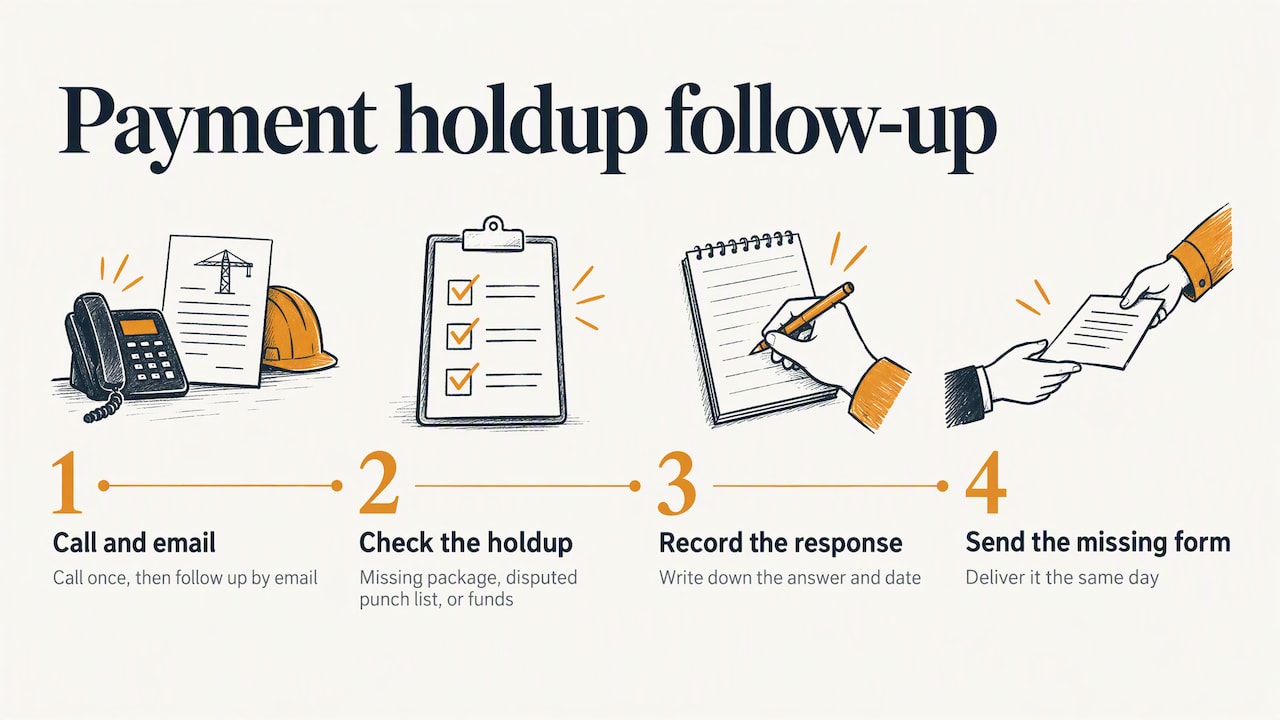
Step 1: Confirm what the holdup is
Call once, then follow with an email. Ask directly: is anything missing from the package, is a punch-list item disputed, or is the owner waiting on funds? Write down the answer and the date. If it is a missing form, send it the same day. Our payment reminder email templates cover timing and wording for this stage.
Step 2: Check whether payment depends on someone else
If you’re a sub, read your pay clause. Under the American Bar Association’s summary, pay-when-paid clauses generally regulate timing, while pay-if-paid clauses are meant as a condition precedent to payment. Ambiguous language may be read as requiring payment within a reasonable time. How courts treat these clauses differs by state, so an attorney should read yours before you rely on either reading.
Step 3: Send a written demand
State the amount, the contract section, the date it was due, and a firm date to pay. Attach the invoice and proof of completion. Stay on facts. Don’t threaten anything you aren’t prepared to do. Our overdue invoice collection plan lays out the sequence from reminder to demand to next steps.
Step 4: Watch lien and bond deadlines
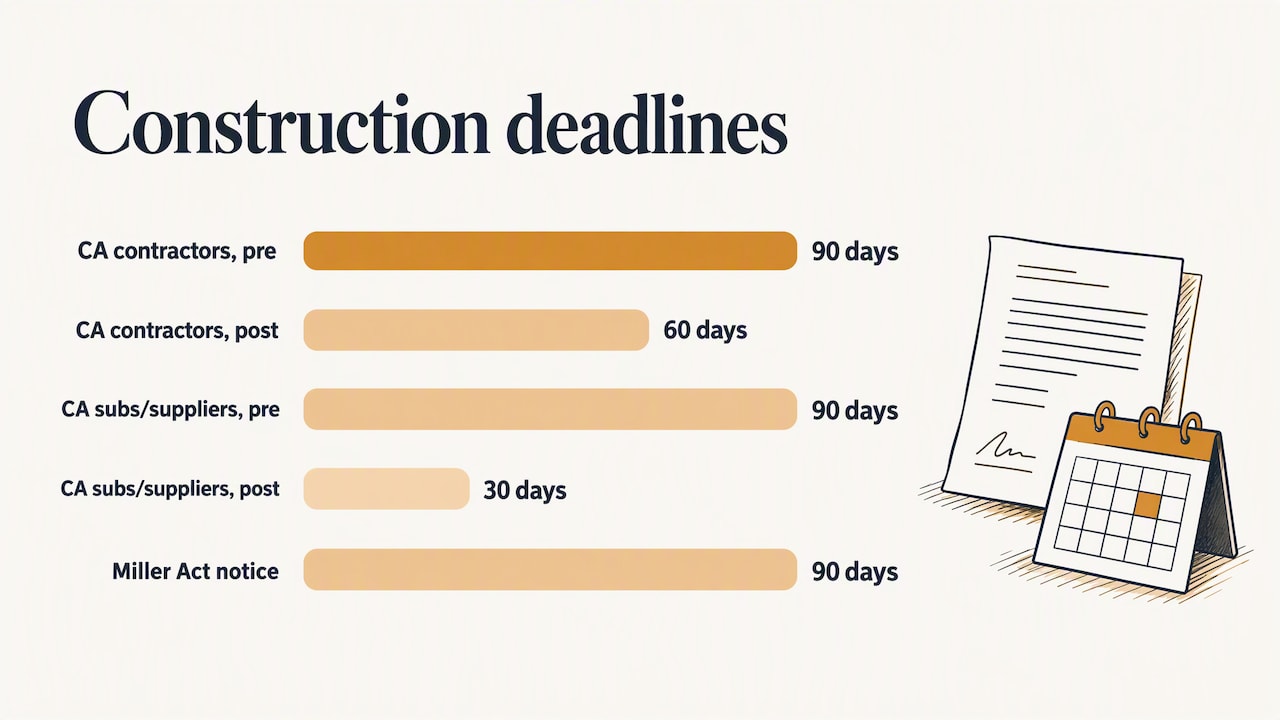
This is where waiting costs real money. Deadlines vary by state and claim type. In California, for example, a recorded notice of completion shortens the lien-recording period from 90 to 60 days for contractors and from 90 to 30 days for subcontractors and suppliers. On federal jobs, the Miller Act requires second-tier subcontractors and suppliers to give written notice to the prime contractor within 90 days after last furnishing labor or materials, with suit filed within one year. Direct-privity claimants don’t need that notice.
Two more cautions from the ABA’s discussion of lien statutes: warranty work and trivial punch-list work often do not extend the deadline, so don’t count a return visit as the “last day of work.” And when timing is unclear, read the controlling statute and file by the earliest plausible deadline, while avoiding a false or improper lien. A lien filed carelessly can hurt you, so have a construction attorney in your state review it.
Step 5: Choose the remedy that fits the amount
For a modest balance, small claims court may be quicker and cheaper than a lien action. For a large balance on real property, a lien or bond claim and a lawyer’s letter often get attention fast. Which route works depends on your state, your contract and the dollar figure, so get local advice before you pick.
Our perspective: final payment is won in the first week
We talk with tradespeople all the time who dread the last invoice. They did the work well, and then spend a weekend reconstructing it from memory, texts and photos buried in a phone. The owner pushes back on a change order nobody wrote down, and a small dispute holds up a big check.
Our view is that final payment is decided long before the final invoice. If every change was recorded when it was agreed, every draw had photos behind it, and every conversation with the customer was captured as it happened, the final request is just a summary. That is why we built Hechito to capture voice notes and photos on the job and turn them into organized records, estimates and invoices, in English or Spanish, so you aren’t typing it all up at night. The tool doesn’t replace your contract or your attorney. It makes sure that when someone asks “what did we agree to?”, you have the answer in hand.
— Francisco
Keep the paperwork behind your final invoice
Hechito keeps job records, estimates and invoices in one place, built from what you say and photograph on site. When it’s time to send the final invoice, the change orders, photos and customer conversations are already filed, and payment follow-ups can be handled for you. You can see how the virtual co-workers work on the Chalán, Lupita and Godínez page.
If you’d rather start from the basics, the Hechito contractors page shows how voice-to-invoice works, and you can send job notes by text through Hechito messaging. For cash that moves steadily the whole way through a job, not just at the end, read our guide to cash flow in construction.
Start the next job so the last check is easy
A few contract habits make final payment routine:
- Write a scope of work that says what “done” means. Our scope of work checks help here.
- Define substantial and final completion in the contract, and list the closeout documents.
- Put a payment due date and a late-payment term in writing.
- Log change orders when they are agreed and have them signed before the work.
- Keep a running punch list with dated photos, and close items out as you go.
- Ask subs and suppliers for waivers with each payment, not at the end.
None of this takes long when it happens as you work. It takes a weekend when it happens afterward.
FAQ
Is it normal to pay a contractor 50% upfront?
A large deposit is common on small jobs and for custom materials, but it’s not a universal norm. Some states cap the deposit a home improvement contractor can take, so check your state’s licensing board rules. Whatever the split, put it in the contract with a payment schedule so the final payment amount is never in doubt.
What is a final payment called?
You’ll see it called final payment, final invoice, final application for payment, or retainage release, depending on the contract. On many commercial jobs it’s a final application for payment submitted with closeout documents. It is the last payment under the contract, after the work is complete and warranties have begun.
When can I send the final payment request?
After final completion as your contract defines it: work finished, punch list closed, inspection passed if required, and closeout documents assembled. Sending earlier usually just gets the request returned. Check the contract for a notice method and a deadline for the owner to respond.
Can I file a lien if the owner won’t pay the final invoice?
Often, yes, but each state has its own notice requirements and deadlines, and missing one can cost you the right. Find your statute early and talk to a construction attorney in your state before filing. File only a lien you can support, because an improper lien can create liability for you.
Sources
- ConsensusDocs: Effectively Managing Project Closeout
- AIA Contracts: Construction Payment Process Explained for Contractors
- NYC DDC: Substantial and Final Payment Document Checklist
- Arkansas State Building Services: Closeout
- Northfield, MN: Project Closeout specification
- California CSLB: How to Prevent a Mechanics Lien
- AGC: Subcontractor Default White Paper
- AGC: Law in Brief, May 2017
- AGC: Colorado HB 26-1311
- ABA: Pay-if-Paid vs. Pay-When-Paid Clauses
- ABA: Lien statutes and the last work performed
- ABA: Miller Act Payment Bond Claims
Recommended
This is the paperwork Hechito does for you — while you talk.