Retainage Explained: How It Works and How to Get Paid

Retainage Explained: How It Works and How to Get Paid

Retainage is a slice of every progress payment that the party paying you keeps back until the job reaches an agreed milestone. It is usually 5% to 10%, it is set by your contract and your state’s law, and you only see it again if you finish the closeout paperwork. This guide shows how the math works, when the money comes back, and how to stop retainage from quietly eating your cash flow.
HechitoKeep Job Details OrganizedHechito captures conversations and job details in real time, helping contractors turn verbal notes into organized records without extra typing.Visit HechitoTL;DR
- Retainage (also called retention or a holdback) is a percentage of each progress payment withheld as security that the work gets finished and fixed. Procore puts the typical range at 5% to 10%.
- Release is driven by your contract, not by the calendar. Lien waivers, warranties and owner sign-off usually have to be in hand first.
- Limits vary by state and by public versus private work, so check the statute before you bid.
- Mirror the terms down the chain: if 5% is held from you, hold 5% from your subs, and track the balance separately.
- The contractors who get retainage back fastest package their closeout documents early instead of waiting to be asked.
Table of Contents
- What retainage means in construction
- How retainage works on a progress payment
- What percentage is normal, and what does the law say?
- When does retainage get released?
- The retainage release invoice
- Document control: the part that actually gets retainage paid
- Accounting for retainage without losing track
- Our perspective: retainage is a paperwork problem
- How Hechito fits in
- Common retainage mistakes to avoid
- FAQ
- Sources
What retainage means in construction
When an owner pays a general contractor, or a general contractor pays a subcontractor, the payer does not always send the full invoice amount. A fixed percentage stays behind. That held-back money is retainage. Levelset describes it as money withheld until the end of the project or a time the contract specifies, and notes that it is also known as retention.
The logic is simple. Work on a site is never perfectly done on the day the last big invoice goes out. There are punch-list items, defects that show up late, and subs who have not been paid. While the owner still holds a meaningful sum, you have a strong reason to come back, fix things and close the job properly. The Justia legal dictionary frames it the same way: a portion held back so that sub-contractors are paid and the project is finished.
Retainage is not a penalty and it is not a dispute. It is a contract term. That matters, because the biggest mistake we see is treating it as a surprise deduction instead of a number you planned for when you priced the job.
Retainage, retention and holdback
These words describe the same practice. “Retainage” is the term most American contractors use, while “retention” and “holdback” turn up in contract forms and in other markets. Wikipedia’s entry describes retention as money withheld by one party as security against incomplete or defective work. If you see any of the three in a contract, read the clause the same way: what percentage, held from which payments, released when and on what conditions.
How retainage works on a progress payment
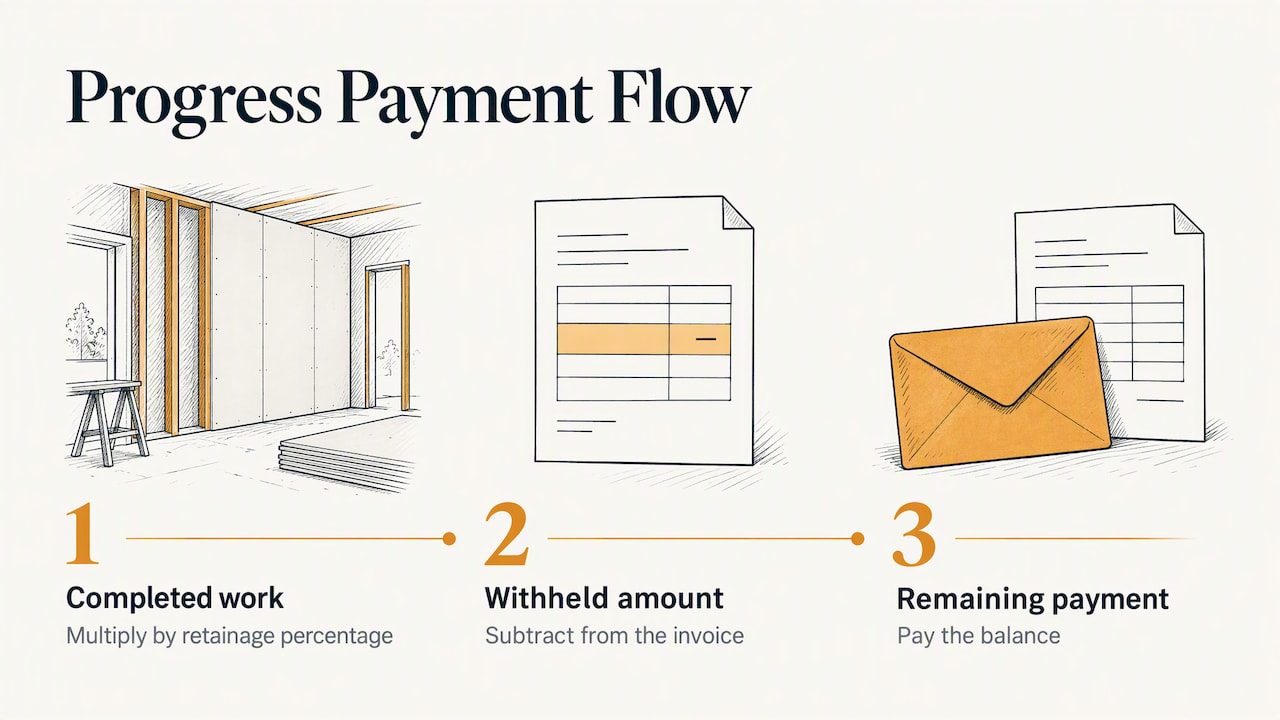
Most commercial and many residential remodeling jobs are billed in stages. Each invoice, often called a draw or pay application, covers the work completed since the last one. The payer multiplies the completed work by the retainage percentage, subtracts that amount, and pays the rest.
A worked example
Say you are an electrical contractor on a $200,000 contract with 10% retainage, billed monthly.
| Item | Month 1 |
|---|---|
| Work completed this period | $40,000 |
| Retainage held (10%) | $4,000 |
| Amount paid to you | $36,000 |
If every month looked like that, then by the time the job is 100% billed you would have invoiced $200,000, been paid $180,000 and be waiting on $20,000. For a small shop, $20,000 is often the entire margin on the job, and in some cases more.
That is why the percentage, not the headline contract price, tells you how much working capital a job will demand. Your labor, materials and payroll are paid in full on schedule. Your customer’s holdback is not.
How is retainage calculated?
The formula is the same everywhere: work billed this period times the retainage rate equals the amount held. Two details change the result:
- Whether retainage applies to materials stored on site. Some contracts hold it on everything billed, others only on labor or installed work.
- Whether the rate steps down. Many contracts hold 10% early and reduce it to 5% once the job is half done or substantially complete. The step-down is only valid if the contract says so, so read it before you assume.
For a closer look at how draws and billing stages interact, see our guide to progress billing in construction and the one on construction payment schedules.
What percentage is normal, and what does the law say?
The common answer is 5% to 10%. Quickbase calls it typically 5-10% of each progress payment, and an accounting firm’s QuickBooks guide reports standard rates of 5-10% on private work and 5% on most public and commercial jobs. Treat those as norms, not rules. Your contract and your state decide.
So what does 5% retainage mean in practice? On a $100,000 contract, $5,000 stays held. A 10% retainage on the same contract holds $10,000. Same job, double the cash tied up.
Federal work
On federal construction contracts, the Federal Acquisition Regulation lets the government retain a percentage of a progress payment when a contractor has not made satisfactory progress. The text is in FAR 32.103. It is a tool tied to performance, not an automatic deduction on every payment.
State limits
State law is where it gets uneven. Some states cap retainage, some only on public work, some on private work too, and some say nothing at all. Two examples:
- Florida public projects. Under Florida Statutes section 255.078, a public entity may withhold no more than 5% of each progress payment as retainage.
- Colorado. House Bill 21-1167 defines retainage in statute and sets rules for contracts and subcontracts. Read the current text before relying on it for a particular job.
If you work across state lines, check the statute for the state where the project sits, not where your company is registered. When the stakes are high, such as a large public job or a contract with unusual release terms, ask a construction attorney licensed in that state to read the clause.
When does retainage get released?
This is the question that decides whether retainage is a minor nuisance or a cash flow problem. The honest answer is: when your contract says it is due, and only if you have done what the contract requires.
Common release points include:
- Substantial completion. Some contracts release part of the retainage, or reduce the rate, at this stage.
- Final completion. Punch list finished, final inspection passed.
- A fixed date after completion. Some contracts hold a portion through a warranty period.
An accounting firm’s write-up on turning retainage into cash flow makes a point we agree with: release is a contract-driven event, and simply finishing the work is rarely enough. The paying party is generally not obligated to release until closeout requirements are satisfied, such as lien waivers, warranties and owner sign-off.
How long can a company hold retainage?
There is no single national answer. The contract sets the trigger, and many states add prompt-payment deadlines after that trigger. Some states set deadlines after completion or acceptance; others leave it to the contract. Look at your state’s prompt-payment statute and at the exact words of your release clause. If the payer is a public entity, the rules are usually written into the bid documents.
The retainage release invoice
Many contractors wait for the owner to tell them the job is complete. The more efficient teams do the opposite: they send a retainage release request with the closeout package attached. The same accounting source notes that incomplete documentation, such as missing lien waivers, warranties or as-builts, is the leading cause of delays.
A clean retainage release invoice usually includes:
- The contract or subcontract number, project name and address.
- The original contract amount, approved change orders and adjusted contract total.
- Total billed to date, total paid, and the retainage balance being requested, shown as a separate line.
- A reference to the contract clause that triggers release.
- Attachments: final lien waiver, warranties, as-builts or manuals, punch-list sign-off, and any certificates the contract names.
- Payment terms and a due date.
If you want a checklist for invoices that do not get bounced, our piece on contractor payment terms covers what payers look for. And when the due date passes, payment reminder emails gives timing and wording that keeps the relationship intact.
Retainage on invoices in construction
On the invoice itself, show retainage as its own line instead of netting it silently out of the total. A simple layout:
| Line | Amount |
|---|---|
| Work completed this period | $40,000 |
| Less retainage (10%) | ($4,000) |
| Net due this period | $36,000 |
| Retainage held to date | $12,000 |
The running “retainage held to date” figure is what you will want when it is time to ask for release. Payers who see the number on every invoice are far less likely to forget it exists.
Document control: the part that actually gets retainage paid
Search for retainage and you will also find people asking about document control in construction. That is no coincidence. Retainage is released against documents, so the contractor with the better paper trail gets paid sooner.
Document control just means knowing where every record is, which version is current, and being able to produce it when someone asks. For retainage, the records that matter most are:
- The signed contract and any change orders. Approved scope and price changes change what retainage is owed.
- Pay applications and invoices. Each one with its retainage line.
- Lien waivers. Yours and your subs’, conditional with each payment and final at closeout.
- Daily logs and photos. They prove what was installed and when. Our guide to daily construction logs lists the fields worth capturing.
- Punch lists and sign-offs. Dated, with names.
- Warranties, manuals and as-builts. Often the last items missing.
A habit that helps: start a closeout folder on day one of the job, not in the last week. Drop each document in as it arrives. By the time the work is complete, the package is already assembled.
Accounting for retainage without losing track
Retainage is money you have earned but cannot spend. If it sits inside ordinary accounts receivable, your books look healthier than your bank balance. The QuickBooks tracking guide recommends dedicated Retainage Receivable (asset) and Retainage Payable (liability) accounts so that it is visible for cash flow forecasting.
Three habits keep it under control:
- Track it per job. A total across all jobs hides which payers are overdue.
- Mirror your terms downstream. If your customer holds 5% from you, hold 5% from your subcontractors. Otherwise you are financing the job with your own money while your subs are paid in full. The same guide flags this as a common and costly mistake. Check your state’s rules and your subcontract first, because some states limit what you can hold from subs.
- Do not release your subs’ retainage before yours is secured. Paying out early costs you leverage over their punch-list items.
For the broader picture, see how retainage fits into cash flow in construction, job costing and bookkeeping for contractors. And if you are pricing new work, build the retainage drag into your numbers; our post on profit margin in construction is a good place to start.
Our perspective: retainage is a paperwork problem
We build software for tradespeople, and we hear the same story from electricians, painters, framers and remodelers. The work is done. The customer is happy. The last 5% or 10% is still sitting there months later, and the reason is almost never a refusal to pay. It is a missing waiver, a photo nobody took, a change order that was agreed on the porch and never written down.
The accounting firms cited above describe retainage as a financing tool, and that is how we see it too. If you treat it as a separate category, you can forecast it, ask for it on time and price jobs to cover the wait. If you do not, you end up financing the owner’s risk out of your own pocket.
What we would do differently on a typical small-shop job:
- Put the retainage percentage and release trigger in your estimate, in plain words, so no one is surprised.
- Photograph the work at each stage and keep the photos attached to the job, not buried in a phone’s camera roll.
- Capture verbal agreements the same day, while you remember them. A spoken change order only helps you if it becomes a record.
- Send the closeout package yourself, the day the work is done.
None of that requires a back office. It requires that the information from the job site reaches the paperwork without you retyping it at 9 p.m. That is the problem we built Hechito to remove.
— Francisco
How Hechito fits in
Hechito is built for contractors and tradespeople who would rather be working than doing admin. You talk through the job and snap photos on site, and the details become organized records instead of notes you have to type up later. That gives you the dated trail that closeout and release requests depend on.
Our virtual co-workers each take a piece of the load. Chalán turns voice notes and photos from the job site into quotes and invoices, and Godínez handles bookkeeping that matches the bank to your jobs. Hechito works in English and Spanish, so a crew that talks in both languages still gets clean documents in the language the customer needs. You can see how the crew works on the Hechito crew page and review plans on the pricing page.
Common retainage mistakes to avoid
- Not reading the clause before signing. Percentage, step-down, release trigger and deadline are all negotiable before you sign and rarely after.
- Waiting to be notified. The owner has no reason to chase you.
- Missing lien waivers. One missing waiver from a sub or supplier can hold up your release.
- Failing to separate retainage in your books. You will overestimate available cash.
- Ignoring state caps. If a payer holds more than your state allows, you have something to raise, ideally with advice from a construction attorney.
- Letting punch-list items drag. The longer small items stay open, the longer the balance stays held.
FAQ
What is retainage?
Retainage is a percentage of each progress payment that the payer holds until the project reaches a milestone such as substantial completion or final acceptance. It acts as security that the work will be finished and defects fixed. It is also called retention or a holdback.
What is the difference between retainage and retention?
There is no practical difference. Both describe money withheld from payments as security for completed, defect-free work. “Retainage” is the word most American contractors use, and you will see the other two in contract forms.
How is retainage calculated?
Multiply the value of work billed in the period by the retainage rate. On a $40,000 draw with 10% retainage, $4,000 is held and $36,000 is paid. Check whether your contract applies the rate to stored materials and whether it steps down after a certain point.
How long can a company hold retainage?
It depends on your contract and your state. The contract sets the release trigger, and some states add prompt-payment deadlines after completion. Read your release clause and your state statute, and ask a construction attorney if the payer is past the deadline.
Sources
- Retainage: How It Works and Best Practices, Procore
- Retainage in Construction: Overview, Rules and FAQs, Levelset
- Retainage in Construction: Definition and How It Works, Quickbase
- Retainage definition, Justia Legal Dictionary
- Retainage, Wikipedia
- FAR 32.103 Progress payments under construction contracts
- Florida Statutes 255.078, Public construction retainage
- Colorado House Bill 21-1167
- Turn Retainage into Cash Flow
- How to Track Retainage in QuickBooks Online
Recommended
This is the paperwork Hechito does for you — while you talk.