Profit Margin in Construction: Benchmarks and How to Price

Profit Margin in Construction: Benchmarks and How to Price

A healthy net profit margin for a construction company usually lands somewhere between 5% and 10% before tax. Specialty trades and well-run residential builders can do better, and gross margins run much higher because overhead has not come out yet. Where you land depends on your trade, your overhead and how accurately you price. Below you get the real benchmarks, the markup-versus-margin math that trips up many contractors, and the habits that decide whether a job pays.
HechitoKeep More Margin in Every JobHechito captures job details through voice and images, helping contractors turn quotes into invoices with less paperwork and fewer missed details.Visit HechitoTL;DR
- Net profit before tax for the typical U.S. construction firm was 6.7% in 2024, per CFMA. Single-family home builders average higher, but they also carry land and sales risk.
- Markup and margin are not the same number. A 25% markup gives you a 20% margin, not 25%.
- Margin is usually lost in the bid and in the paperwork: missed indirect costs, unbilled change orders and late invoices.
- Profit on paper is not cash in the bank. Forecast cash per job, especially with draws and retainage.
Table of Contents
- What construction profit margin actually means
- What the benchmarks say
- Markup vs. margin: the math that costs contractors money
- Why margins slip after you win the job
- How to set your price from a target margin
- Profit is not cash
- Our perspective: margin leaks in the paperwork
- Where Hechito fits
- A simple monthly margin check
- FAQ
- Sources
What construction profit margin actually means
There are two margins, and people mix them up constantly.
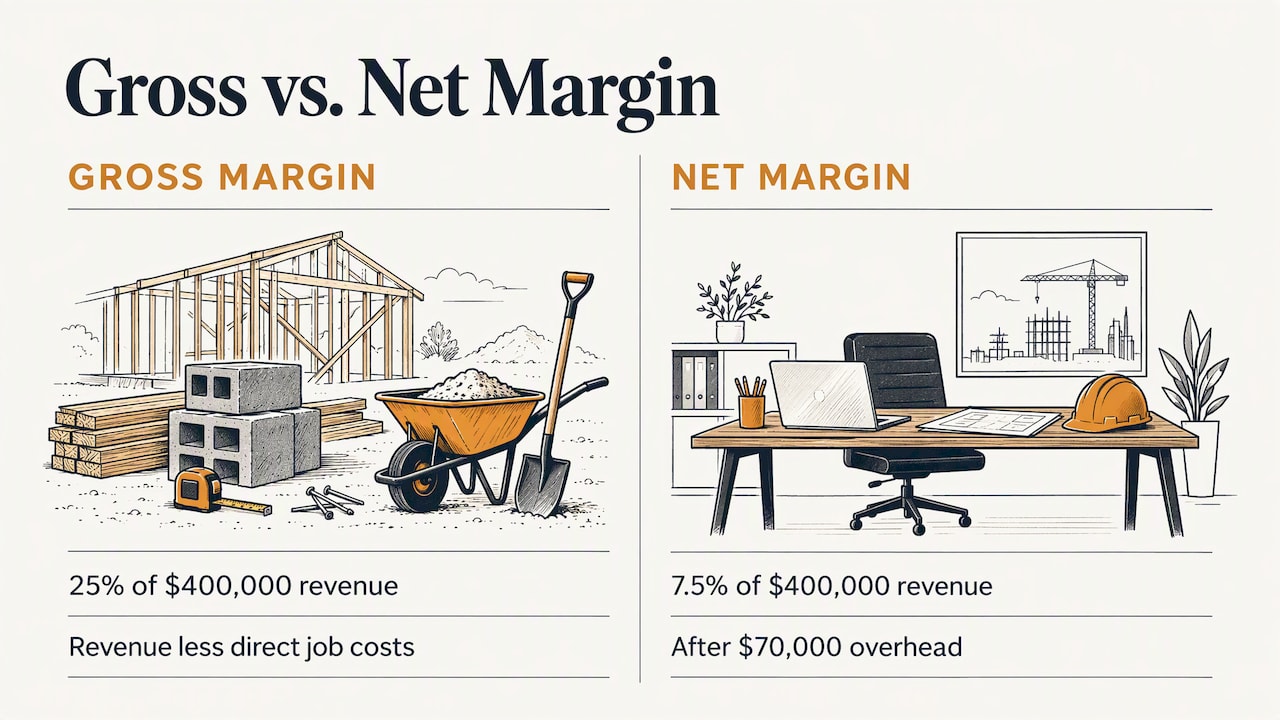
Gross profit margin is revenue minus direct job costs (labor, materials, subs, equipment on the job), divided by revenue. It tells you whether the work itself pays.
Net profit margin is what is left after overhead too: office rent, insurance, vehicles, admin pay, software, your own salary if you run it through the books. Net is what the business really keeps.
If you bring in $400,000 in a year, spend $300,000 on direct job costs and $70,000 on overhead, your gross margin is 25% and your net margin is 7.5%. Same business, two very different numbers. When you read a benchmark, check which one it is. Many of the confusing numbers online come from articles quoting gross and net side by side.
What the benchmarks say
Published figures vary because they measure different businesses. Here is what the primary sources show.
| Source | What it measures | Figure |
|---|---|---|
| CFMA Financial Benchmarker, FY2024 | Typical construction firm, net income before tax | 6.7%, up from 6.3% in 2023 |
| NAHB Cost of Constructing a Home 2024 | Builder profit on a new single-family home, share of sales price | 11.0%, up from 10.1% in 2022 |
| NAHB Cost of Doing Business Study 2025 | Single-family builders, 2023 net and gross margin | 8.7% net, 20.7% gross |
A few readings of that table:
- Net in the mid-single digits is normal. If you clear 6% to 8% after all overhead, you are doing about as well as the typical firm. Above 10% for a working contractor is worth celebrating, and worth checking: are you leaving overhead out of the calculation?
- Home builders look richer than they are. The NAHB study found that in 2024 overhead and general expenses were 5.7% of the sales price, and that is on top of land and financing. Their 11.0% is also a pre-tax share of the sales price, and the long-run average since 1998 is 9.8%, so recent years have been strong rather than typical.
- Gross margin is not take-home. A 20% gross margin sounds generous until overhead takes 10% to 13% of revenue.
Some web pages claim a “good” net margin of 15% to 20% for construction. That is not what the CFMA or NAHB data show for a typical firm, so treat it as a stretch target for a specialty shop with low overhead, not a baseline.
Markup vs. margin: the math that costs contractors money
Markup is a percentage of your cost. Margin is a percentage of your price. Because the base is different, the same dollars produce different percentages.
- Markup = (price − cost) ÷ cost
- Margin = (price − cost) ÷ price
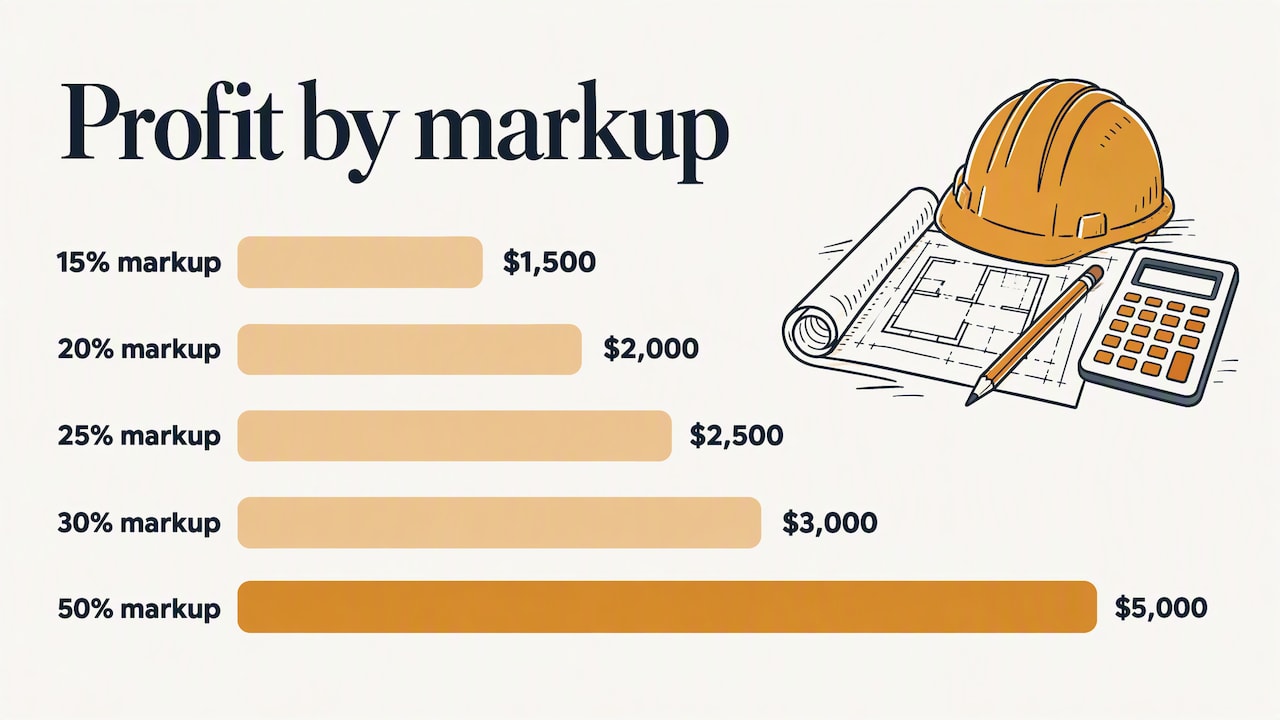
Take a job with $10,000 in direct cost.
| Markup on cost | Price | Profit | Margin on price |
|---|---|---|---|
| 15% | $11,500 | $1,500 | 13.0% |
| 20% | $12,000 | $2,000 | 16.7% |
| 25% | $12,500 | $2,500 | 20.0% |
| 30% | $13,000 | $3,000 | 23.1% |
| 50% | $15,000 | $5,000 | 33.3% |
The mistake happens when you want a 20% margin and add 20% to your costs. You end up at 16.7%. To hit a target margin, divide cost by (1 − target margin). For 20%: $10,000 ÷ 0.80 = $12,500. Same as a 25% markup.
This matters most on thin-margin work. When you only keep 7% net, a three-point slip from using the wrong formula eats nearly half your profit.
What markup do contractors actually charge?
For general contractors, Angi’s markup guide says most residential GCs apply a markup between 15% and 20% on direct project costs to cover overhead and profit. That is a markup that must pay for overhead and profit. It is not a profit margin. A 15% markup on cost, after 10% of price goes to overhead, leaves very little.
A quick test: add up your last 12 months of overhead, divide by your last 12 months of revenue. If overhead is 12% of revenue, a 13% margin job only nets 1%.
Why margins slip after you win the job
The number in your estimate and the number in your bank account rarely match. Four gaps cause most of it.
1. Indirect costs that never made it into the bid
Supervision, insurance, equipment upkeep and admin time are real costs, and they are easy to leave out. Construction Executive describes how contractors underestimate these and lose margin; a proper burden analysis of indirect costs separates jobs that look profitable from jobs that are. If you are a small shop, a simple version works: total your overhead, spread it across billable labor hours, and add it to every labor line.
2. Small estimating errors
Once you win a bid, most costs are locked. Construction Executive reports that quantity or pricing mistakes of just 5% to 15% can wipe out margin through change orders, budget creep and rework. When your net margin is 7%, a 7% miss is your entire profit. A clear written scope helps here, and so does a tight scope of work that says what is in and what is out.
3. Changes that never get billed
The customer asks for an extra outlet, a different tile, a second coat. You say yes on the spot and plan to sort it out later. Later never comes, or comes without proof. CFMA’s article on the project manager’s financial role points to missed change orders and delayed financial visibility as quiet margin killers. The fix is boring: write it down and price it before you do the work, with a photo of the before state.
4. Winning the wrong work
The CFMA benchmarking data suggests that winning the right work matters more than winning the biggest work. Compare jobs by the gross profit you expect, not the contract value, and look back at which job types, customers or crews have actually paid. If bathroom remodels have averaged 28% gross and decks 14%, that tells you where to spend your estimating hours.
How to set your price from a target margin
Here is a repeatable method for a small contractor.
- Find your overhead rate. Last 12 months of overhead divided by last 12 months of revenue. Say it is 11%.
- Pick a net profit target. Say 8%, which sits between the typical firm’s 6.7% and the stronger builder numbers above.
- Add them. 11% + 8% = 19% gross margin needed on every job.
- Price with the margin formula. Direct cost ÷ (1 − 0.19). On $10,000 of direct cost, that is $12,346.
- Check the markup that produces. $2,346 ÷ $10,000 = 23.5% markup. That is above the 15% to 20% range many residential GCs use, which is the point: the common markup often does not cover both overhead and profit for a small shop.
- Add contingency separately. Do not hide it in margin. Risky jobs (old houses, crawl spaces, unknown conditions) get a visible allowance or a clause for unforeseen conditions.
- Review after every job. Compare estimated and actual cost by category. Adjust your labor hours and material waste assumptions.
Step 7 is where most small contractors stall, because the actual numbers are scattered across receipts, texts and memory. Our piece on job costing for contractors covers how field data feeds that comparison.
Profit is not cash
A 9% margin job can still put you in a hole. Contractors pay crews, suppliers and subs weeks before the customer pays, and retainage can sit for months. Industry CPAs quoted by Construction Executive note that a firm can look profitable on paper while struggling to fund payroll or cover retainage gaps, and they recommend forecasting cash flow job by job.
Practical moves:
- Put a deposit and a draw schedule in the contract. See how payment schedules with photo verification keep draws from being disputed.
- Bill in stages instead of at the end. Progress billing keeps money coming in while you carry costs.
- State the terms plainly on every invoice. A payment terms checklist reduces rejections and delays.
- Send the invoice the day you finish, not at the end of the week.
Our perspective: margin leaks in the paperwork
We build for contractors and tradespeople, and the pattern we see is consistent: the margin is usually lost between the job site and the desk, not in the price list.
The extra hour the customer asked for gets mentioned in the driveway and never makes the invoice. The material run is paid for with a card and the receipt ends up in a truck cupholder. The estimate is written at 9 p.m. from memory, so it is vague, and vague estimates start arguments. Each of these is a few dollars. Added up over a year, on a business keeping 7% net, they are the difference between a good year and a flat one.
That is why we built Hechito around capturing the work as it happens, by voice and photo, so the details exist when you need to quote, bill or back up a change. You talk on the job, and the estimate, invoice and records come out of what you said and showed. It works in English and Spanish, and you can mix both on the same job, with documents produced in the language your customer needs. A tool that only records tasks leaves the typing to you. We want the paperwork finished, because every evening hour you spend on admin is an hour you did not bill or rest.
Our advice, whatever software you use: know your overhead rate, price from a target margin, and never do extra work without writing it down first.
— Francisco
Where Hechito fits
If you recognize the leaks above, our crew of virtual co-workers covers them. Chalán turns what you say and photograph on the job site into voice quotes and invoices. Lupita answers your calls in two languages, so you do not miss new work while you are on a ladder. Godínez matches your bank activity to your jobs, which helps when you want real numbers to compare against your estimates, and our bookkeeping for contractors guide explains the approach. You can see how each one works on the crew page and check the current plans on our pricing page. If you quote in both English and Spanish, read about dual-language estimates.
A simple monthly margin check
Once a month, take 20 minutes and answer five questions:
- What was gross margin on each job closed this month, using real costs and not the estimate?
- Which jobs came in under target, and what was the cause: labor hours, material waste, an unbilled change?
- Is overhead still near the rate you used in your pricing?
- How many invoices are older than your stated terms?
- What is the cash picture for the next 30 days, per job?
Keep a daily log so that when the numbers look off, you can trace why. Over a few months, you build your own benchmark, which beats any industry average because it reflects your trade, your region and your crew.
FAQ
What is a good profit margin for a contractor?
For net profit before tax, 6% to 8% is a realistic baseline for a typical firm, since CFMA data shows 6.7% for fiscal 2024. Stronger specialty shops and home builders can exceed that. Aim for a gross margin that covers your overhead rate plus your target net.
What is the difference between markup and margin in construction?
Markup is profit as a percentage of your cost, and margin is profit as a percentage of your selling price. A 25% markup equals a 20% margin. Use margin when you set targets, because it ties directly to what you keep from each dollar billed.
What is a typical markup for a general contractor?
Angi reports that most residential GCs mark up direct costs by 15% to 20%. That markup has to cover overhead and profit together, so check it against your own overhead rate before copying it.
How do contractors make a profit?
They price above total cost, including overhead, then protect that spread by estimating accurately, billing every change and collecting on time. Most lost profit comes from missed indirect costs, scope creep and slow payment, not from the headline price.
Sources
- CFMA Financial Benchmarker (2024 data)
- NAHB, Cost of Constructing a Home 2024
- NAHB, new study on builder financial performance (April 2025)
- Construction Executive, Get Direct About Indirect Costs in Construction
- Construction Executive, The ROI of Estimating Accuracy in Preconstruction
- Construction Executive, Why Construction Firms Need Specialized CPAs
- Construction Executive, Profitability in Construction: It’s All in the Bidding
- CFMA, Where Projects Win or Lose: The Financial Role of the Project Manager
- Angi, General Contractor Markup Guide
Recommended
This is the paperwork Hechito does for you — while you talk.