How to Text Estimates to Clients (With Templates)
How to Text Estimates to Clients (With Templates)
To text an estimate to a client, get their permission first. Then send a short message with your name, your business, the job, the total price and a link to the full estimate. Keep the line items out of the text itself. Follow up once or twice, spaced out, and move to a phone call when the job is big. This guide gives you the wording, the timing and the U.S. rules to check, so you can copy it and send it today.
HechitoKeep Estimates Moving Without More TypingHechito captures job details through voice and images, then automates the paperwork from quoting to invoicing for contractors and tradespeople.Visit HechitoTL;DR
- Ask before you text. Note the client’s yes in the job file, and send from a number the client recognizes.
- Put the business name, the job, the total and a link in the message. Leave the full breakdown to the linked estimate.
- Follow up a day or two later with a short question, then once or twice more with space between. For jobs over $5,000, use the text to set up a call.
- Under U.S. rules, texts are generally treated like calls. Consent, opt-out language and sensible send times matter most when a message looks like marketing.
- The estimate behind the text matters as much as the text. Write it clearly, in the client’s language.
Table of Contents
- Why texting works for estimates
- Get permission before you send
- The U.S. rules to know
- What a good estimate text contains
- Templates you can copy
- The estimate behind the text
- Follow up without nagging
- Mistakes that cost you jobs
- Texting in English and Spanish
- Our perspective: the text is the easy part
- Put the whole process on rails
- A simple checklist before you hit send
- FAQ
- Sources
Why texting works for estimates
Most homeowners and property managers keep their phone within reach all day. An email with a PDF can sit unopened for days. A text from a contractor they just met sits on the lock screen, and the answer is often a one-line reply.
Texting also fits how trades work. You are on a ladder or in a crawl space, not at a desk. A short message sent right after the walk-through reaches the client while the job is still fresh in their mind.
The risk is that a text feels informal, and informal can read as sloppy. A text that lists forty line items or comes from an unknown number looks like a scam. The fix is structure: say who you are, what the job is, what it costs and where to read the details.
Get permission before you send
This step comes first because it protects you and sets the tone. Ask in person or on the phone: “Is it okay if I text the estimate to this number?” Then note the answer in the client’s file. A guide to sending quotes by text advises exactly this: get explicit prior permission and record that you asked.
A client who gave you their number so you could quote the job has reasonable grounds to expect a message about that job. That is different from adding them to a list of seasonal promotions. Keep the two apart. If you later want to send offers, such as a spring gutter-cleaning special, ask for that permission separately.
Two practical habits make this easy:
- Ask at the walk-through. One sentence while you are still on site: “I’ll text you the estimate tonight, is this the best number?”
- Offer a choice. Some clients prefer email. Offering both is better than guessing, and it shows you respect how they like to work.
The U.S. rules to know
This is general information, not legal advice. If you plan to text at volume or run promotions by text, talk to an attorney who handles consumer communications law.
The FCC says that texts are generally treated as calls under the TCPA, the law that restricts unsolicited advertisements and autodialed or prerecorded communications. According to the same FCC page, non-emergency autodialed and prerecorded calls to cell phones generally require prior express consent. The consent has to be written if the message contains an advertisement.
What that means for a contractor in practice:
- A one-to-one estimate you typed for a client who asked for it is a different thing from a bulk promotional blast. The more a message looks like advertising, the more the written-consent rule matters.
- The FTC treats telemarketing differently. Its Telemarketing Sales Rule covers calls with offers and promotions, and the FTC has stated that telemarketing robocalls require express written consent.
- Opt-out language is cheap insurance. On anything marketing-adjacent, such as a “still interested?” reminder, practitioners suggest adding a line like Reply STOP to opt out. Honor it right away.
- Mind the clock. The same source suggests keeping to quiet hours, generally 8:00 a.m. to 9:00 p.m. in the recipient’s local time, and avoiding marketing texts on Sundays. That is a sound habit even for a plain estimate. A text at 10:30 p.m. will not win anyone’s trust.
State laws can add their own limits, so check your state’s rules if you text across state lines.
What a good estimate text contains
A text estimate has five parts. Put them in this order.
- Greeting and name. “Hi Maria, it’s Jake.”
- Business name. So the client knows who is writing, even if your number is new to them.
- The job. “Your estimate for the back porch roof.”
- The total. One number. Clients want the price before they open anything else.
- A link and a next step. Where to see the details, how long the price holds, and an invitation to reply.
Here is a template adapted from that same guide’s example:
Hi Maria, it’s Jake from Riverside Roofing. Your estimate for the back porch roof is ready: $3,850 total. Full details and options here: [link]. Price good for 30 days. Any questions, just reply. - Jake
That message is about 40 words. It names the sender, the job and the price, and tells the client what to do next. Notice what it leaves out: no list of shingles, no labor hours, no payment schedule. Those live in the linked estimate.
Why link instead of pasting the breakdown
Long texts get skimmed. A wall of line items looks like homework, and clients cannot easily forward it to a spouse or landlord. A link opens a clean page they can scroll, save and share. The research recommends keeping text quotes short and linking to the full estimate rather than pasting every line.
Templates you can copy
Change the details to match your trade and your voice. Keep each one under about 50 words.
First send, after a walk-through
Hi [Name], this is [You] from [Business]. Thanks for having me out today. Your estimate for [job] is ready: [total]. Details here: [link]. Good through [date]. Reply with any questions.
Quote with options
Hi [Name], [You] from [Business]. I put together two options for [job]: [Option A total] or [Option B total]. Both are in the link so you can compare: [link]. Happy to talk through them if you’d like.
Day-after nudge
Hi [Name], [You] from [Business]. Did you get a chance to look at the estimate for [job]? Glad to answer anything.
Larger job, moving to a call
Hi [Name], [You] from [Business]. The estimate for [job] is in the link: [link]. A few choices on materials could change the price, so I’d like to walk you through them. Do you have ten minutes tomorrow?
Price change after scope changes
Hi [Name], [You] from [Business]. Since we added [change], the total for [job] is now [new total]. Updated estimate: [link]. Nothing starts until you approve it.
That last one keeps both sides clear about who approves changes. Construction contract guidance makes the same point: clear lines of authority to authorize payments and changes should be established in the general conditions. On a small job, the text approval and the saved record serve the same purpose.
The estimate behind the text
The text gets the client to the page. The estimate on that page closes the job. A professional estimate follows a uniform, readable format. According to the American Society of Professional Estimators, it carries project information and a level of estimate. Each item includes a description, quantity, unit of measure, material cost, labor hours and cost, equipment cost, any subcontract cost and the total.
For larger projects, the Associated General Contractors of America says an estimate should address every project element, including site work, equipment, disposal, fees, allowances and contingencies. You do not need that depth for a water heater swap. The principle still applies: if a cost is likely, put it on the page, so the client does not meet it later as a surprise.
Two more details save arguments:
- Call it what it is. Clients mix up estimates and quotes, and the difference affects who carries the risk if costs move. Our piece on estimate vs. quote disputes explains how to label each one.
- Spell out payment terms. Deposit, milestones and due dates belong in the document, not in a later text thread. A payment terms checklist helps you cover the basics.
On bigger jobs billed in stages, the text is only the start. Once the client accepts, you need a way to bill each stage and handle retainage. This explainer on progress billing for contractors covers how that works in construction.
Follow up without nagging
Most estimates do not get answered the first time. That is normal, not a rejection. The research suggests following up a day or two later with a short question, then once or twice more, spaced out. For larger jobs, mix in a call and offer to answer questions.
A workable rhythm:
| When | What | Channel |
|---|---|---|
| Same day | Send the estimate with a link | Text |
| 1 to 2 days later | Short question: any questions on the estimate? | Text |
| About a week later | Offer to walk through options or adjust scope | Text or call |
| One more time, later | Final check, with a clear price-valid date | Text |
The timing is a guide, not a rule. Adjust for the season and the client. A homeowner with a leaking roof moves faster than someone planning a remodel next spring.
For big tickets, The Service Operator recommends against closing by text alone. For items over $5,000, use the text to set up a brief phone call to discuss the estimate. That matches how most clients feel: they want to hear a person explain a five-figure number.
The same source offers a useful mindset. Treat follow-up as running a standard process, not begging for work. That keeps your tone matter-of-fact. “Following up as promised” sounds like a professional. “Just checking in again!!” for the fourth time does not.
Answering client questions in the thread
Clients often reply with a price question, a scope question or a request to change something. A few rules keep this clean:
- Answer the question asked, in one or two sentences.
- If the answer changes the price, send an updated estimate link, not a new number buried in a text.
- If a reply gets long or emotional, call. Texts flatten tone.
- Save the thread with the job record, so you can find who agreed to what.
Mistakes that cost you jobs
The guide on texting quotes lists the common ones: long texts, walls of line items, an unknown number and strings of “just checking in” messages. Here is how each plays out.
- Texting from a number the client does not know. If you use a personal cell, tell the client at the walk-through which number you will text from. A message from an unfamiliar number can look like spam.
- Pasting everything into the message. The client cannot find the total. Lead with the price, link the rest.
- No expiry on the price. Lumber, fixtures and labor costs move. A line like “good for 30 days” protects you and gives the client a reason to decide.
- Following up too often. Three messages in two days read as pressure.
- Mixed messages across channels. If the email says one thing and the text says another, the client trusts neither. One estimate, one source of truth.
- Skipping the record. If a client says “you never told me that,” a saved estimate and thread settle it.
Texting in English and Spanish
Many trade businesses serve clients who prefer Spanish, or crews who talk in both languages on site. A text in the client’s language is more than courtesy. It prevents misunderstandings about scope and price.
The short message can be simple in either language, but the linked estimate should match. If the client reads Spanish, they should not have to translate an English document before they sign. Our article on dual-language estimates from voice and photos shows how to produce both versions from the same job notes.
Our perspective: the text is the easy part
We built Hechito for contractors who lose evenings to paperwork. When we talk to tradespeople about estimates, the same thing comes up: sending the text takes ten seconds, and writing the estimate takes an hour at the kitchen table after a long day.
That gap is where jobs get lost. The walk-through happens Tuesday, the estimate goes out Friday, and by then the client has talked to two other contractors. Speed matters, and speed comes from capturing the job while you are standing in it: what the client said, what you measured, what you photographed.
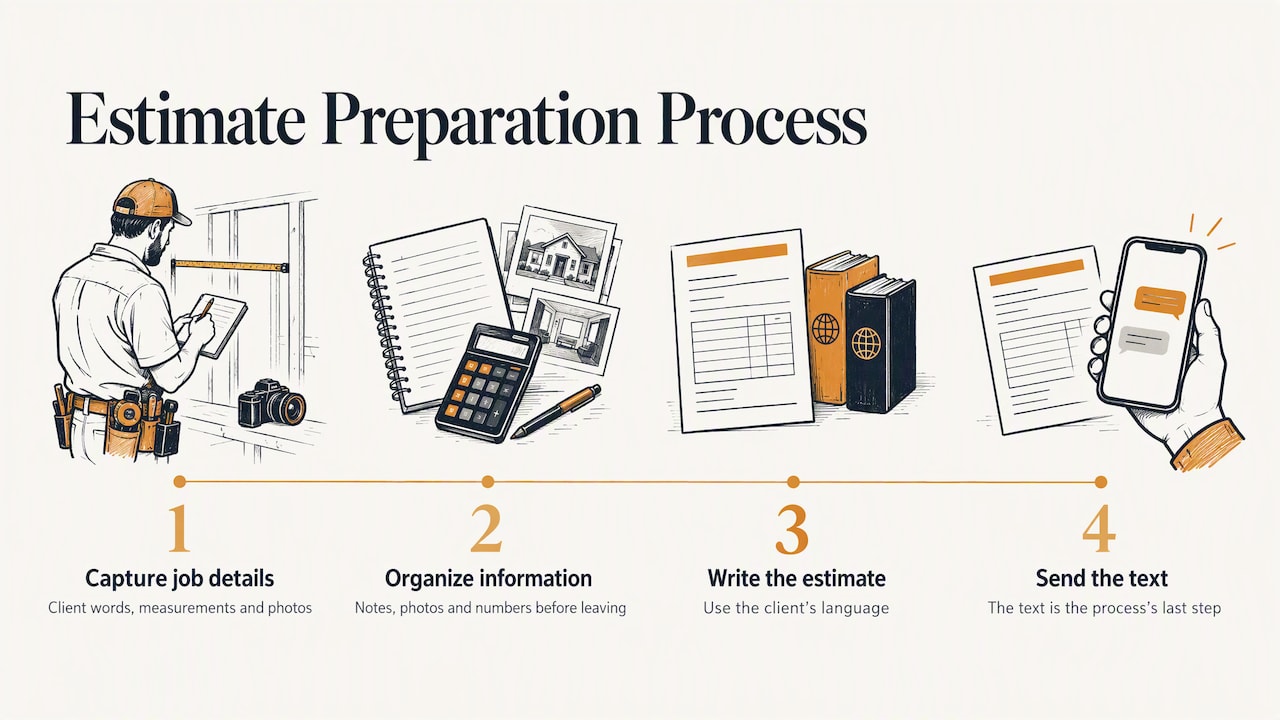
So our view is this. Do not treat the text as a writing exercise. Treat it as the last step of a process that began at the walk-through. If your notes, photos and numbers are already organized when you leave the driveway, the message nearly writes itself. If they are in your head and on a dozen camera-roll photos, you will dread it and put it off.
We also think the estimate should speak the client’s language, literally. A Spanish-speaking homeowner who gets an English-only document is likely to hesitate, and a hesitating client is a client who calls someone else. Being able to speak in either language or both, and get a clean document in the language the client needs, removes that friction.
— Francisco
Put the whole process on rails
If you want the estimate drafted before you reach the truck, Chalán turns what you say and photograph on the job site into quotes and invoices. It works in English and Spanish, so the document matches the client. You can see how the crew works together on the Hechito crew page, and the current plans are on the pricing page.
After the estimate is accepted, the same notes carry into invoicing and payment reminders. If you want to tighten that side as well, see our guides to payment reminder emails and cash flow in construction.
A simple checklist before you hit send
- The client said yes to texting this number, and it is noted.
- You are sending from a number they know.
- The message names you, your business, the job and the total.
- The link opens a clean, complete estimate in the client’s language.
- The price has an expiry or validity period.
- It is within sensible hours in the client’s time zone.
- You have a follow-up planned: a short question tomorrow, a call if the job is large.
FAQ
Is it okay to text an estimate to a client?
Yes, when the client has agreed to be contacted that way. Ask at the walk-through and note it in the job file. The FCC treats texts generally as calls under the TCPA, so consent matters most when a message looks like advertising. For legal questions about your specific practices, consult an attorney.
What should I say in a text when I send an estimate?
Include your name, your business, the job, the total price, a link to the full estimate and how long the price is good for. Invite a reply. Keep it to about 40 to 50 words.
How often should I follow up after texting an estimate?
Follow up a day or two later with a short question, then once or twice more, spaced out. Do not send a string of “just checking in” messages. For jobs over $5,000, use a text to schedule a call.
Should I put the price in the text or only in the link?
Put the total in the text. Clients want to see it right away, and it filters out mismatched expectations early. Keep the line items, options and terms in the linked estimate.
Sources
- Sending Quotes and Estimates by Text
- FCC: Unlawful Communications, Robocalls and Spoofing
- FTC closing letter on telemarketing robocalls, July 14, 2015
- Estimate Follow-Up That Closes: The 24-72-7-14 Play
- ASPE: The Essentials of Successful Estimating
- AGC: School Construction Guide
- ConsensusDOCS Guidebook, March 2021 edition
Recommended
This is the paperwork Hechito does for you — while you talk.