Bank Reconciliation for Contractors: A Step-by-Step Guide
Bank Reconciliation for Contractors: A Step-by-Step Guide
Bank reconciliation for a contractor means matching every job payment, subcontractor check, supplier charge and bank fee in your books against your bank statement until both show the same balance. Do it monthly at the least, and every week if you have many jobs open. Do it on records you capture at the job, not from memory at night. That is where Hechito helps: it turns what you say and photograph on site into organized records, and it manages receipts and bank reconciliation, so there is less to untangle when the statement arrives.
HechitoKeep Job Records Ready for ReconciliationHechito captures job details by voice and photo, helping contractors keep organized records for matching payments, receipts, and invoices.VisitTL;DR
- Reconciliation compares your books with your bank statement, explains every difference, and ends with both balances agreeing.
- The core move: add deposits in transit and subtract outstanding checks on the bank side, then add or subtract fees, interest and bounced checks on the books side.
- Your bank balance is not spendable cash. Money owed to suppliers and subs, and checks not yet cashed, change the picture.
- Reconcile monthly at minimum, weekly in busy season, and have someone other than the person who pays bills review it.
- The cleaner your receipts, invoices and job notes, the faster the matching goes. Hechito captures those by voice and photo as the work happens.
Table of Contents
- What bank reconciliation is, in plain terms
- Why it matters more for contractors
- What you need before you start
- The two timing items that cause most confusion
- How to reconcile a contractor bank account, step by step
- A worked example
- Fixing what does not match
- How often to reconcile
- Know your real spendable cash
- Separate duties, even in a small shop
- Where the time really goes, and what to do about it
- What we think
- How Hechito fits into your reconciliation routine
- Your month-end checklist
- FAQ
- Sources
What bank reconciliation is, in plain terms
Your accounting records say you have one number. Your bank says you have another. Reconciliation is the job of explaining the gap line by line until the two agree.
JPMorgan describes it as comparing a company’s internal records against the bank’s records, and lays out a process of gathering both sets of data, matching transactions, identifying what does not match, classifying the differences, correcting them and reviewing the result. The differences usually fall into four buckets: timing differences, bank errors, errors in your own books, and items nobody can explain yet.
Two terms come up constantly:
- Book balance: the cash balance in your accounting records, after everything you have entered.
- Bank balance: what the bank statement shows on its closing date.
If you have ever looked at your online banking and thought you had more money than you really did, you have already met the reason this matters.
Why it matters more for contractors
A contractor’s cash does not move in a straight line. You buy materials before you bill. You pay subs before the customer pays you. Draws, deposits and retainage arrive on different days than the work happens.
The numbers show how stretched that gap gets. Crestmont Capital’s 2026 late-payment data, drawing on Federal Reserve, Dun & Bradstreet and Xero research, reports that construction firms carry average outstanding receivables above $130,000 per firm, and that CFMA research found nearly 70% of construction firms have a payment delay on at least one active project at any time.
With that much money in motion, a bank statement alone cannot tell you where you stand. The NPMCA, a contractor trade association, makes the same point: a job’s margin and the money sitting in the account answer different questions, because customer payment delays, deposits, loan principal and upcoming bills all affect cash timing even when a job is profitable. Reconciliation is what keeps those two views from drifting apart. For the profit side of that distinction, this explanation of cash versus accrual accounting for contractors is a good companion read.
There is also a control reason. Rebecca Badgett of the UNC School of Government writes in Coates’ Canons that reconciliation is a key internal control: it lets you catch accounting errors sooner than you otherwise would. For a small contractor, that can mean catching a double-charged supplier invoice in week two instead of at tax time.
What you need before you start
The U.S. Department of Justice’s Office of Justice Programs publishes a bank reconciliation guide sheet that lists the inputs plainly. You need:
- The general ledger balance for the bank account (the book balance, in your accounting records).
- The bank statement, usually covering about 30 days.
- Deposits recorded in your books but not yet received by the bank.
- Checks you wrote and recorded that the bank has not yet cleared.
For a contractor, add the supporting paper behind each line: the customer invoice a deposit belongs to, the supplier receipt behind each card charge, the sub invoice behind each check. If those are scattered across truck seats, text threads and glove boxes, the matching step is where the hours go. Our guide to a job-based receipt system covers how to keep them attached to the job from the start.
The two timing items that cause most confusion
AccountingCoach defines both clearly.
- Outstanding checks are checks you wrote and recorded, but the bank has not cleared. They are subtracted from the bank balance. You paid the sub on Friday, but the sub may not cash it for a week.
- Deposits in transit are cash and checks you received and recorded, but the bank has not processed yet. They are added to the bank balance. That customer check you dropped in the deposit slot after hours is a classic one.
Neither is an error. They are timing, and they resolve on their own as the bank catches up. You only need to document them until they clear. The trouble starts when an outstanding check is still outstanding months later. That is a stale check, and it deserves a phone call.
How to reconcile a contractor bank account, step by step
This follows the six-step sequence in Coates’ Canons, with the contractor details added at each step.
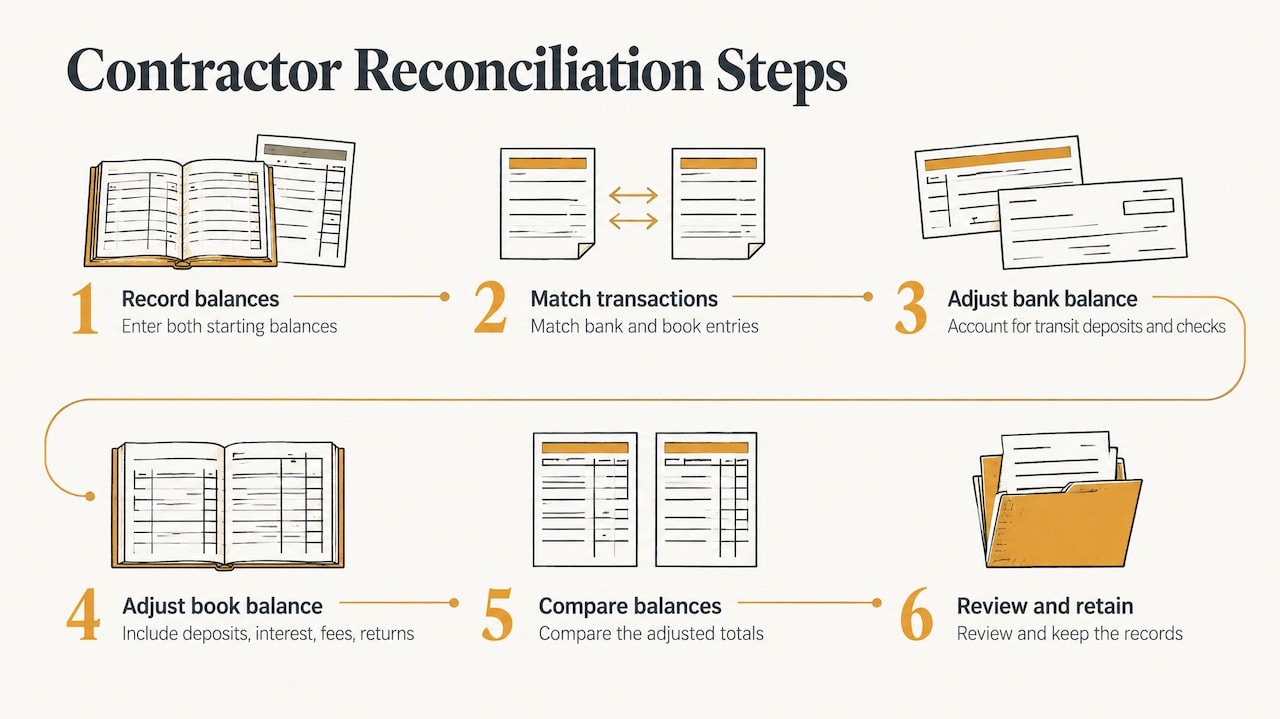
Step 1: Write down both unadjusted balances
Note the ending balance on the bank statement and the ending balance in your books for the same date. Do not touch either yet. Where it goes wrong: reconciling against a book balance that is missing a week of entries. Get your records current first. Hechito’s voice and photo capture is built to turn job details and receipts into organized records as you work, so the books are less likely to be a week behind when the statement lands.
Step 2: Mark what appears in both places
Go down the statement and tick off each transaction that also appears in your books. Customer deposits, supplier payments, fuel, tool purchases, sub checks. What remains unticked on either side is what you need to explain. Where it goes wrong: matching by amount alone. Two $1,250 deposits from different customers can hide a mistake, so match to the invoice or job too.
Step 3: Adjust the bank balance for timing
Add deposits in transit. Subtract outstanding checks. The result is your adjusted bank balance.
Step 4: Adjust the books for things the bank knows and you do not
Add direct deposits and interest the bank credited that you have not recorded. Subtract bank fees and bounced customer checks. These need real entries in your books, unlike timing items. Where it goes wrong: ignoring small recurring charges, such as monthly fees or card processing deductions, because each looks too small to matter. Together they are why a reconciliation will not close.
Step 5: Compare the two adjusted balances
They should match, with nothing left unreconciled. If they do not, look for transposed digits (a $540 entry typed as $450 is off by $90, a number divisible by nine, which is a classic sign), a transaction missing from your books, or a duplicate entry.
Step 6: Review and sign off
Have a second person look it over and sign, and keep the reconciliation with the statement. If you are a one-person shop, that second person can be your bookkeeper, your accountant, or a trusted partner. The point, per Coates’ Canons, is that the review and the saved records show the control was actually carried out.
A worked example
This is an illustration with made-up numbers, not data from a real business. A remodeler’s October statement closes like this.
| Item | Amount |
|---|---|
| Bank statement ending balance | $48,300 |
| Add: deposit in transit (customer check dropped off Oct. 31) | +$6,500 |
| Less: outstanding check to a framing sub | −$4,200 |
| Less: outstanding check to a lumber supplier | −$1,150 |
| Adjusted bank balance | $49,450 |
On the books side:
| Item | Amount |
|---|---|
| Book balance before reconciling | $49,880 |
| Less: monthly account fee not yet recorded | −$35 |
| Less: customer check returned for insufficient funds | −$395 |
| Adjusted book balance | $49,450 |
Both sides land on $49,450, so the account is reconciled. Notice what the remodeler learned along the way. The bounced $395 check means a customer still owes that amount and a collection step is due. The two outstanding checks mean $5,350 is already spoken for, even though the bank balance looks higher. If you do this at the end of every month, you also see right away when a check that was written in September is still uncashed in November.
Fixing what does not match
When a line will not reconcile, work it by cause rather than by guesswork. Ramp’s guide is not used here; instead, use this simple sort, which follows the four buckets from the JPMorgan process above.
- Timing: an outstanding check or deposit in transit. Document it and wait.
- Book-side error: a missed entry, a wrong amount, a duplicate. Correct it in your books with a proper entry dated when the transaction actually happened.
- Bank-side error: the bank posted something wrong. Contact the bank with the statement line in hand.
- Unexplained: a payment to a vendor you do not recognize, an altered check, a withdrawal nobody authorized. Stop, document it and call your bank right away.
Do not force a match by backdating or inventing a plug entry. It makes the balance agree today and makes your financials unreliable later.
One more habit helps. Keep a short list of reconciling items that are older than a few weeks, and chase each one. A customer check that never reached the bank is a collections problem. Our overdue invoice collection plan walks through that follow-up.
How often to reconcile
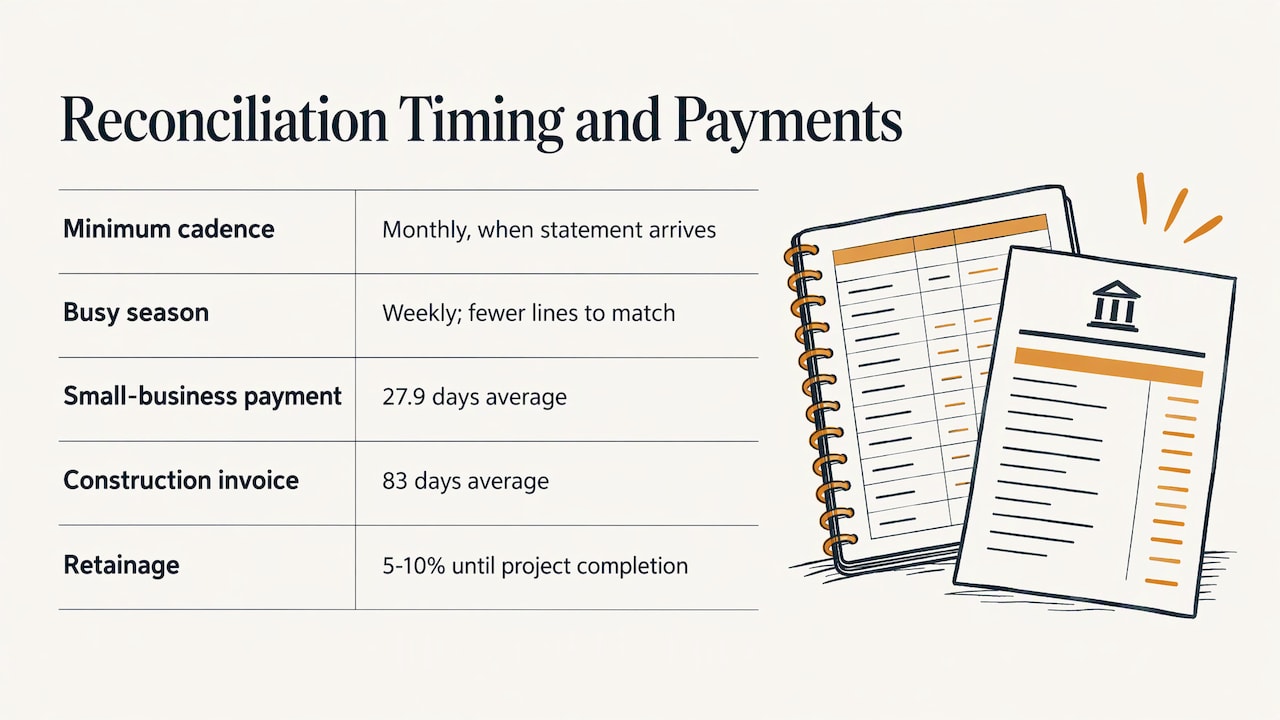
Monthly is the floor, because that is when the statement arrives. In busy season, with many jobs, draws and subs, weekly is easier than monthly, because there are fewer lines to match and mistakes are fresher in your mind. Waiting works against you: the longer a gap sits, the harder it is to remember which job a $780 charge belonged to.
Payment timing is why the habit pays off. Xero Small Business Insights data cited on Xero US’s glossary page shows US small businesses waited an average of 27.9 days to be paid in the December 2025 quarter. Construction often waits longer. A 2025 QuickBooks survey, cited by UpstreamCFO, found construction invoices take an average of 83 days to be paid and retainage holds back 5 to 10% until project completion. With waits like that, a clear picture of what has actually landed in the bank is the difference between confidently paying a sub and hoping.
Know your real spendable cash
A useful output of every reconciliation is a short cash summary:
- Start with the reconciled bank balance.
- Subtract checks that are outstanding.
- Add deposits in transit.
- Subtract bills and sub payments coming due.
What is left is the money you can really spend. It is the number to look at before you commit to a materials order or a payroll run. Our posts on cash flow in construction and accounts receivable in construction go deeper on keeping that number healthy.
Separate duties, even in a small shop
The person who pays the bills should not be the only person who reconciles the account. That separation is what makes the control work. In a crew of three, it can be as simple as the owner paying bills and the office manager or outside bookkeeper reconciling, or the other way around, with the owner reviewing and signing. Keep the signed reconciliation and the statement together in one folder, digital or paper, so you can show what was done and when.
Where the time really goes, and what to do about it
The reconciling arithmetic is the easy part. The hard part is finding the invoice, receipt or job note behind each line. Most mismatches in a contractor’s account trace back to one of these:
- A receipt that was never entered, so a card charge has no match.
- A customer payment that was never tied to an invoice.
- A sub payment with no record of which job it belongs to.
- A change order agreed on site that never made it into an invoice.
All four are capture problems, not math problems. Fix them at the source and reconciliation shrinks from an evening to a quick review. That is the idea behind bookkeeping from field capture, and it connects to job costing, because a payment matched to the right job also tells you what that job really earned.
What we think
Most tradespeople we talk to do not hate bookkeeping because it is hard. They hate it because it lands at night, after a full day, when the details have faded.
Reconciliation is only painful when the records behind it are thin. If a receipt is photographed at the supply counter, a change order is spoken into the phone on site and an invoice goes out the day the work is done, then matching the bank statement becomes a check, not a investigation.
That is why we built Hechito around capturing the job as it happens, in English or Spanish, and why it handles receipts, payment chasing and bank reconciliation instead of leaving them as a stack for later. Paperwork should keep up with the work, so you can get back to the work.
Francisco
How Hechito fits into your reconciliation routine
Hechito is a platform for contractors and tradespeople that automates quoting, invoicing and job records from voice and photo capture. It sends estimates and invoices, chases payments, manages receipts and bank reconciliation, and works in English and Spanish. It also offers virtual co-worker features for field, phone and bookkeeping tasks, available as Chalán, Lupita and Godínez.
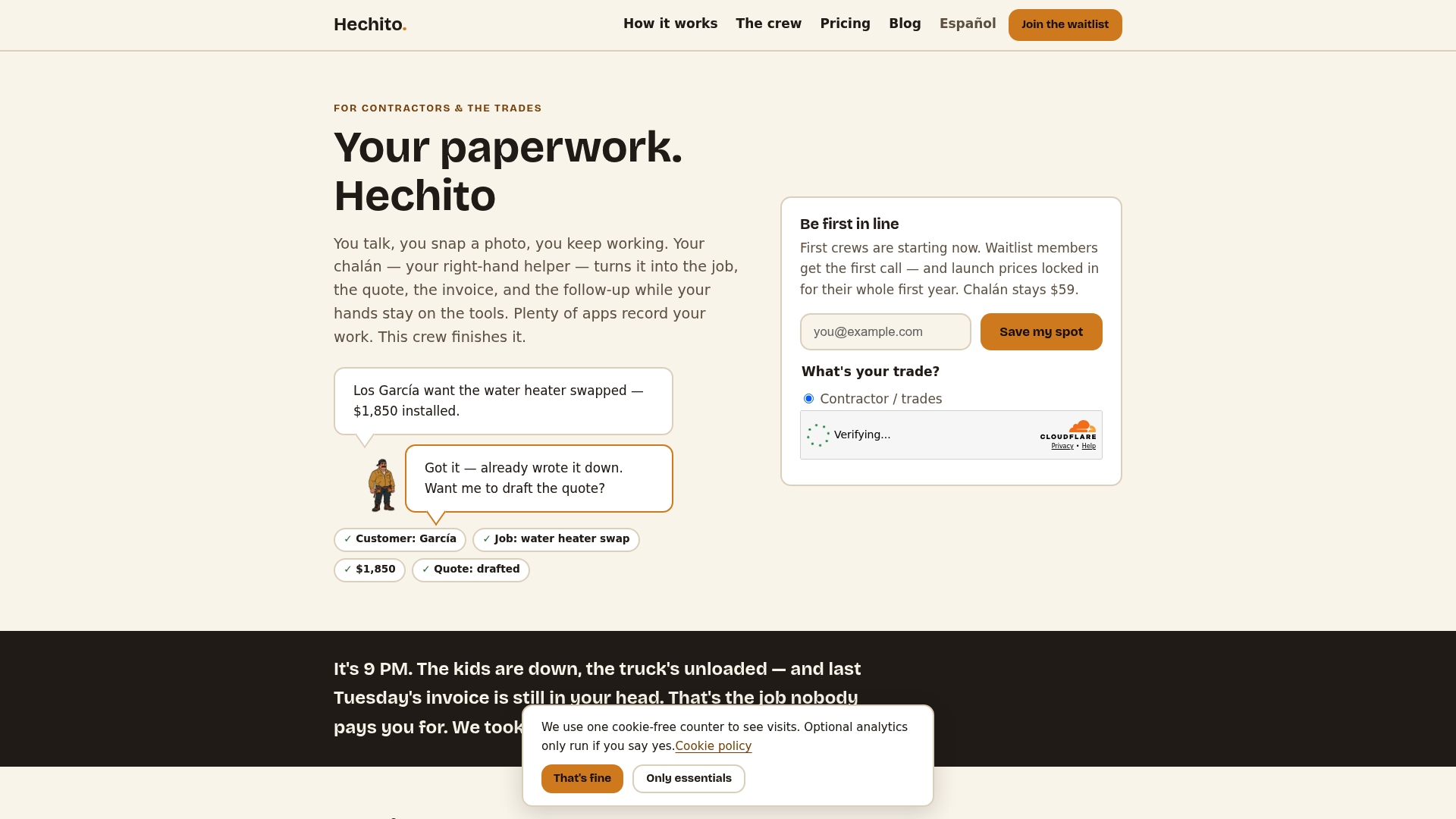
If month-end matching is where your evenings go, see how Hechito works, look at the crew options, or check the pricing page for current plans.
Your month-end checklist
Pin this next to the statement.
- Confirm all receipts, invoices and deposits for the month are entered.
- Record both unadjusted balances.
- Match every statement line to a book entry and its job or invoice.
- Add deposits in transit and subtract outstanding checks.
- Record fees, interest, direct deposits and bounced checks in your books.
- Confirm both adjusted balances agree.
- Investigate and document anything unexplained.
- Have someone other than the bill payer review and sign.
- Save the statement and reconciliation together.
- Update your cash summary and list stale items to chase.
FAQ
What are the main parts of a bank reconciliation?
In practice there are four: the bank balance, the book balance, the timing adjustments (deposits in transit and outstanding checks), and the book adjustments (fees, interest, bounced checks). When both adjusted balances agree, you are done. A signed review turns it into a record you can rely on.
Do I need to reconcile if I only use one business account?
Yes. A single account still collects customer payments, supplier charges and fees that can be recorded wrong or missed. Reconciling a single account is quicker, and it is the easiest way to keep business money separate from personal spending.
What do I do with an outstanding check that never clears?
Contact the payee to confirm they received it. If it is lost or stale, void it in your books and reissue it, so your records and your real obligations match. Keep a note of what you did and when.
Can I reconcile my accounts myself, or do I need an accountant?
Many small contractors reconcile their own accounts, because the steps are simple once records are in order. What matters is that someone else reviews the result, and that you bring your accountant in for anything unexplained or any tax question.
Sources
- JPMorgan: Bank Reconciliation, How to Reconcile a Business Bank Account
- Coates’ Canons: The Bank Reconciliation, A Key Internal Control
- OJP: Bank Reconciliation Guide Sheet
- AccountingCoach: Bank Reconciliation Explanation
- NPMCA: Bank Account and Bookkeeping
- Crestmont Capital: Late Payment Statistics for Businesses
- Xero US: What is bank reconciliation?
- UpstreamCFO: Cash Flow Problems? How AI Can Help Contractors
- Cash vs. accrual accounting for contractors
Recommended
This is the paperwork Hechito does for you — while you talk.