Accounts Receivable in Construction: How Contractors Get Paid

Accounts Receivable in Construction: How Contractors Get Paid

Accounts receivable in construction is the money customers owe you for work you have already billed. It covers progress billings, retainage and final invoices. Managing it well comes down to four habits: bill on time with complete paperwork, track what is retained, review an aging report every week, and follow up on a schedule instead of when you remember.
This guide is for contractors, trade business owners and small crews who do the work and also handle the paper. It explains where receivables sit in your books, how the cycle runs from billing to cash, and how to keep unpaid invoices from piling up.
HechitoKeep Job Details Ready for BillingHechito captures customer conversations and job details in real time, helping contractors turn field notes into organized records for quoting and invoicing.Explore HechitoTL;DR
- Construction receivables are more than invoices: they include progress billings, retained amounts and sometimes work done but not yet billed.
- Most payment delays start with incomplete paperwork: missing lien waivers, schedules of values, change orders or job photos.
- Review an aging report weekly and sort unpaid balances into current, 30, 60 and 90+ day buckets.
- Track retainage separately so you know what is owed now and what is owed at closeout.
- Capture job details when they happen, so billing is a matter of sending, not reconstructing.
Table of Contents
- What accounts receivable means on a construction job
- How the construction receivables cycle works
- The paperwork that supports a payment request
- Progress billing, retainage and change orders
- How revenue recognition connects to receivables
- Tracking overdue invoices with an aging report
- Simple KPIs worth watching
- Projecting what you will actually collect
- Habits that shorten the collection cycle
- Our perspective
- Getting the paperwork off your evenings
- FAQ
- Sources
What accounts receivable means on a construction job
In plain terms, a receivable is a customer’s debt to you. Under US GAAP, a receivable is an unconditional right to payment, meaning only the passage of time stands between you and payment. A contract asset is different: it is a conditional right. You have done work, but getting paid depends on something else, such as an approval or a milestone. It becomes a receivable once the right to payment becomes unconditional, which can happen before you issue an invoice.
That distinction matters because construction is full of in-between states. You may have framed a wall, but the draw is not approved. You may have finished the job, but ten percent is held until closeout.
A public construction company’s annual filing shows how this looks on a balance sheet. It reports trade receivables, retainage receivable, contract assets and contract liabilities as separate lines, with retainage receivable at $49.2 million at the end of 2025, up from $35.6 million a year earlier. A small contractor does not need that level of detail. But the same logic applies to you: money owed now, money held back, and work done but not yet billable are three different things.
The main buckets of construction receivables
| Bucket | What it is | When you can collect |
|---|---|---|
| Billed and due | Invoices or pay apps you have submitted, past or within terms | By the payment terms in your contract |
| Retainage | A percentage held back from each payment | Usually at substantial completion or closeout, per the contract |
| Unbilled work | Work done but not yet invoiced | After you bill, which you control |
| Disputed or pending change orders | Extra work without signed approval | After approval, which is often the slow part |
Keeping these apart tells you the truth about your cash. A big receivables number can hide the fact that half of it is retainage you will not see for months.
How the construction receivables cycle works
The cycle has five steps, and delays can creep in at every one.
- Contract and terms. The agreement sets the billing schedule, payment terms, retainage percentage and what documents each bill needs. Vague terms are the root of most slow payments. Our invoice checklist on contractor payment terms covers what to spell out.
- Work and documentation. Daily reports, photos, material receipts and signed change orders are the evidence behind every bill.
- Billing. You send an invoice, or on larger jobs a pay application, for the work completed in the period.
- Review and approval. The owner, general contractor or architect checks the bill. This is where missing paper stops the clock.
- Payment and reconciliation. Money arrives, you match it to the invoice, and you update the balance. What stays unpaid moves into collections follow-up.
The fastest way to shorten the cycle is not chasing harder at step five. It is cleaning up steps two and three so the bill is approved the first time.
The paperwork that supports a payment request
On commercial and larger residential jobs, contractors generally do not just send an invoice. They submit a pay application. AIA’s guidance on pay apps lists the standard package: the G702 application, invoices, continuation sheets, a schedule of values, subcontractor and supplier lists, relevant change orders or directives, and daily reports or photos. G706 and G707 are standard at closeout. Lien waivers are often required, and the guidance says they are best submitted together with each application.
A few practical points follow from that list:
- Match the schedule of values. Your percent complete on each line should agree with what the reviewer can see on site.
- Attach change orders. Extra work without a signed change order is the classic disputed receivable.
- Send waivers with the bill. Submitting them later gives the reviewer a reason to hold the payment.
- Include photos and daily logs. They answer “was this done?” before anyone asks. Our guide to daily construction logs shows seven fields worth capturing, and the piece on verifying draws with field photos shows how photos back up a payment schedule.
Smaller jobs often use a simpler invoice, but the habit holds: the more evidence travels with the bill, the less back-and-forth it takes to get paid.
Progress billing, retainage and change orders
Progress billing
Progress billing means you invoice as work advances instead of once at the end. It keeps cash moving and keeps your exposure small. Each bill adds a receivable, so the volume of documents rises too. Our article on progress billing in construction walks through the rhythm.
Retainage
Retainage is a portion of each payment the customer holds back until the job reaches a defined stage. A pay application typically shows the retainage withheld next to prior payments and the amount requested, so retainage directly reduces the cash you receive on each bill. It stays on your books as a receivable, but you cannot spend it. Track it on its own line and put the release conditions on your calendar. We cover this in detail in retainage explained.
Change orders
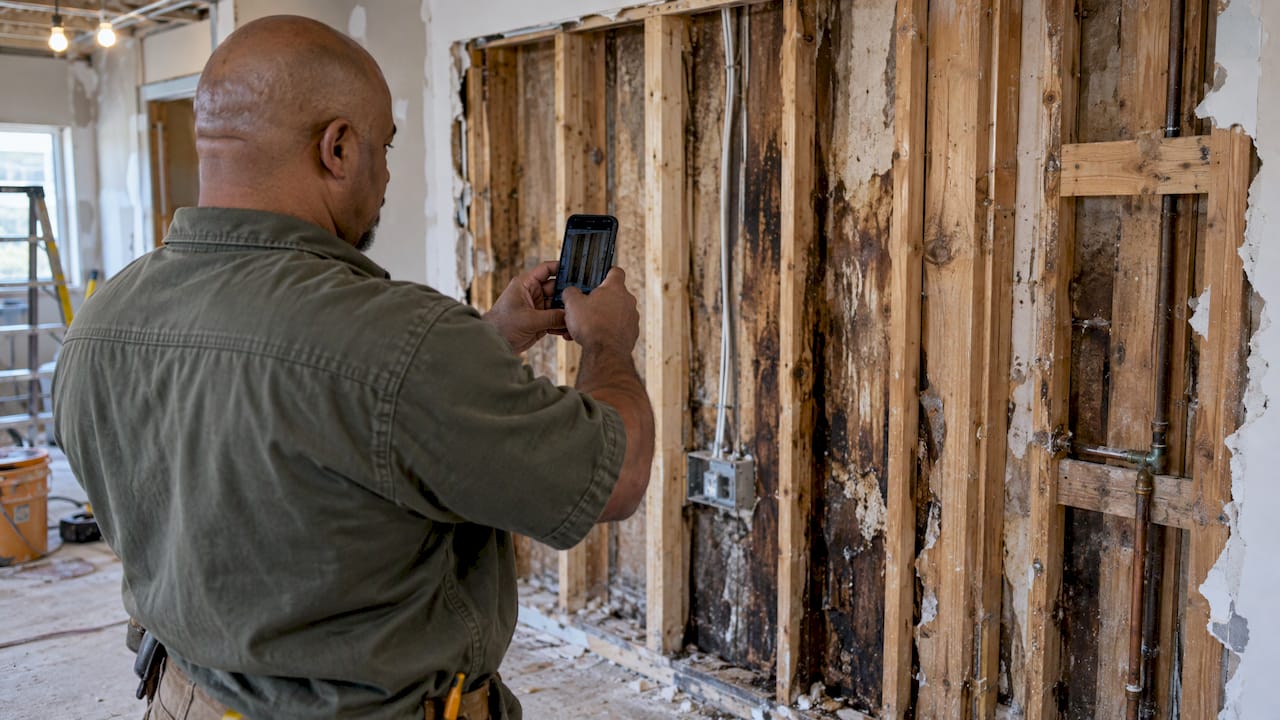
Change orders turn extra work into billable work. The rule is simple: no signed approval, no assumption of payment. Capture the request when the customer says it, with the scope, the price and a photo of the condition, then get it signed before you start.
Lien waivers
Waivers are the paperwork that trades release of lien rights for payment. Requirements and forms vary by state, so check your state’s rules and your contract. For the deadline-sensitive parts, a construction attorney in your state is the right person to ask.
How revenue recognition connects to receivables
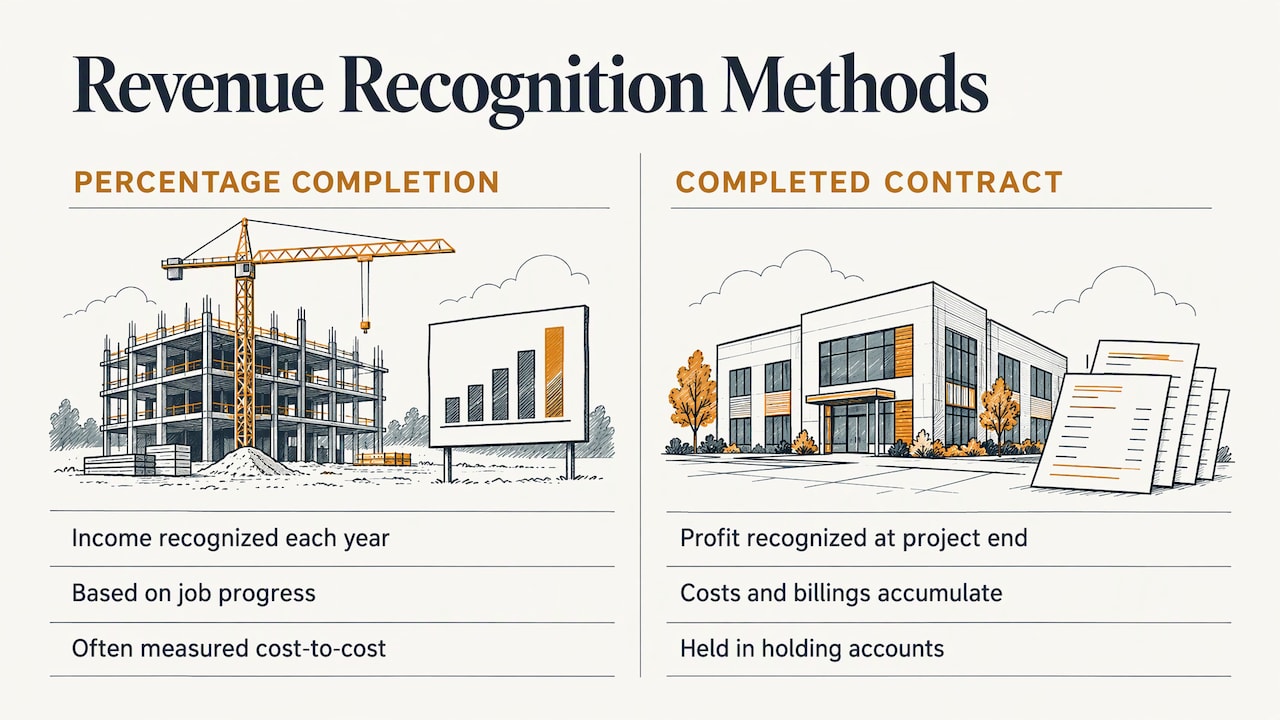
If a bookkeeper or CPA handles your books, they may talk about when revenue is recorded. Two methods come up often. With percentage-of-completion, income is recognized each year based on how far along the job is, often measured by cost-to-cost. With completed-contract, costs and billings accumulate in holding accounts, and profit is recognized at the end of the project.
You do not need to choose between them on your own. Which method fits depends on your size, your contracts and your tax situation, so ask your CPA. What you do need is to understand that revenue recognized and cash collected are different clocks. Revenue can be recorded while the receivable is still outstanding, which is why a profitable job can still strain your bank balance. For more on that gap, see cash flow in construction.
Tracking overdue invoices with an aging report
An aging report lists every unpaid invoice grouped by how many days it is past due. One construction accounting guide describes it as the report that shows all unpaid invoices by days past due, used to track what is outstanding.
Most reports use the same buckets:
| Bucket | What it signals | What to do |
|---|---|---|
| Current | Within terms | Nothing yet, confirm it was received |
| 1 to 30 days | Probably an approval or processing delay | Friendly reminder and ask what is needed |
| 31 to 60 days | Something is stuck | Call, check for missing documents or waivers |
| 61 to 90 days | Real risk | Written notice, involve the decision maker |
| 90+ days | Serious exposure | Formal demand, review lien and legal options with an attorney |
Review it weekly, not monthly. A thirty-day-old problem is cheap to fix. A ninety-day-old one is expensive. If you want a step-by-step routine, read our invoice aging process guide.
Simple KPIs worth watching
You do not need a dashboard full of ratios. Three numbers cover most small contractors:
- Days sales outstanding (DSO). Divide your receivables by your credit sales for a period, then multiply by the number of days in that period. It tells you the average days it takes you to collect. Compare it to your stated terms.
- Percent over 60 days. The share of your receivables sitting in the two oldest buckets. If it climbs, collections are slipping.
- Retainage as a share of receivables. It shows how much of your “owed” money is locked until closeout.
The point is the trend. Pick the same day each week or month, record the numbers, and watch which way they move.
Projecting what you will actually collect
To forecast cash, start with your receivables and remove anything you already know will not be paid. Then apply a collection estimate to each aging bucket, using your own history: for example, what share of invoices under 30 days old usually gets paid within the next month, and what share of 90+ day invoices ever does. Add what you expect from new billings and you have a rough cash forecast.
The estimates are only as good as your history, so start simple. After a quarter of tracking, your own numbers will be better than any rule of thumb.
Habits that shorten the collection cycle
- State terms on every bill. Due date, accepted payment methods and any late-payment terms in your contract.
- Bill on a fixed day. Weekly or biweekly, the same day, so customers expect it.
- Send complete packages. Waivers, change orders, photos and logs together.
- Follow up on a schedule. A reminder before the due date, one on the day, and another a week later. Our overdue invoice collection plan lays out the sequence, and invoice chase automation shows how to stop doing it by hand.
- Reconcile quickly. Match payments to invoices as they land so your aging report is accurate. Good bookkeeping for contractors depends on it.
- Know your customer. For larger jobs, check how the customer or general contractor pays before extending terms.
Our perspective
Most contractors we talk to do not have a collections problem. They have a memory problem. The conversation where the customer approved extra work happened in a driveway. The photo of the finished rough-in is on a phone. The material receipt is in a truck door. By the time the invoice is due, nobody can reconstruct it, and the customer knows it.
That is why we built Hechito around capturing the job as it happens. You talk, you snap a photo, and the details are filed. Quotes, estimates and invoices come out of that record, and the follow-up on late payments does not depend on you finding time after dinner. It works in English and Spanish, so a crew that speaks both does not have to translate paperwork by hand.
Our view is simple: receivables get healthy upstream. If the record is complete when the work is done, billing is fast, approvals are quicker and the aging report stays short.
Francisco
Getting the paperwork off your evenings
If billing and follow-up are what eat your nights, Hechito is built for that. You describe the job by voice and photo from the site, and it turns that into organized records, estimates and invoices, then chases payments and helps with receipts and bank reconciliation. Our crew members, Chalán, Lupita and Godínez, each cover a different part of the work, from the field to the phone to the books. See how it works on our contractors page or meet the crew.

You can also read how Hechito works or check the pricing page.
FAQ
What is accounts receivable in construction?
It is the money customers owe you for work you have billed or earned. It includes progress billings, retainage held back until closeout and, depending on your accounting, work done but not yet invoiced. Tracking these separately shows how much cash you can actually expect soon.
What documents do I need to get a pay application approved?
On larger jobs, the standard package includes the application form, a continuation sheet, a schedule of values, change orders, lien waivers, and daily reports or photos. Your contract lists the exact requirements. Sending everything at once avoids most holds.
How often should I review my aging report?
Weekly is a good rhythm for a small contractor. It catches invoices in the 30-day bucket before they turn into 60- and 90-day problems. Pair it with a set follow-up schedule so each late invoice gets a defined next step.
Is retainage part of accounts receivable?
Yes, it is usually shown as a retainage receivable, separate from regular trade receivables. You are owed it, but only once the release conditions in your contract are met. Keep it on its own line so it does not inflate your sense of available cash.
When should I involve an attorney about unpaid invoices?
When an invoice is far past due and your reminders have gone unanswered, or when lien deadlines are approaching. Lien and notice rules differ by state, so a construction attorney in your state can tell you the deadlines that apply.
Sources
- SEC filing: receivables, retainage and contract balances (FY2025)
- PwC: presenting contract-related assets and liabilities under ASC 606
- AIA Contracts: lien waiver best practices for pay apps
- Revenue recognition: accounting principles and methods
Recommended
This is the paperwork Hechito does for you — while you talk.

On iPhone? Coming very soon to the App Store.