Line Items in Estimates: What to Include and How to Write Them
Line Items in Estimates: What to Include and How to Write Them
A good estimate line item says what work is being done, how much of it, in what unit, at what cost, and what the line adds up to. Get those five things on every line and your customer can follow the price, you can defend it, and nobody argues about “drywall work” three weeks into the job. This guide walks through each part of a line, which costs deserve their own line, how to handle options and exclusions, and where most contractors lose money by leaving a line off.
HechitoKeep Estimate Details OrganizedCapture job details with voice and images, then turn them into organized records for quoting and invoicing in English or Spanish.VisitTL;DR
- Every line should carry a description of real work, a quantity, a unit of measure, a unit cost and a line total. Add markup and labor hours where your pricing needs them.
- Break out labor, materials, equipment and subcontractor work separately so each number can be traced.
- Put permits, delivery, disposal, allowances and contingency on their own lines. A missing line usually gets paid out of your profit.
- Show optional work apart from the base price and write exclusions as plainly as inclusions.
- Capturing line items by voice and photo on the job is faster than rebuilding them at the kitchen table at night.
Table of Contents
- What a line item is and why it matters
- The anatomy of a good line
- Which costs get their own line
- Putting lines in a customer-ready order
- Showing optional work separately
- Allowances, contingencies and exclusions
- Common line-item mistakes
- Where the lines actually come from
- Perspective
- Put it to work with Hechito
- FAQ
- Sources
What a line item is and why it matters
A line item is one row of your estimate: one piece of work or one cost, priced on its own. The estimate is the sum of those rows, plus taxes, overhead and profit.
There are two audiences for those rows. The customer reads them to understand what they are buying. You read them later, when a job runs over and you need to know why. The Associated General Contractors’ estimating course makes the second point directly: documentation exists to catch errors and to compare against future jobs, so a more detailed estimate makes the next one easier to price.
The same course says an estimate should be transparent enough that any knowledgeable person can trace where each number came from, with assumptions spelled out. That is a good test for every line you write: could someone else see how you got this number?
The anatomy of a good line
The American Society of Professional Estimators describes a uniform estimate format with these parts: CSI section (the standard industry numbering system for types of work), a work breakdown structure when used, a description, quantity, unit of measure, material cost, labor hours, labor cost, equipment cost, subcontract cost where it applies, and total cost.
You do not need the full commercial format for a bathroom remodel or a service call. A small-job version looks like this:
| Part | What goes in it | Example |
|---|---|---|
| Description | The actual work, in a sentence | Install, tape, finish and sand drywall in the hallway |
| Quantity | How much | 800 |
| Unit | What you measure it in | sq. ft. |
| Unit cost | Your cost per unit, labor and material | Your own number |
| Markup | Your margin, if shown per line | Your own percentage |
| Line total | Quantity times unit cost, plus markup | Calculated |
Write the description like a scope
A description such as “drywall work” tells the customer nothing and tells you nothing when you reopen the file in six months. Construction Lead Pro suggests describing a real piece of work, for example installing 800 square feet of drywall, taping, finishing and sanding it. That one sentence also fixes the scope: taping and sanding are in, painting is not mentioned and therefore not promised.
Use the unit the trade uses
Pick the unit that matches how the material is bought and the work is measured. The AGC module lists common ones: concrete in cubic yards, roofing in squares, countertops in linear or square feet, rebar in pounds, trusses by each. It also shows the arithmetic that turns a quantity into a schedule: 50 cubic yards at 5 cubic yards an hour is 10 hours.
If your unit is wrong, your math is wrong. Pricing tile per box when you install it per square foot is how waste disappears from a price.
Build the unit cost honestly
ASPE says a good material unit cost accounts for the purchase price, potential escalation, waste, order quantity, shipping and sales tax. It also notes that most estimators keep a database of unit costs for standard items and refresh it monthly, quarterly or annually.
Labor is harder. The same guide calls worker or crew productivity “the great variable.” Price labor at your average day, not your best day. If you want a deeper walkthrough of building prices that hold up, our piece on unit cost pricing in construction goes line by line.
Which costs get their own line
Contractors often fold things together to keep the estimate short. That shortens the page and shrinks the margin. The Associated Builders and Contractors define direct costs as material, labor (plus burden such as FUTA, SUTA, FICA and workers’ comp), equipment and subcontractor costs, separate from indirect costs. Those four are the backbone of the estimate.
A complete estimate also separates:
- Labor by trade. Home Services Co advises showing hours and rate, or a flat price with the labor assumption noted.
- Materials with description, quantity and cost.
- Permit and inspection fees, stated explicitly.
- Equipment rental and disposal fees.
- Subcontractor costs, listed apart from your own work, as Romero Construction describes.
- Overhead and profit, shown openly or built into unit prices.
- Contingency for unknowns and allowances for items the customer has not picked yet.
Construction Lead Pro warns that a missing permit, delivery charge or allowance can end up paid from the job’s profit. That is the plainest reason to give each of them a line.
Markup and waste
Show markup in the way your customers will accept. Some contractors put it on every line, others show a single overhead and profit line, others bake it into unit prices. Home Services Co describes a typical material markup of 15 to 30 percent and says markups above 40 percent invite questions. If you want benchmarks for your own pricing, see our guide to profit margin in construction.
Waste belongs in the quantity or the unit cost, never in your head. Toricent Construction’s estimating guide recommends accounting for material waste of 5 to 10 percent and a contingency of typically 5 to 15 percent, depending on risk. Pick numbers from your own past jobs and write them where the customer can see the reasoning.
Putting lines in a customer-ready order
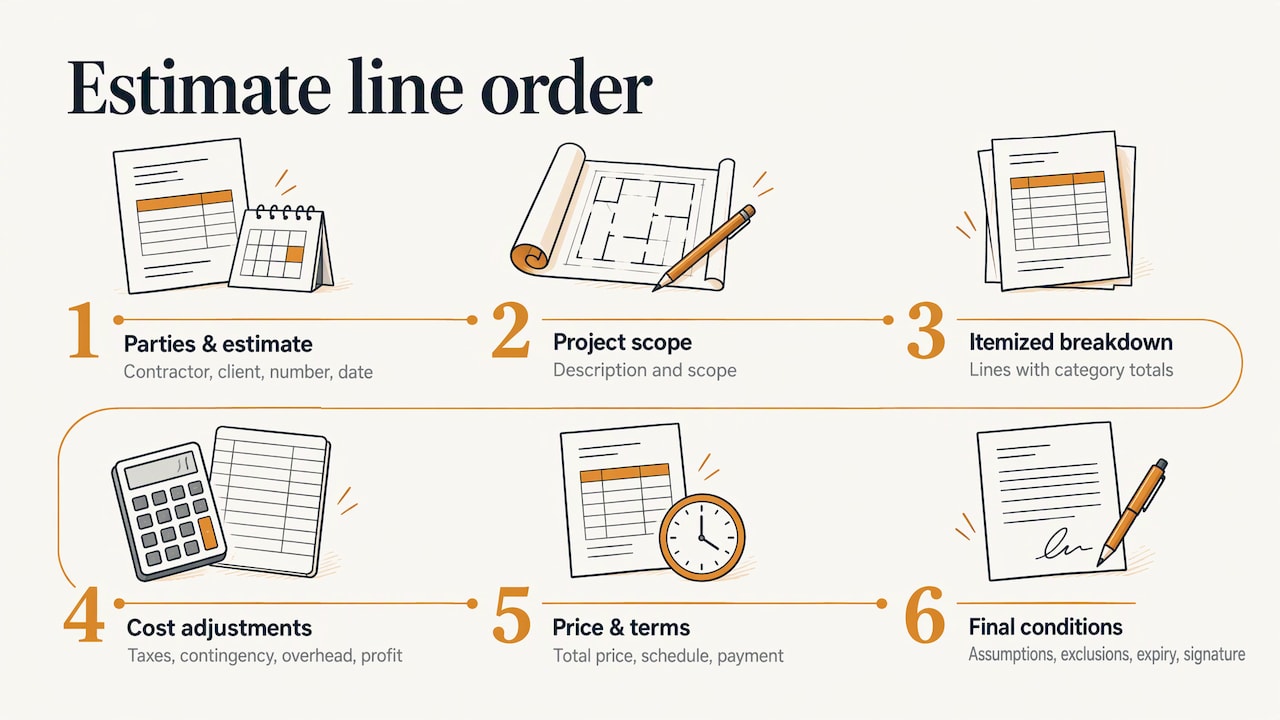
Order matters as much as content. Construction Lead Pro recommends this sequence: contractor and client details with the estimate number and date, project description and scope, the itemized breakdown with category totals, taxes, contingency, overhead and profit, total price and schedule, payment terms, assumptions, exclusions and expiry date, then an acceptance signature.
Group lines by phase or by trade, give each group a subtotal, and keep the grand total at the bottom. A customer who sees “Demolition,” “Framing,” “Electrical” and “Finish” with a subtotal each can find the part they want to question without questioning the whole bid.
If you want a starting layout, our article on construction estimate templates covers what to include and how to use one. For the scope paragraph that sits above your lines, see construction scope of work checks.
Showing optional work separately
Options should never be buried inside the base price. AppMaster’s estimate guide explains why: customers often approve the main job right away but need time to decide on extras. Keep add-ons separate, label them in plain words instead of “Option B,” and let the total update as each one is chosen.
A clean layout has three groups: included, optional, and not selected. Each optional line gets the same anatomy as a base line: description, quantity, unit, cost. That way “upgrade to quartz” or “add under-cabinet lighting” is a decision the customer can make in one read, and the signed estimate records exactly what they chose. It also keeps your base price comparable when the customer is collecting several bids.
Allowances, contingencies and exclusions
These are three places where estimates go wrong. Romero Construction notes that a low allowance, a thin contingency and a broad exclusion list together turn an affordable-looking bid into a mid-build change order.
Write each one so it cannot be misread:
- Allowance: the dollar amount for something not yet chosen, such as fixtures or tile, and what happens if the customer’s pick costs more. State whether the overage carries markup.
- Contingency: a percentage held for unknowns, with a sentence on how it is used.
- Exclusion: what is not included, in the same plain voice as the scope.
Procedura’s author puts it well: exclusions are the boundary that makes everything inside the scope billable and everything outside a change order. Their suggested block is five lines on every estimate, such as “Includes: drywall patch and texture to match existing. Excludes: painting of patched areas.” See their estimating structure for the full approach. For more on recording assumptions, exclusions and supporting calculations so the estimate survives handoff, documenting assumptions and exclusions is worth reading alongside your own paperwork.
A missing line is rarely a favor to the customer. As Romero puts it, it is an unexpected cost waiting for later, and savvy customers ask why a standard category is absent. Answer that question before it is asked.
Common line-item mistakes
- Vague descriptions. “Electrical” or “misc” cannot be priced, defended or compared.
- Best-day labor. Procedura lists pricing labor at your fastest speed as a typical estimating error.
- Round-number material allowances that forget fasteners, fittings and consumables.
- Scope discussed but never written. If you agreed to it at the walkthrough, it needs a line.
- Forgotten soft costs: permits, delivery, tax, disposal and cleanup.
- No units. A quantity without a unit is a guess.
- Wrong unit. Pricing by the piece what you buy by the board foot.
Toricent frames a comprehensive estimate as one where you can defend every line item, not just get the numbers right. A quick check before sending: for each line, ask what you would say if the customer pointed at it and asked why.
Where the lines actually come from
The slow part of line items is not the format. It is remembering everything you saw and said at the walkthrough. The customer mentions the second bathroom fan, you spot rotted sill plate behind the tub, and by evening half of it is gone from your head.
The fix is to capture each line as it happens. Photos of the existing conditions and a spoken note per item give you the description, the quantity and the scope in the moment. Our guide to estimating from photos shows how contractors turn site images into measurable lines.
Once the estimate is approved, the same lines should carry through to the invoice without being retyped. Our estimate to invoice workflow lays out the seven steps, and the difference between the two documents is covered in estimate vs. quote.
Perspective
We built Hechito because the paperwork is where good tradespeople lose their evenings. Line items are a perfect example: everybody agrees a detailed estimate protects the job, and almost nobody wants to type one after ten hours on site.
Our view is that the line item should be born at the moment you see the work. You talk through what you are looking at, you take the photo, and the estimate fills in with the description, the scope and the details you would otherwise forget. That is why Hechito captures voice and images in real time and turns them into organized records, quotes and invoices without extra typing.
It also works in English and Spanish, and you can speak either or both. The document comes out cleanly in the language the customer needs. A crew that talks Spanish on site and a customer who reads English should not mean a second round of paperwork.
A detailed estimate is not extra work. It is the job done once, correctly, so that the invoice, the change order and the payment all follow from it.
Francisco
Put it to work with Hechito
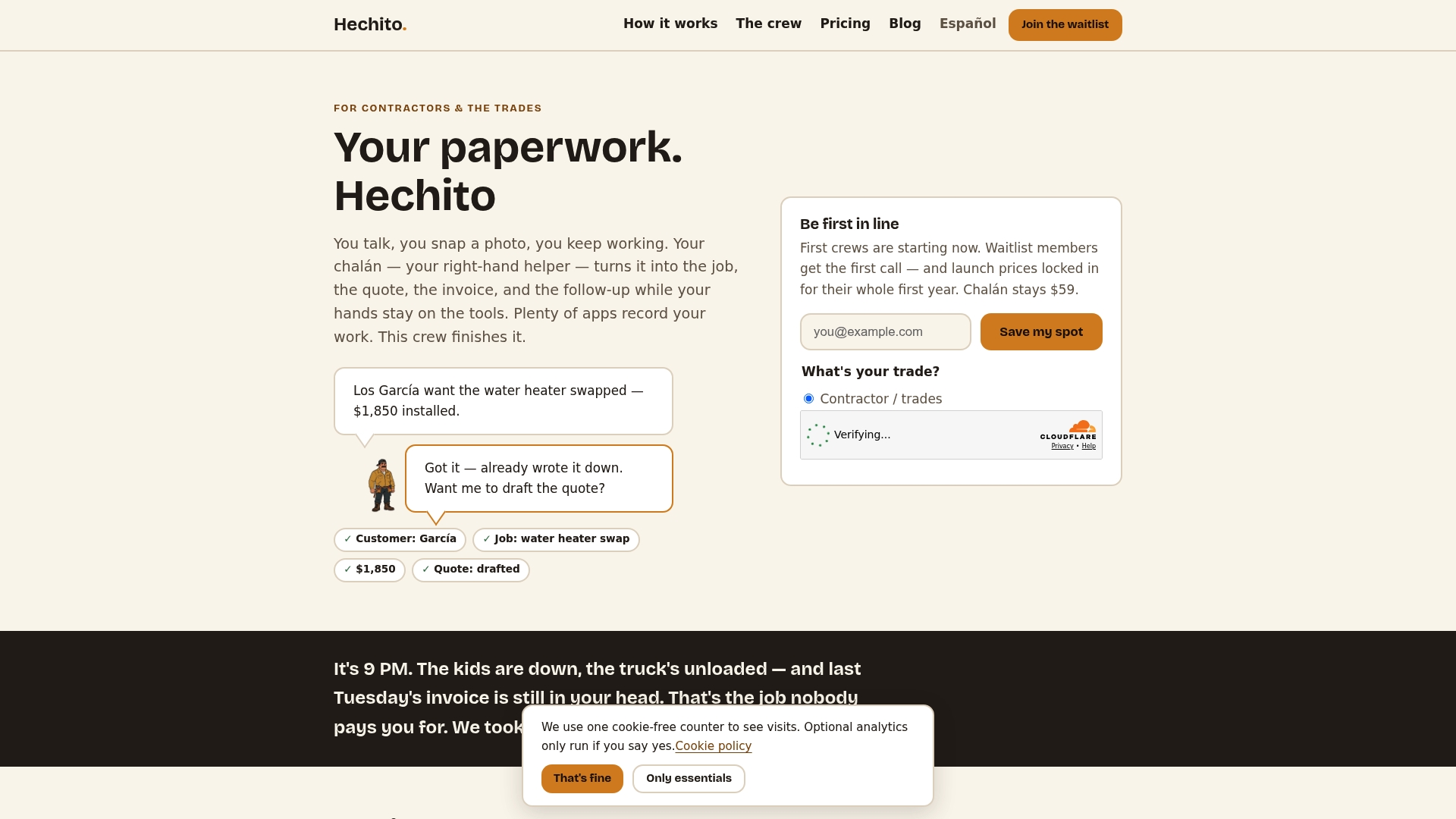
If you would rather talk your way through the walkthrough than type it up later, Hechito is built for that. It captures customer conversations and job details by voice and photo, turns them into organized records, sends estimates and invoices, and chases payments. It works as a virtual co-worker for field, phone and bookkeeping tasks, available as Chalán, Lupita and Godínez. See the crew options, check pricing, or look at how Hechito works for contractors.
You can also see how it handles bilingual jobs in our article on dual language estimates from voice and photos.
FAQ
What does “line item price” mean?
It is the price of one specific piece of work or cost on your estimate, calculated from its quantity and unit cost. Adding all line item prices, plus overhead, profit and tax, gives the total. Showing them lets the customer see what each part costs.
How detailed should each line be?
Detailed enough that someone who was not at the walkthrough could tell what is included and where the number came from. Use a real description, a quantity and a unit. For small jobs, a flat price per line with the labor assumption noted is acceptable.
Should I show markup on every line?
There is no single rule. Some contractors show markup per line, others show one overhead and profit line, and others build it into unit prices. Pick one method, apply it the same way on every estimate, and be ready to explain it.
How do I handle things the customer has not chosen yet?
Use an allowance: a stated dollar amount for the item, with a note on what happens if the final selection costs more. Keep real add-ons in a separate optional section so the base price stays clear.
Sources
- AGC Construction Estimating Course, Module 1
- ASPE, The Essentials of Successful Estimating
- Construction Lead Pro, How to Write a Construction Estimate
- ABC Estimating, July 2013
- Home Services Co, How to Read a Contractor’s Estimate Line by Line
- Romero Construction, Why Itemized Estimates Matter for Homeowners
- Toricent Construction, Complete Guide to Construction Estimating
- AppMaster, Scope-to-Estimate App for Custom Project Quotes
- Procedura, Why Contractor Estimates Miss
- Construction Closeout Documents: What Owners Must Collect
Recommended
This is the paperwork Hechito does for you — while you talk.