Unit Cost Pricing in Construction: Build Prices That Hold
Unit Cost Pricing in Construction: Build Prices That Hold
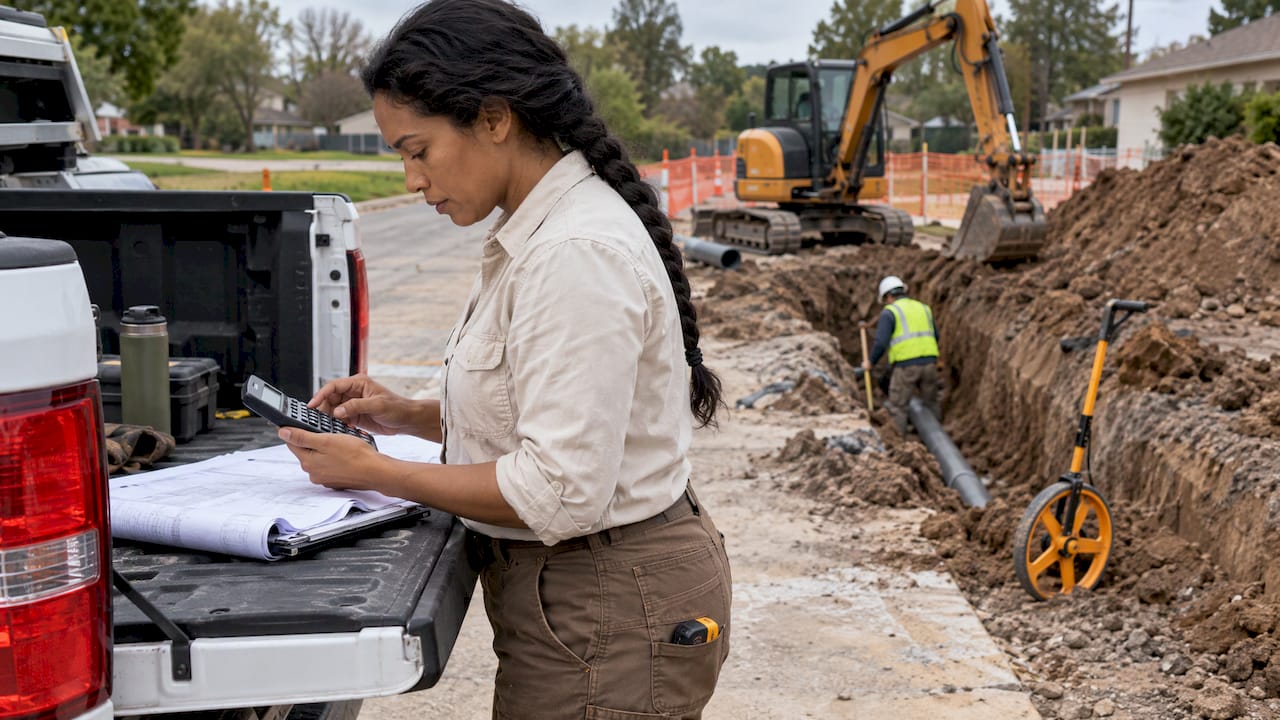
Unit cost pricing means breaking a job into repeatable units (a square foot of drywall, a cubic yard of concrete, a linear foot of pipe), working out what each unit costs you, and then adding overhead and profit to get the price you quote. Do it well and every estimate comes from the same method. Do it badly and you eat the difference on every job.
This guide walks through the full chain: what a unit cost is, how it differs from a unit price and a unit price contract, how to build one, where markup fits, and how to document it so a customer, an inspector or your own bookkeeper can follow your math.
HechitoKeep Job Details With Your EstimateHechito captures customer conversations and job details in real time, helping contractors turn project notes into organized records without extra typing.Visit HechitoTL;DR
- A unit cost is what a unit of work costs you. A unit price is what you charge for it. The gap between them has to cover overhead and profit.
- Build each unit from materials, labor, equipment, time, overhead and profit, then multiply by measured quantities.
- Markup is applied on top of cost; margin is measured against the price. A 25% markup is a 20% margin, not 25%.
- Write down quantities, units, drawing references and assumptions at the moment you make them, and your estimate becomes defensible.
- Mobilization and contingency have no universal percentage. Price them per project.
Table of Contents
- Unit cost, unit price and unit price contract: three different things
- How to build a unit cost from scratch
- A worked example
- Overhead, markup and margin
- Mobilization and contingency: no fixed percentages
- Document every unit price
- Keeping unit costs current
- Perspective
- Put your unit prices to work with Hechito
- Common unit pricing mistakes
- FAQ
- Sources
Unit cost, unit price and unit price contract: three different things
The three terms get mixed up, and the mix-up costs money.
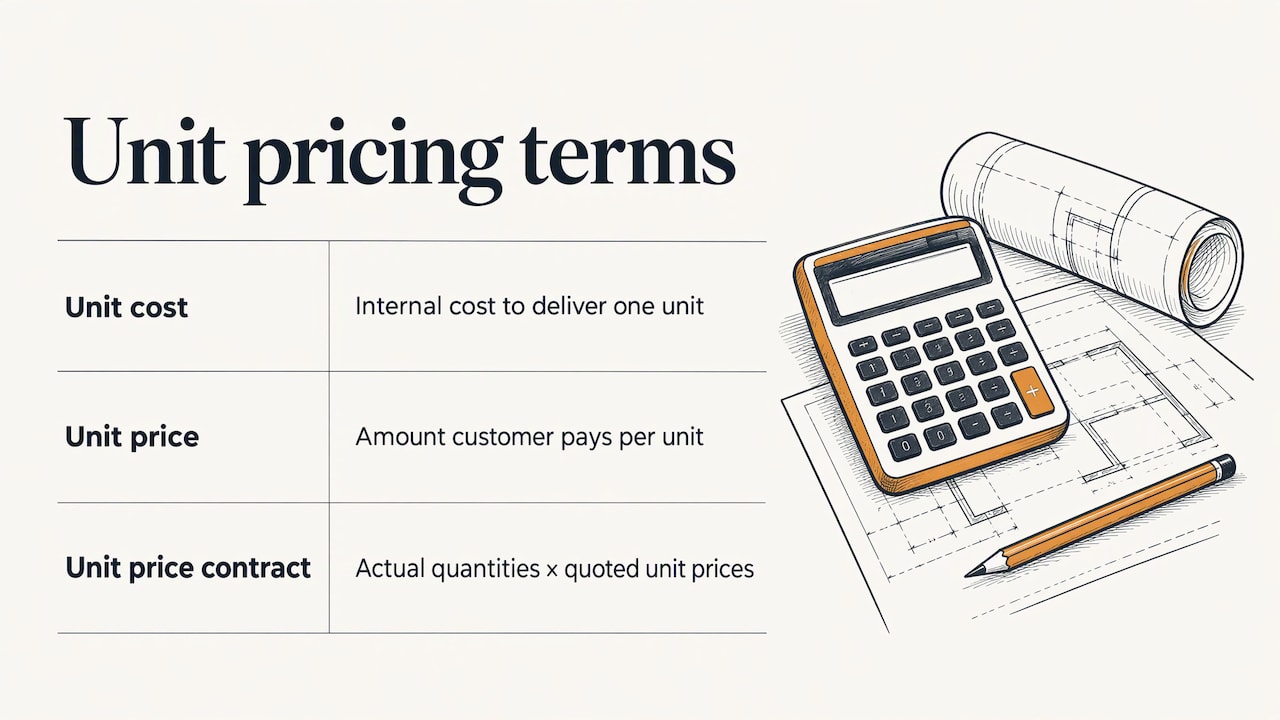
Unit cost is internal. Investopedia describes it as the total expenditure to produce, store and sell a single unit of a product or service, including fixed and variable costs. In a contractor’s shop, that is what one square foot of tile or one linear foot of trench actually costs you to deliver.
Unit price is external. It is the amount the customer pays per unit. One plain-language comparison puts it this way: the customer sees the unit price, while unit cost usually stays inside the company and is used to judge profitability.
A unit price contract is a way of contracting. According to Carnegie Mellon’s construction pricing text, contractors submit unit prices for tasks whose quantities are uncertain, and total payment is based on the actual quantities multiplied by the quoted unit prices. That is different from a lump-sum bid, where the total price is fixed up front.
So you can use unit cost pricing inside a lump-sum job (to build your number) or inside a unit price contract (where the unit prices become the contract). Either way, the quality of your unit cost decides whether you make money.
When a unit price contract fits
Unit price work suits jobs where you cannot know the final quantity until the work is done: excavation, rock removal, paving, piling, some concrete flatwork and repair work. The customer pays for what is actually installed, and you are protected if quantities grow. If quantities shrink, your fixed costs still have to be covered, so your unit prices need to carry a fair share of overhead and mobilization.
How to build a unit cost from scratch
The Idaho Transportation Department’s Construction Cost Estimating Guide lays out the logic public agencies use: break each work item into materials, equipment, labor, time, overhead and profit, then build estimates from work-item quantities and unit prices. Private contractors can use the same skeleton.
Step 1: Define the unit
Pick a unit that matches how the work is measured and how the customer thinks about it: square feet of drywall, linear feet of fence, each for a door, cubic yards of concrete. A unit should be small enough to repeat and large enough to be meaningful. If two crews would measure it differently, the unit is too vague.
Step 2: Price the materials
Material cost is more than the sticker price. The ASPE paper The Essentials of Successful Estimating says material unit cost should consider the cost to purchase, potential escalation, waste, order quantity, shipping and sales tax. Leave out waste or delivery and your unit cost is low on every job.
Step 3: Price the labor
Labor is hours per unit times your loaded hourly rate. Loaded means wages plus the burden you pay on top: payroll taxes, insurance, benefits, and paid time you cannot bill. Track real hours per unit from past jobs. Your own production rates beat any published average because they reflect your crew, your methods and your typical site conditions.
Step 4: Add equipment
Count owned or rented equipment per unit, including fuel, delivery and any operator time you did not already count as labor. For small tools, many contractors fold the cost into overhead instead of pricing it per unit. Pick one approach and stay consistent.
Step 5: Multiply by quantity
Total cost for a work item is unit cost times takeoff quantity. The ITD guide notes that material takeoffs should identify the drawing sheets they came from, which makes quantity errors easy to trace later.
A worked example
These figures are illustrative, not market prices. Use your own numbers.
Say you hang and finish drywall and price per 100 square feet.
| Component | Basis | Cost per 100 sq ft |
|---|---|---|
| Materials | Board, mud, tape, screws, including waste and delivery | $62.00 |
| Labor | 3.5 hours at a $38.00 loaded rate | $133.00 |
| Equipment | Lift rental and consumables, spread per unit | $5.00 |
| Direct unit cost | $200.00 | |
| Overhead and profit | 20% markup on cost | $40.00 |
| Unit price | $240.00 |
A 1,200 square foot job is 12 units, so the quote is 12 x $240.00 = $2,880.00. Your direct cost is 12 x $200.00 = $2,400.00.
Notice what the example shows. The customer sees $2.40 per square foot. You see $2.00 of cost and $0.40 left to pay for the truck, the insurance, the office and your own income.
Overhead, markup and margin
This is where most small contractors lose money without noticing.
Overhead is every cost that is not tied to one job: insurance, vehicles, software, phone, accounting, licenses, the time you spend quoting. You have to recover it somewhere, and unit prices are the usual place.
Markup is a percentage added to cost. Margin is the share of the final price that is profit (or, with overhead included, what is left after direct costs). They are not the same number.
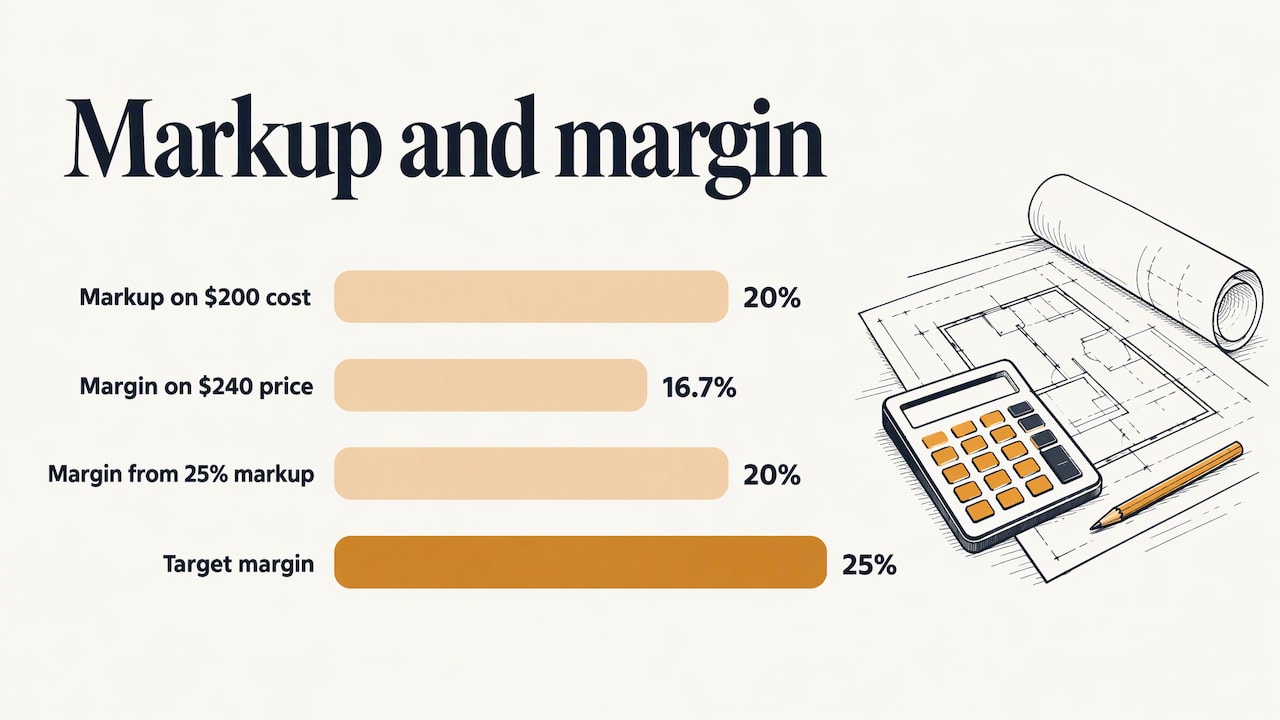
Using the example above: cost is $200.00 and price is $240.00. The markup is $40.00 / $200.00 = 20%. The margin is $40.00 / $240.00, about 16.7%.
This matters in reverse. If you want a 25% margin and you add a 25% markup, you land at only 20%. To hit a target margin, divide your cost by (1 minus the margin): for a 25% margin on $200.00 of cost, price = $200.00 / 0.75 = $266.67. For benchmarks and how to pick a target, see our guide to profit margin in construction.
Where to set your markup
There is no single correct percentage. Your markup should come from your actual overhead: add up a year of non-job costs, divide by a year of direct job costs, and you have the overhead rate your units must carry before any profit. Profit goes on top, sized to the risk and the market. Revisit the number every year, since insurance, fuel and labor burden all move.
Mobilization and contingency: no fixed percentages
Two items trip up unit-based estimates because they do not fit neatly into a unit.
Mobilization is getting people, equipment and materials to the site and set up. The ITD guide says mobilization should reflect project location, complexity, specialized equipment, types of work and season, and that there are no true rules for what percentage or value to use on each project. A job 90 miles away in January needs more than a job two miles away in May.
Price it as its own line, built from the actual trips, equipment moves, temporary facilities and setup time. Disposal is part of that picture too: when a job generates demolition waste, construction debris removal costs belong in the estimate as their own line rather than being buried in labor.
Contingency covers what you cannot yet see. The same guide says it should reflect the project’s complexity, level of development and size. A fully drawn, simple job needs less; a vague scope with unknown conditions needs more. Show contingency as a visible line, not padding hidden inside the unit prices, so you can explain it and release it if the job goes well.
Document every unit price
A unit price you cannot explain is a unit price you will end up discounting. Documentation is also what protects you when a customer questions an invoice or a change order.
Professional estimators set a high bar. The Texas DOT’s procedure for reviewing and documenting construction estimates (May 2025) requires, for each bid item, documented quantity calculations, documented unit price determination including assumptions, justification for prices outside average low bid prices, and notes on unique items. You do not need that much paperwork on a bathroom remodel, but the habit scales down well.
A practical row for your own estimate, following the ASPE format, includes:
- Description of the work item
- Quantity and unit of measure
- Material cost
- Labor hours and labor cost
- Equipment cost
- Subcontract cost
- Total cost
Two more fields pay for themselves: a drawing or photo reference, and a notes column for assumptions. One takeoff workflow guide recommends recording assumptions as you make them, tied to the related drawing reference, and flagging the high-impact ones. Assumptions like “existing subfloor is level” or “customer supplies fixtures” are the ones that become disputes if they live only in your head.
A written methodology, data sources and calculations also give you a defensible audit trail, as this basis-of-estimate template describes. Even for small work, a feasibility check up front helps: a site feasibility assessment is one example of writing down constraints and assumptions before numbers get committed.
On site, photos are the cheapest documentation you have. Our guide to construction photo documentation covers what to capture, and our post on scope of work shows how to tie each unit to a defined piece of the job.
Keeping unit costs current
A unit cost is a snapshot. Review it on a schedule:
- After every job, compare estimated hours and material per unit to actual. Log the difference.
- Every quarter, refresh material prices for your top ten items.
- Every year, recalculate your overhead rate and labor burden.
- When you win or lose a lot of bids, check whether your units are drifting high or low.
The feedback loop is where unit pricing pays off. Field data from daily logs and job costing tells you what each unit really cost. We cover that in job costing for contractors and in our guide to daily construction logs.
Unit pricing versus time and materials
Unit pricing fits repeatable work with measurable output. When scope is unclear or the work is open-ended, time and materials may fit better. Our guide to time and materials invoicing explains how to bill that way cleanly. Many contractors use both: unit prices for the known work, T&M for the surprises.
Perspective
Most of the contractors we talk to do not have a pricing problem. They have a memory problem. They know what a square foot of tile costs them, but the number lives in their head, and the details that justify it (the stairs, the long carry, the customer who changed the layout) never make it onto paper.
We built Hechito around that gap. Our view is that the best unit cost is the one captured while the work is happening: a voice note about quantities and conditions, a photo of the wall before it is closed up, a quick description of what the customer asked for. When that conversation turns into an organized record without extra typing, your estimates and invoices start from facts instead of recollection.
We also believe the paperwork should work in the language your crew and customers actually speak. Hechito runs in English and Spanish, so you can talk in either or both, and the documents come out in the language the customer needs.
Unit pricing is only as good as the records behind it. Make recording effortless and the pricing improves on its own.
Francisco
Put your unit prices to work with Hechito
Once your unit costs are set, the next job is turning them into estimates and invoices without spending your evenings at the kitchen table. Hechito captures customer conversations and job details by voice and photo on site, organizes them into records, and automates the path from quote to invoice. Our crew member Chalán handles voice quotes and invoices from the job site, and you can see how the whole crew fits together on our crew page.

Want to see how it works for your trade? Start at our contractor page, or see how pricing works. For a closer look at bilingual quoting, read how contractors turn voice and photos into dual language estimates.
Common unit pricing mistakes
- Pricing from the material list alone. Labor, waste, delivery and equipment are part of the unit.
- Using someone else’s labor rates. Published averages do not know your crew. Track your own hours per unit.
- Confusing markup and margin. A 25% markup does not produce a 25% margin.
- Burying mobilization in the units. If the job is small or far away, the units will not carry it.
- Leaving assumptions unwritten. The assumption you did not note is the one the customer remembers differently.
- Never updating. A unit cost from two years ago is a guess.
- Mixing up estimate and quote. Say which one you are giving. Our guide on estimate vs. quote disputes shows how to keep that clear.
Once a job is underway, unit prices also make billing simpler. You bill installed quantities against agreed units, which pairs well with the approach in our guide to progress billing.
FAQ
What is the formula for unit cost?
Add the materials (with waste and delivery), the labor (hours per unit times your loaded rate) and the equipment for one unit. That total is your direct unit cost. To get a unit price, add overhead and profit on top, either as a markup on cost or by dividing cost by one minus your target margin.
What is the difference between unit cost and unit price?
Unit cost is what it costs you to deliver one unit of work. Unit price is what the customer pays for that unit. Unit cost is usually internal, and unit price must cover it plus overhead and profit.
What markup should a contractor use?
There is no single right percentage. Start from your real annual overhead divided by your direct job costs, then add the profit your market and risk justify. Remember that markup is measured on cost, while margin is measured on price, so a 20% markup yields roughly a 16.7% margin.
Is unit cost estimating the same as a unit price contract?
No. Unit cost estimating is a method for building prices. A unit price contract is an agreement in which payment equals the measured quantity times the agreed unit price. You can use unit cost estimating to prepare unit prices for either a unit price contract or a lump-sum bid.
Sources
- Understanding Unit Cost (Investopedia)
- Unit Price vs. Unit Cost (difference.wiki)
- Construction Pricing and Contracting (Carnegie Mellon University)
- Construction Cost Estimating Guide (Idaho Transportation Department)
- The Essentials of Successful Estimating (ASPE)
- Standard Operating Procedure for Reviewing and Documenting Construction Estimates (TxDOT)
- Basis of Estimate Template (Mastt)
- Site Measurement and Takeoff (Subtrak)
- Construction Debris Removal in Parker, CO (EZ Haulaway)
- Site Feasibility Assessment guide (Urbanza Town Planners)
Recommended
This is the paperwork Hechito does for you — while you talk.

On iPhone? Coming very soon to the App Store.