Time and Materials Invoicing: A Contractor's Guide

Time and Materials Invoicing: A Contractor’s Guide

Time and materials invoicing means you bill the customer for the hours worked at an agreed rate, plus the materials used, usually with an agreed markup on the materials. It fits jobs where nobody can price the work up front. It gets paid fast when every line on the invoice can be matched to a signed daily ticket, a receipt and a work order. This guide shows you how to build that invoice, what to put on it and how to keep the paperwork from eating your evenings.
HechitoSpend Less Time on Job PaperworkHechito captures job details through voice and images, then turns them into organized records from quoting to invoicing.Visit HechitoTL;DR
- Time and materials (T&M) billing charges labor and materials as they happen, plus a predetermined markup, instead of one fixed price.
- Use it when the scope or duration cannot be estimated with confidence: repairs, remodels with hidden conditions, emergency calls and change work.
- Get paid faster by attaching daily tickets, receipts and the work order or PO number to every invoice.
- Agree the labor rate, the markup and any cap in writing before the first hour is worked.
- Capture hours and materials the day they happen, then reconcile payments against your bank records weekly.
Table of Contents
- What time and materials invoicing actually is
- When T&M is the right call
- Set the terms before the first hour
- Calculating labor, materials and markup
- What a T&M invoice should include
- Daily tickets: the habit that gets you paid
- Keeping the customer informed on charges
- Perspective: why we built Hechito around the job site, not the office
- Putting it together with Hechito
- Reconciling T&M payments with your bank
- Protecting cash flow on T&M work
- Converting T&M to fixed price
- FAQ
- Sources
What time and materials invoicing actually is
In a T&M job, you do not quote one lump sum. You agree on how you will charge, then bill what the job actually takes. Cornell’s Legal Information Institute describes it as charging the cost of labor and materials used, plus a predetermined percent markup, and notes it is useful when the extent or duration of the work, or its costs, cannot be estimated accurately when the contract is signed.
That last point matters. The federal acquisition rules say the same thing in stricter terms: a T&M contract may be used only when it is not possible at the time of contracting to estimate the extent or duration of the work, or to anticipate costs with reasonable confidence. Those rules govern federal contracts, but the logic carries over to private work. If you can price it, price it. If you cannot, T&M keeps you from guessing low and eating the difference.
There are two pieces to every T&M invoice:
- Labor: hours worked, multiplied by an agreed hourly rate, by person or by trade category.
- Materials: what you bought for the job, at cost or at cost plus the agreed markup, with receipts behind it.
Everything else, such as equipment, subcontractors, permits and dump fees, should be named in your agreement as either included in your rate or billed as its own line.
When T&M is the right call
T&M works best when the unknowns are real, not when you just have not done the takeoff. Good fits:
- Repairs and troubleshooting. A leak behind a wall, a dead circuit, a failed compressor. You find the problem as you work.
- Remodels with hidden conditions. Rot, old wiring or surprise framing change the scope after demolition.
- Emergency and after-hours calls. The customer needs you now and the scope is unclear.
- Change work on a fixed-price job. An owner asks for extras mid-project and you need a clean way to bill them separately.
- Early phases. You are helping a customer define the project before a fixed price makes sense.
It works less well when the scope is clear and the customer wants a firm number. There, a fixed-price quote or a progress-billing schedule is easier to sell. If you bill in stages, our guide to construction progress billing covers how to keep cash moving with field photos.
T&M versus a quote
Customers often hear “estimate” and treat it as a promise. On T&M work, you can give a ballpark but the invoice follows the actual hours and materials. Say so in writing. If the difference between an estimate and a quote is fuzzy in your shop, this breakdown of estimate vs. quote disputes will help you set expectations before the first day.
Set the terms before the first hour
Most T&M disputes start with something that was never written down. Before work begins, put these items on paper and get a signature or a written reply:
- Labor rates. Per person, per trade or per category (lead, journeyman, apprentice, helper). Make clear what the rate covers. Under the federal T&M approach, fixed hourly rates cover wages, overhead, general and administrative expenses and profit, and materials are billed on top at actual cost. Private contracts are free to set their own structure, but the lesson is useful: decide what is baked into the rate so you do not bill it twice.
- Markup on materials. A percentage, and whether it applies to all materials or only above a certain amount.
- Overtime and after-hours rates. Spell out when they start.
- Minimums. A one-hour or two-hour minimum for service calls, and how travel is treated.
- A not-to-exceed number or a check-in point. A cap, or a rule that you call the customer when charges reach a set amount, protects the relationship. Many customers will approve T&M if they know there is a ceiling.
- Who signs daily tickets. Name the foreman, owner or site manager who will confirm hours and materials.
- Payment terms. Due dates, deposit, late fees if your state allows them. Our invoice checklist for contractor payment terms walks through the wording that cuts rejections.
Calculating labor, materials and markup
Labor
Bill the hours actually worked at the agreed rate. Round consistently: to the nearest quarter hour is common, but write the rule down. Keep each person’s hours separate, because customers and auditors want to see who did what.
A worked example. Two technicians repair a failed water line and rebuild a section of subfloor over two days.
| Item | Qty | Rate | Amount |
|---|---|---|---|
| Lead plumber, Day 1 | 8 hrs | $95/hr | $760.00 |
| Helper, Day 1 | 8 hrs | $55/hr | $440.00 |
| Lead plumber, Day 2 | 5 hrs | $95/hr | $475.00 |
| Carpenter, Day 2 | 6 hrs | $80/hr | $480.00 |
| Labor subtotal | $2,155.00 |
The rates here are made up to show the layout. Use your own.
Materials
List each material as its own line with quantity, unit cost and extended cost, then apply the agreed markup.
| Item | Qty | Unit cost | Cost | Markup (15%) | Billed |
|---|---|---|---|---|---|
| 3/4" copper pipe, 10 ft | 3 | $42.00 | $126.00 | $18.90 | $144.90 |
| Fittings and solder | 1 lot | $38.50 | $38.50 | $5.78 | $44.28 |
| 3/4" plywood sheets | 2 | $61.00 | $122.00 | $18.30 | $140.30 |
| Materials subtotal | $286.50 | $42.98 | $329.48 |
Labor plus materials on this example comes to $2,484.48 before tax. Sales tax on labor and materials varies by state and by whether the work counts as a repair or new construction, so check with your state revenue department or your accountant before you set up the tax line.
Common ways T&M invoices go wrong
- Double-billing the same cost. If your hourly rate already covers small consumables and shop supplies, do not add them again as materials. Likewise, if you bill drive time to the supplier as labor, think twice before also marking up the materials from that trip. Pick one approach, put it in the agreement and apply it the same way every time.
- Vague line items. “Misc. materials, $412” invites a challenge. List the items.
- Missing hours. Time spent on the phone with the customer, an inspector or a supplier is real work. If it is billable under your agreement, it must be captured when it happens, not remembered on Friday.
- Markup changes midway. A markup that moves after the customer has signed is a dispute waiting to happen.
What a T&M invoice should include
A clean T&M invoice lets the customer check every number without calling you. A practical T&M billing guide from a business advisory firm suggests including the work order or PO number and the dates covered, labor by day and by person or category with hours, rate and amount, materials by line with quantity, unit cost and markup, and totals billed to date against any cap. It also recommends attaching signed daily tickets or timesheets and receipts.
Here is a checklist you can copy:
- Your business name, license number where your state requires it, and contact details
- Customer name, job address, and PO or contract number if they use one
- Invoice number, invoice date and the period covered
- Reference to the agreement or work order, with the agreed rates and markup
- Labor lines by date, person or category, hours, rate and amount
- Materials lines with quantity, unit cost, markup and amount
- Any other agreed charges: equipment, subcontractors, permits, disposal
- Subtotal, tax, total, and billed-to-date against any not-to-exceed amount
- Payment terms, due date and how to pay
- Attachments: signed daily tickets, receipts, and photos where they help
The PO number is not a formality. Larger customers, property managers and general contractors often route invoices through approval queues, and a missing reference can send yours to the bottom of the pile.
Daily tickets: the habit that gets you paid
The invoice is the end of the process. The ticket is where the process is won or lost. The same guide notes that a T&M invoice is easiest to pay when the customer can check it against daily tickets signed by their foreman or manager, plus receipts and the work order.
A good daily ticket captures:
- Date, job and location
- Who worked and for how many hours
- What was done, in plain words
- Materials used or delivered, with quantities
- Equipment on site
- Any change from the plan, and who approved it
- A signature or written confirmation from the customer’s representative
This is the same information that belongs in a daily log. If you want a field-by-field template, see our guide to daily construction logs for payroll and claims. One log can feed payroll, the customer’s sign-off and the invoice.
The practical problem is that nobody wants to type this at 6 p.m. after ten hours on a ladder. That is why tickets get skipped, then reconstructed from memory, and then argued about.
Keeping the customer informed on charges
Surprise is what makes customers dispute T&M invoices. The charges themselves rarely do. A few habits take the surprise out:
- Send a short daily or weekly summary of hours and materials while the job runs.
- Flag changes the day they appear. “We opened the wall and found rot along the sill plate. Here is a photo. Continuing means about two more days.” Get a yes in writing, even a text.
- Report against the cap. If you agreed a not-to-exceed figure, tell the customer when you pass the halfway point.
- Photograph the work and the materials. Photos back up hidden-condition charges better than any explanation.
- Invoice on a schedule. Weekly or biweekly invoices keep each one small and easy to review. A single invoice at the end of a long job is where disputes and delays grow.
If an invoice does go unpaid, a step-by-step plan for overdue invoice collection helps you follow up without souring the relationship.
Perspective: why we built Hechito around the job site, not the office
We look at T&M invoicing as a capture problem, not an accounting problem. The math is simple: hours times rate, cost plus markup. What fails is remembering, at the end of the day or the end of the week, who worked how long, what was bought and what the customer approved. Every missed hour and every unlogged box of fittings is margin you did the work for and never billed.
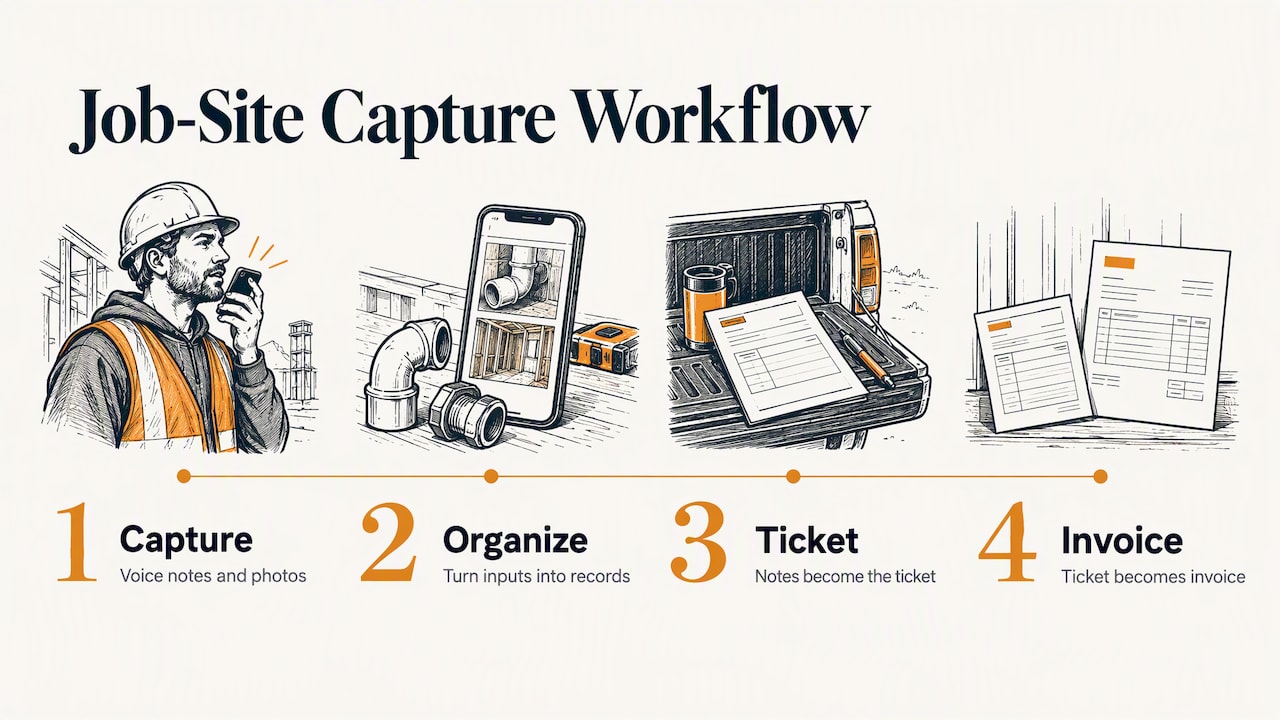
That is why Hechito starts with your voice and your camera. You talk through what happened on the job, snap photos of materials and conditions, and we turn that into organized records you can quote and invoice from, without retyping. The idea is that the notes you would have scribbled on a tailgate become the ticket, and the ticket becomes the invoice.
We also build for crews that work in both English and Spanish. A lot of the best tradespeople think and talk on the job in Spanish, and the customer’s paperwork has to come out in English, or the other way around. In Hechito, you can speak either language or both, and documents are generated in the language the customer needs.
Our view is that a tradesperson should not need to become a part-time office manager to get paid fairly. The software should behave like a helper who finishes the task, not an app that makes you do the typing.
— Francisco
Putting it together with Hechito
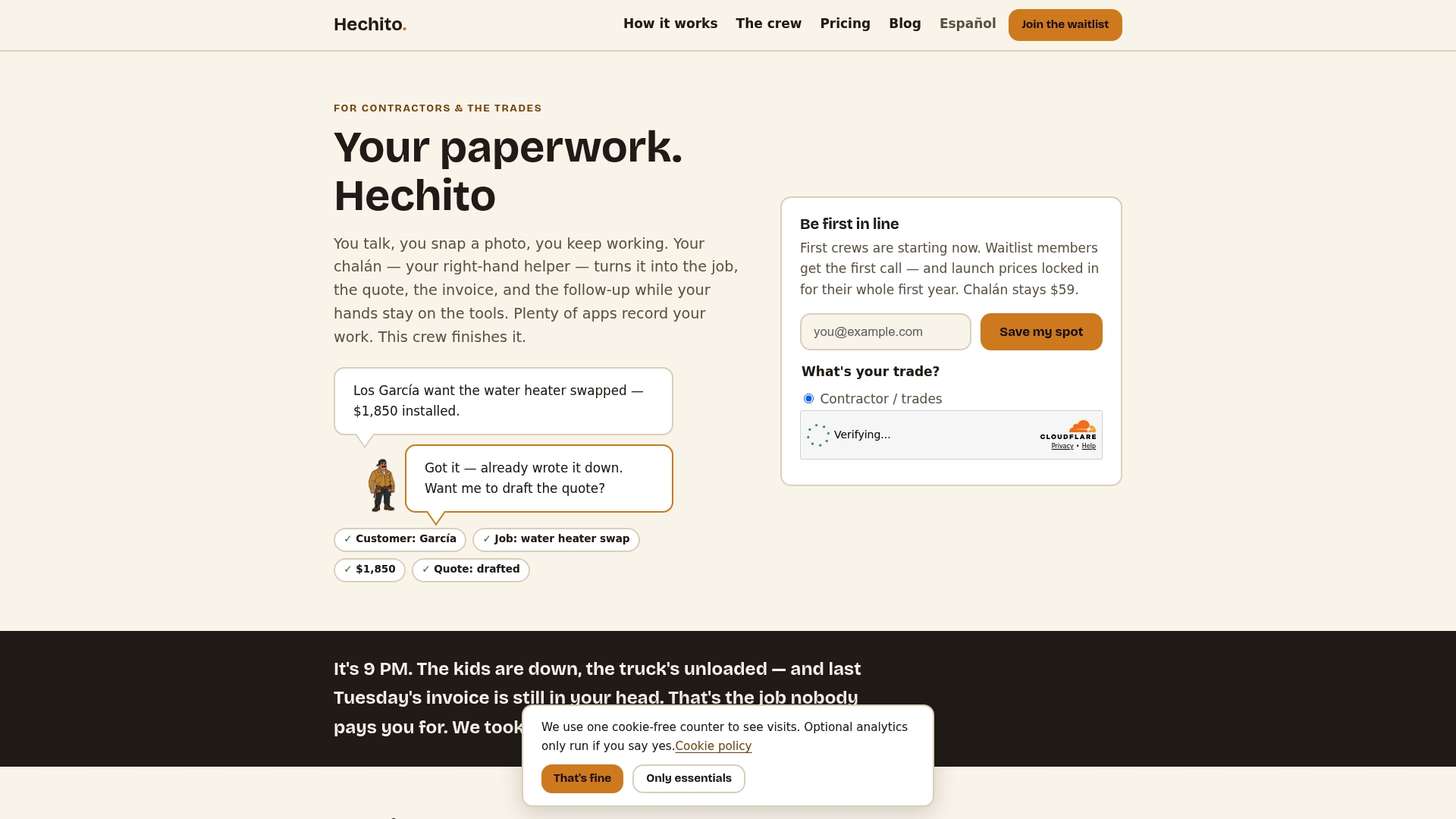
If you run T&M jobs, the part that costs you money is the gap between the work and the record of the work. Hechito is built to close it: capture the conversation, hours and materials by voice and photo on site, then turn them into estimates and invoices, chase payments and keep receipts organized.
Our crew of virtual co-workers, Chalán for the field, Lupita for the phone and Godínez for bookkeeping, each handles a different slice of that paperwork. You can see how they work on the crew page, or look at Hechito’s invoicing and estimate app for contractors if you want the overview first.
If you are bilingual on the job, our guide to turning voice and photos into dual-language estimates shows how the same approach works for customers who read English or Spanish.
Reconciling T&M payments with your bank
Billing is half the job. The other half is knowing what actually arrived. Reconciliation means matching every deposit to an invoice and every withdrawal to a job or an expense, so your books agree with your bank.
A simple weekly routine:
- Match deposits to invoices. Mark each invoice paid in full, partly paid or open. Note checks that cover several invoices.
- Match card and supplier charges to receipts. Every material line you billed should trace to a receipt and every receipt to a job.
- Flag the leftovers. Anything in the bank you cannot tie to a job is either overhead or a missed charge. Missed charges are the ones to catch.
- Compare billed and spent by job. If you bought $800 of material and billed $500, find out why before you close the job.
- Close the week. Once the statement and your records agree, move on.
There is also a compliance reason to keep this tidy. The IRS tells sole proprietors who file Schedule C that they need adequate records, such as bank statements, accounting records or ledgers, and invoices or receipts, to support their income and expenses. A T&M invoice paired with its tickets and receipts is exactly that kind of support.
What to look for in bank reconciliation software
If you are comparing tools, judge them on how they fit a small contracting business, not on how many features they list:
- Automatic bank feeds that import transactions daily, so you are not uploading statements.
- Transaction matching that suggests which invoice a deposit belongs to, and which receipt a charge belongs to.
- Job tagging, so costs and payments sit under the job, not just under a category.
- Receipt capture from a phone photo.
- Invoice tracking that shows open, paid and overdue balances at a glance.
- Simple export for your accountant at tax time.
For receipt scanning, expense records and invoice creation in a single tool, a platform like income and expense record software with receipt scanning shows the kind of workflow worth looking for, even though your own needs as a US contractor will depend on your entity type and state.
For more on connecting field data to your books, read our pieces on bookkeeping for contractors using field capture and job costing for contractors.
Protecting cash flow on T&M work
T&M shifts risk from you to the customer, but it can also shift cash flow onto you. You pay your crew and your supplier now, and the customer pays later. A few ways to stay ahead:
- Ask for a deposit that covers initial materials.
- Bill weekly or biweekly, not at the end.
- Pass through large material purchases right away rather than carrying them for weeks.
- Set clear due dates and follow up the day an invoice goes past due.
- Know your numbers by job so you can see which T&M jobs are running behind on billing.
Our article on cash flow in construction goes deeper on keeping money moving between jobs.
Converting T&M to fixed price
Once the unknowns are gone, many contractors convert the rest of a job to a fixed price. The demo is done, the hidden conditions are visible and the remaining scope can be priced. The conversion works best when you have a clean record of what has been billed so far, because the customer can see that your T&M numbers were honest. That is another reason to keep daily tickets: they are the track record that earns the customer’s trust for the next phase.
FAQ
What is the difference between time and materials billing and cost-plus?
Both bill actual costs. T&M bills labor at agreed hourly rates and materials at cost or with a set markup. Cost-plus typically bills your actual costs and adds a fee or percentage on top. Which one applies depends on what your contract says, so name the method in writing.
Can I mark up materials on a T&M invoice?
Yes, if your agreement says so. The standard definition of T&M billing includes a predetermined percent markup on top of labor and materials costs. Put the percentage in writing before work begins and apply it the same way on every invoice.
How often should I send T&M invoices?
Weekly or biweekly works for most jobs. Smaller, more frequent invoices are easier for customers to check against daily tickets, and they get you paid sooner than one large bill at the end. Follow the schedule in your agreement.
What records should I keep?
Keep the signed agreement, daily tickets, timesheets, receipts, photos, invoices and bank statements. The IRS says Schedule C filers need adequate records such as bank statements, ledgers, invoices and receipts to support income and expenses. Ask your tax professional how long to keep them in your situation.
Is T&M billing a good idea for every job?
No. It suits work where the scope or cost cannot be pinned down at the start. When the scope is clear and the customer wants a firm price, a fixed-price quote or progress billing is usually the easier sell.
Sources
- Labor and materials (time and materials), Cornell Legal Information Institute
- FAR 16.601 Time-and-materials contracts, Acquisition.gov
- Time and Materials Billing Without Lost Hours, Lumina Business Advisory
- Form 11652, Internal Revenue Service
- Ledgery, income and expense records with receipt scanning
Recommended
This is the paperwork Hechito does for you — while you talk.