Construction Estimate Templates: What to Include and How to Use Them

Construction Estimate Templates: What to Include and How to Use Them

A good construction estimate template has two parts: a header that pins down the project (client, address, date, scope) and a line-item table that separates materials, labor, equipment, subcontractors, overhead, profit and contingency. Below you’ll find that layout, a worked example, the matching invoice format, and the habits that keep estimates from turning into disputes.
HechitoKeep Estimate Details OrganizedHechito captures customer conversations and job details through voice and images, helping contractors turn them into organized records without extra typing.Visit HechitoTL;DR
- Every estimate needs a project header, a scope statement, itemized lines (quantity, unit, material, labor, equipment, subcontract), markups, assumptions, exclusions and payment terms.
- Use one uniform format for every job. Estimating guidance from ASPE says estimates should be easy for everyone involved to read.
- The invoice should mirror the estimate line by line, with change orders and retainage shown separately.
- A spreadsheet template works. The weak point is filling it in at night from memory, so capture details on the job site.
Table of Contents
- What a construction estimate template must include
- Where to find templates (Excel, Word, PDF, Google Sheets)
- A worked example: bathroom remodel estimate
- How to write a construction estimate step by step
- Construction invoice format and example
- Estimate versus invoice: how they connect
- Mistakes that wreck estimates and invoices
- Our perspective
- Put the template to work with Chalán
- Quick checklist before you send an estimate
- FAQ
- Sources
What a construction estimate template must include
The template is only a container. What matters is that it forces you to write down the same things every time. Professional estimating guidance is consistent on the core fields.
The American Society of Professional Estimators recommends a cover page showing the date, address, plan date, governing entity, project name, design firm, owner, governing codes and estimate level. That is written for larger commercial work, but the idea scales down. For a residential or small commercial job, your header becomes:
- Your business name, license number and contact details
- Client name, phone, email and job site address
- Estimate number and date
- A validity period (how long your prices hold)
- Estimate level: ballpark, preliminary or detailed
The body then follows a uniform line format. ASPE’s format lists CSI section, work-breakdown structure when used, description, quantity, unit, material cost, labor hours and cost, equipment cost, applicable subcontract cost and total cost. You don’t need CSI divisions for a bathroom remodel, but you do need quantity, unit and a separate cost for each of materials, labor and subs.
The sections every template needs
- Scope of work. What you will do, in plain sentences, room by room or phase by phase. If you want a checklist for this part, our scope of work checks walk through it.
- Line items. Quantity, unit, unit cost, extended cost, split into material, labor, equipment and subcontract.
- Markups. General conditions, overhead, profit, taxes and contingency, each on its own line.
- Assumptions. Access, working hours, existing conditions, who pulls permits, who supplies fixtures.
- Exclusions. What is not in the price.
- Payment terms. Deposit, progress draws, retainage if any, and when the final balance is due.
- Acceptance. A signature and date line, so the estimate becomes an agreement.
Where to find templates (Excel, Word, PDF, Google Sheets)
Most templates you will find are free downloads in Excel, Word, PDF and Google Sheets or Docs. Each format has a different job:
| Format | Best for | Watch out for |
|---|---|---|
| Excel or Google Sheets | Math that updates itself: quantities times unit costs, markups, totals | Broken formulas when someone overtypes a cell |
| Word or Google Docs | Scope narrative, assumptions and exclusions | Totals don’t calculate, so errors creep in |
| Sending a finished, locked estimate | Hard to edit, so keep the source file | |
| Estimating or invoicing app | Pulling job data straight into estimates and invoices | Needs a few minutes of setup |
A practical setup many small contractors land on: a spreadsheet for the numbers, a document for the scope and terms, and a PDF export that goes to the client. If you search for templates, judge them by whether they separate labor from materials and have room for assumptions and exclusions. A pretty layout without those fields is a quote form, not an estimate.
A worked example: bathroom remodel estimate
The figures below are made up to show structure. Your unit costs, markups and tax rules will differ, so replace every number with your own.
Header
Estimate #2026-014 | Date: [today] | Valid for 30 days | Client: [name] | Site: [address] | Estimate level: detailed
Scope: Demolish the existing tub surround and vanity. Install a new 60-inch alcove tub, tile surround to 7 feet, new vanity and faucet, and repaint walls and ceiling.
| Item | Qty | Unit | Material | Labor hrs | Labor cost | Sub | Total |
|---|---|---|---|---|---|---|---|
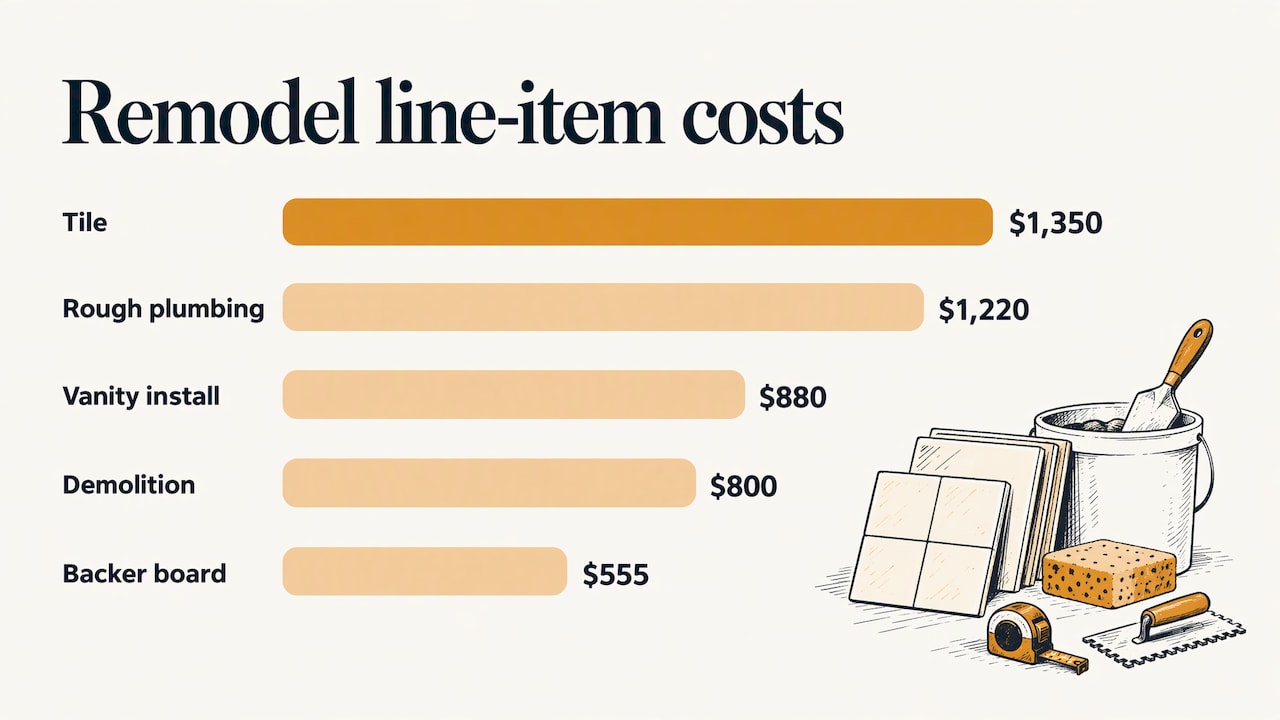
| Demolition and haul-off | 1 | lot | $150 | 10 | $650 | $800 | |
| Rough plumbing | 1 | lot | $320 | $900 | $1,220 | ||
| Backer board and waterproofing | 55 | sq ft | $165 | 6 | $390 | $555 | |
| Tile, 12x24 porcelain | 55 | sq ft | $440 | 14 | $910 | $1,350 | |
| Vanity and faucet install | 1 | each | $620 | 4 | $260 | $880 | |
| Paint | 1 | lot | $90 | 6 | $390 | $480 | |
| Direct cost | $5,285 |
Then the markup block:
| Line | Basis | Amount |
|---|---|---|
| Contingency | 5% of direct cost | $264 |
| Overhead | 10% of direct plus contingency | $555 |
| Profit | 10% of the subtotal so far | $610 |
| Estimate total | $6,714 |
Assumptions: Existing subfloor is sound. Work happens Monday to Friday, 8 a.m. to 4 p.m. Client provides the vanity top selection before demolition.
Exclusions: Permit fees, mold or rot remediation found behind walls, electrical changes, and any upgrades beyond the selected tile.
Payment terms: Deposit at signing, one progress payment after tile, balance on completion walk-through.
Notice how little is vague. The client can see where money goes, and you can see where you made or lost it after the job.
How to write a construction estimate step by step
1. Define the scope first
Don’t price anything until you can describe the work. AGC of Utah’s estimating material advises that for a preliminary estimate you list assumptions and the cost basis, while a detailed estimate uses plans and specifications and quotes for most materials, equipment and subcontracts. In everyday terms: the less drawn and specified, the more assumptions you write down.
2. Take off quantities
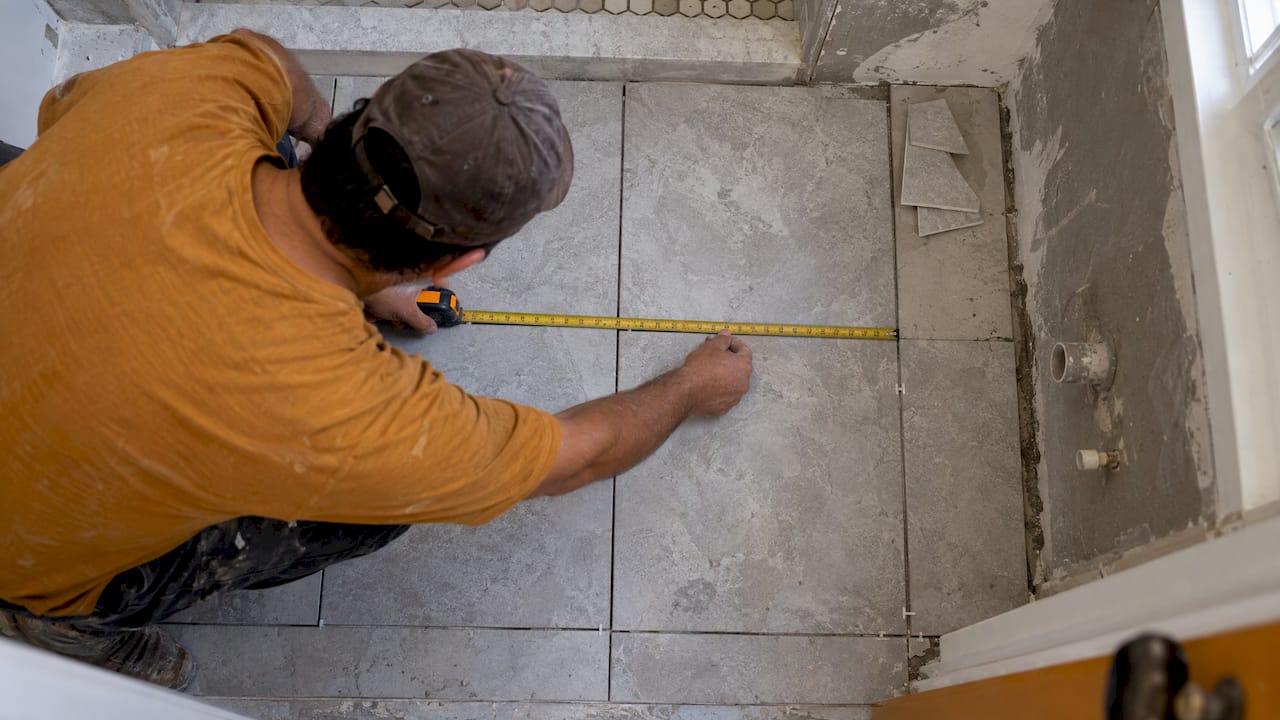
Measure square feet, linear feet, counts. Then add waste. ASPE notes that most materials need a waste factor after quantity takeoff, and that the percentage is largely a matter of experience. Tile with diagonal cuts wastes more than tile laid straight, so track your own waste on each job and reuse the numbers.
3. Price materials completely
A material unit cost is more than the sticker price. ASPE says it should account for purchase cost, escalation, waste, order quantity, shipping and sales tax. Missing the delivery fee on a pallet of material is one of the quietest ways to lose margin.
4. Price labor in hours, then dollars
Estimate hours per task, multiply by a loaded rate (wages plus payroll taxes, insurance and benefits). Keeping hours visible lets you compare against actual time later.
5. Add equipment and subcontractors
Get written subcontractor quotes and carry them as their own column so you can see how much of the job you self-perform.
6. Add general conditions, overhead, profit and contingency
These are separate lines, not buried in unit prices. Contingency deserves a note: AGC of Utah says any estimate prepared before detailed design is complete must include contingency for risk and uncertainty, and that contingency is not intended to cover omissions. If you forgot to price the trim, that is a mistake, not a risk. Contingency covers things like unknown conditions behind a wall.
On design-build remodeling work, where the design and price firm up together, it helps to label each estimate version by level. A page on design-build remodeling shows how that process moves from concept to a final price.
7. Write assumptions and exclusions
The AGC guidance lists what a documented estimate should record: the basis, accuracy, contingency, limitations, scope, labor rates, quantities, escalation, schedule, backup information, cost categories and exclusions. It also treats documentation as quality control: every number should trace back to backup, and stated assumptions help other people spot errors, omissions and duplicated costs.
8. State terms and get a signature
Payment schedule, validity period, change-order process, and a signature. If your clients mix up “estimate” and “quote,” read how to prevent estimate versus quote disputes and label your document clearly.
Construction invoice format and example
An invoice is a request for payment against work that was agreed (the estimate or contract) or performed. The estimate says what you expect to charge. The invoice says what is due now.
What the invoice should contain
- The word “Invoice,” invoice number, issue date and due date
- Your business details and the client’s details
- Job name and site address, plus a reference to the estimate or contract number
- Line items that mirror the estimate, with the amount billed this period
- Approved change orders as separate lines
- Subtotal, tax if applicable, retainage withheld if applicable, and balance due
- Accepted payment methods and late-payment terms you agreed to in the contract
A sample invoice using the bathroom estimate
| Description | Contract amount | Billed to date | This invoice |
|---|---|---|---|
| Original contract | $6,714 | $6,714 | |
| Deposit received at signing | -$2,000 | ||
| Progress payment after tile | $2,500 | ||
| Change order #1: added niche | $380 | $380 | $380 |
| Balance due this invoice | $880 |
Sample numbers again. The point is the traceability: the client sees the contract amount, what has been paid, the change order and what is due now.
Retainage on the invoice
On larger or commercial work, the client may withhold part of each payment. Typical retainage runs 5% to 10% of contract value, held until project completion or final inspection. Show it as its own line so both sides know what’s outstanding. We cover the mechanics in our guide to retainage and how to get paid.
Progress billing
For longer jobs, bill in stages. Contractors are advised to negotiate front-loaded billing schedules that cover big upfront costs. Tie each draw to something visible, like a milestone with photos. See construction progress billing and payment schedules for how to set that up.
Estimate versus invoice: how they connect
| Estimate | Invoice | |
|---|---|---|
| Purpose | Predict cost, win the job | Request payment |
| Timing | Before work starts | During or after work |
| Detail | Quantities, unit costs, markups, assumptions | Amounts due, changes, payments received |
| Binding? | Becomes binding once accepted | Due per agreed terms |
If your invoice lines don’t match your estimate lines, clients start asking questions and payment slows. Use the same item names in both.
Mistakes that wreck estimates and invoices
Scope creep with no paper. Strong change-order controls help avoid scope creep, and processing change orders quickly avoids invoicing delays. Write it up before doing the extra work. Our change order process guide has the steps.
Never comparing estimate to actual. The estimating process sets a project’s financial framework, and comparing original estimates with real-time job performance can reveal discrepancies early. Most contractors measure progress with the cost-to-cost method: job-to-date costs divided by estimated costs gives percent complete. That only works if your estimated costs were itemized to begin with. More in job costing for contractors.
Paperwork done from memory. Notes scribbled on a tailgate and typed up at 9 p.m. lose detail. The client’s offhand request to move an outlet becomes a free change.
Slow follow-up. An invoice sent late gets paid late. When one goes overdue, follow a plan; see overdue invoice collection. Cash timing matters across the whole business, as we explain in cash flow in construction.
Our perspective
Templates fix the format. They don’t fix the real problem, which is that the information you need lives in your head and your truck, not in the document.
We built Hechito around that gap. You talk through the job and send photos while you’re standing there, and the details are captured as they happen instead of rebuilt at the kitchen table. The idea is that quotes, invoices and job records come from what was said and shown on site, so you spend less time typing and fewer details slip.
We also work in English and Spanish, because plenty of crews and customers move between the two in the same conversation. You can speak either language or both, and the document is meant to come out clean in the language the customer needs.
Use a template to learn the structure. Then let the structure fill itself in.
Francisco
Put the template to work with Chalán
If you’d rather not retype your notes into a spreadsheet, Chalán is our voice-first helper for quotes and invoices from the job site. You describe the work, and it’s built to turn that into an organized estimate or invoice. See how it works on the Chalán page, or look at the full crew and pricing.
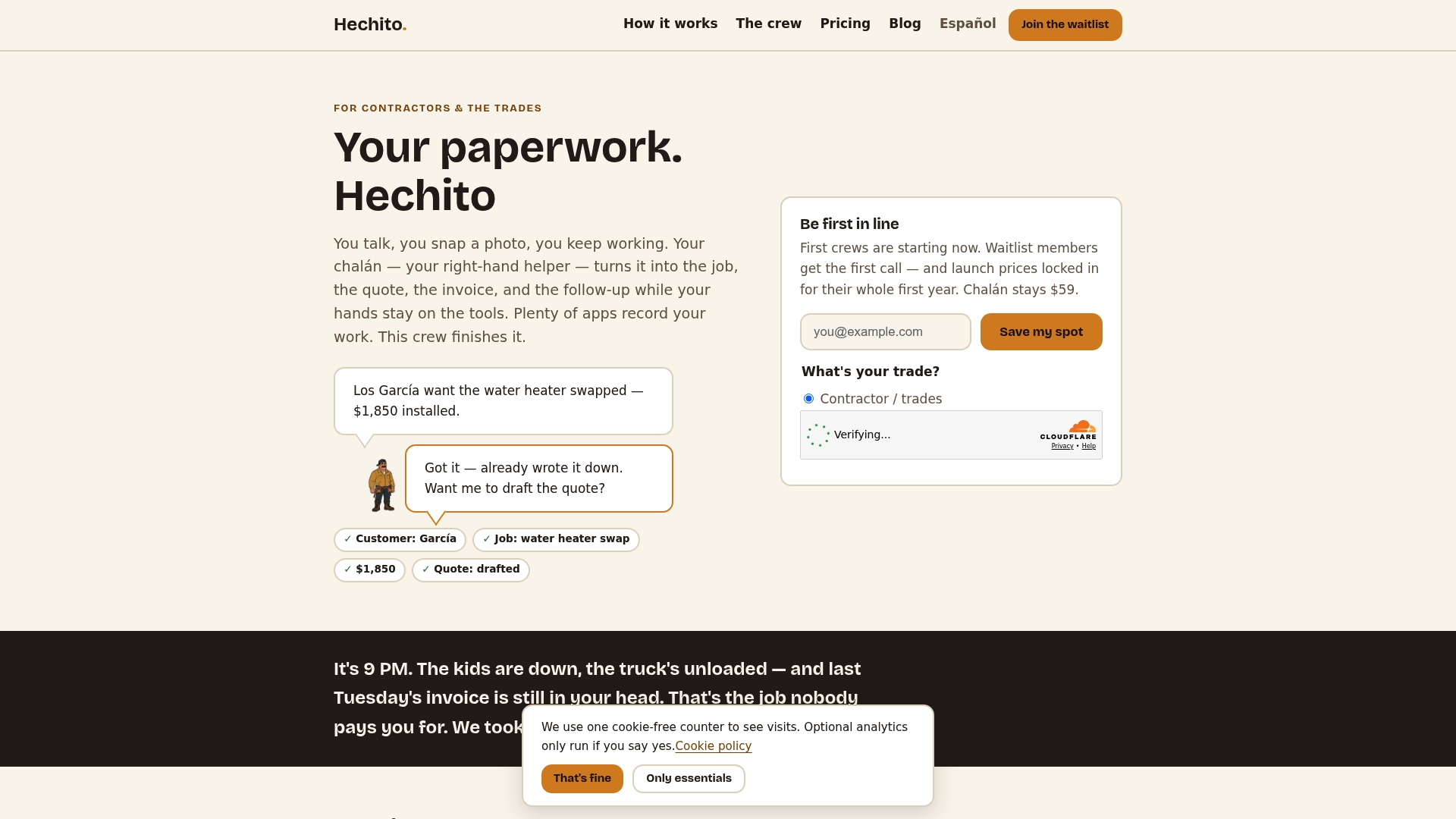
For the whole picture of quoting, invoicing and job records in one place, start at our contractor invoicing and estimate app page.
Quick checklist before you send an estimate
- Is the scope written in sentences a homeowner can follow?
- Are materials, labor, equipment and subs separate?
- Did you include waste, delivery and tax in material costs?
- Are overhead, profit and contingency separate lines?
- Are assumptions and exclusions written down?
- Are payment terms, validity period and a signature line on the page?
- Will your invoice use the same item names?
FAQ
What is the difference between a construction estimate and an invoice?
An estimate predicts what a job will cost before work begins. An invoice asks for payment for work agreed or done. Use matching line items on both so the client can follow the numbers from one to the other.
How detailed should a construction estimate be?
As detailed as the information you have. A preliminary estimate can rely on stated assumptions and a cost basis, while a detailed estimate draws on plans, specifications and real quotes. Either way, write down what you assumed and what you left out.
Should an estimate include contingency?
Yes, when the design or site conditions aren’t fully known. Contingency covers risk and uncertainty, not mistakes or missed items, so price everything you know about first and then add it as its own line.
What should I put on a construction invoice?
Invoice number and dates, both parties’ details, the job address, a reference to the estimate or contract, itemized amounts for this billing, separate change orders, any retainage withheld, and the balance due with payment terms.
Can I use a spreadsheet template instead of software?
Yes. A spreadsheet handles the math well and many contractors start there. The tradeoff is the manual entry: every note, photo and change has to be typed in by you after the fact.
Sources
- The Essentials of Successful Estimating, ASPE
- Estimating, Module 1: Session 1, AGC of Utah
- The Complete Guide to Construction Accounting, Construction Executive
- Executive Insights 2025: Leaders in Construction Accounting, Construction Executive
- Breaking Down the Work-in-Process Schedule, Construction Executive
- Design-Build Remodeling: How It Works and What It Costs
Recommended
This is the paperwork Hechito does for you — while you talk.

On iPhone? Coming very soon to the App Store.