How to Request a Deposit Invoice as a Contractor
How to Request a Deposit Invoice as a Contractor
To request a deposit invoice, send the customer a document labeled “Deposit Invoice” that references the approved estimate, shows the deposit amount and what it covers, states a due date and whether the deposit is refundable, and ties the start date to payment. Before you send it, check what your state allows. Some states cap residential deposits, and some require a signed contract before you collect anything.
This guide covers each step: when to ask, how much, what goes on the invoice, how to word the request, how to show the deposit on the final bill, and what happens if the job changes or is canceled.
Hechitohechito.comKeep Deposit Details With the JobHechito captures customer conversations and job details in real time, helping contractors move from quoting to invoicing with less paperwork.Explore HechitoTL;DR
- Send a deposit invoice only after the estimate is approved, and write the deposit amount, due date, and refund terms on it in plain words.
- Size the deposit to your real exposure: materials you must buy, time you are blocking out, and how well you know the customer.
- Check your state’s cap first. California, Maryland, and Massachusetts all limit residential home improvement deposits.
- Record the deposit as its own line, then subtract it on the final invoice so the customer is never charged twice.
- Send the request while you are still on the job site or on the phone, when the customer’s yes is fresh.
Table of Contents
- What a deposit invoice is, and when to use one
- How much deposit to ask for
- Check your state’s limits first
- What goes on a deposit invoice
- How to word the request
- Perspective: why deposits fail in the field
- Send the request while the job is fresh
- Record the deposit and show it on the final invoice
- If the job changes or gets canceled
- Chasing a deposit that has not arrived
- FAQ
- Sources
What a deposit invoice is, and when to use one
A deposit invoice is a bill for part of the job price, issued before the work begins. It is not the final invoice. It secures the customer’s commitment and gives you cash to buy materials and hold a slot on your calendar.
Three situations make it close to non-negotiable:
- You have to buy materials. Special-order cabinets, windows, fixtures, or lumber packages put your own money at risk. A deposit lets you buy without borrowing. Business.com’s reporting quotes an accountant, Kathy Gilchrist, saying construction companies can use deposits to cover upfront material costs instead of paying interest on financing.
- You are blocking out significant time. If a three-week job means turning down other work, the deposit is what makes the commitment mutual.
- The customer is new to you. A repeat customer with a clean payment history may not need one. A stranger usually does.
Small jobs that finish in a day often skip the deposit and invoice on completion. That is a business choice, not a rule.
A question people often ask: does an invoice mean the customer owes the money? A deposit invoice is a request for payment under terms both sides agreed to, usually in the approved estimate or contract. It is only as strong as that agreement, which is why the estimate should be accepted in writing before you send it.
How much deposit to ask for
There is no universal percentage. NADRA, a professional association for remodelers, advises sizing the deposit to job size, timing, and cash-flow exposure. Its example: a smaller job starting soon may justify 25%, while a job lasting weeks or months may use a smaller first payment followed by payments at startup or at progress milestones.
A practical way to calculate it:
- List what you must pay out before the first progress payment: special-order materials, permit fees, dumpster or equipment rental, subcontractor mobilization.
- Add a cushion for surprises. One contractor guide suggests a 10 to 15% buffer on initial outlays. That guide is written for Ontario, so treat the buffer as a rule of thumb and the legal limits as local.
- Compare the total with the percentage you were going to ask for. If outlays are higher, split the money into a deposit plus a materials payment at delivery.
- Check the result against your state’s cap (next section).
Worked example
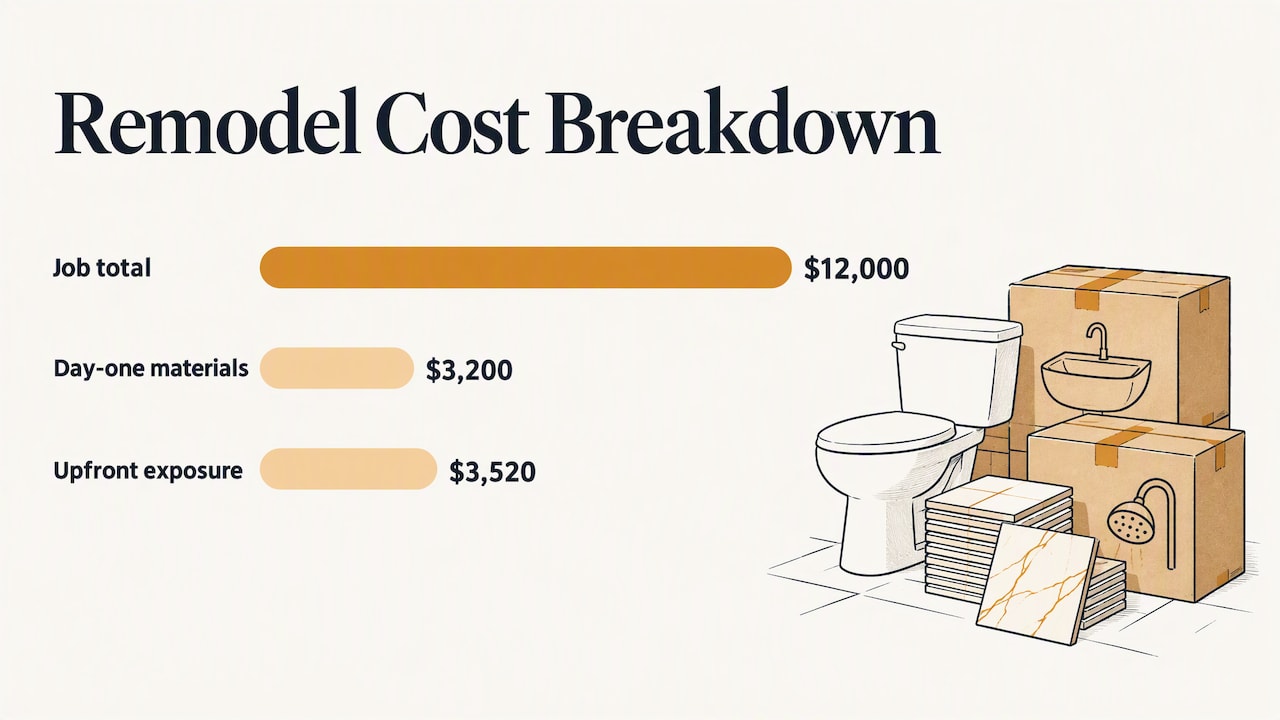
Say you quote a $12,000 bathroom remodel. Tile, vanity, and fixtures run $3,200 and must be ordered on day one. Add a 10% buffer and your upfront exposure is $3,520. That is about 29% of the job, so on a longer job you might ask for the deposit to cover the order, then bill the rest through progress billing as milestones are completed. If your state caps deposits below that figure, the number you can lawfully collect wins, and you structure the first draw around delivery.
Check your state’s limits first
Deposit caps are state law, and the amounts differ a lot. Contractors need to check their own licensing board, but these examples show how much:
| State | Limit on residential home improvement deposits |
|---|---|
| California | The lesser of 10% of the contract price or $1,000, with an exception for contractors holding an approved blanket performance and payment bond |
| Maryland | No more than one-third of the contract price, and no payment before the contract is signed by both parties |
| Massachusetts | The greater of one-third or the cost of special-order materials |
Sources: California’s Contractors State License Board and the Maryland Home Improvement Commission. Check Massachusetts rules with the state’s own home improvement contractor program before relying on that row.
The FTC also notes that some states limit down payments and suggests customers check with their state or local consumer agency. It lists a demand for full payment upfront and pressure to decide immediately among the warning signs of a home improvement scam. A deposit that is modest, documented, and tied to a written contract is what separates you from that pattern, and customers who have been warned about it will notice.
If you work across state lines, keep a one-line note of each state’s cap in your estimate template. And if your state has no cap, a reasonable deposit is still easier to defend than an aggressive one.
What goes on a deposit invoice
The invoice should leave no room for a second reading. Include:
- A clear “Deposit Invoice” label at the top, so it is not mistaken for a final bill.
- Your business details: legal name, address, phone, email, and license number where your state requires one.
- The customer’s name and job address.
- An invoice number and issue date. Sequential numbers make bookkeeping and audits easier.
- A reference to the approved estimate or contract, by number and date.
- The deposit amount, shown both as a dollar figure and as a percentage of the total price.
- What the deposit covers: materials order, scheduling, permits, or all of those.
- A due date. “Due on receipt” or “due within 3 days” is common. Name a specific date that sits before your start date.
- Refund terms: state whether the deposit is refundable, partly refundable, or applied to costs already incurred if the customer cancels. Put the same terms in your contract.
- Accepted payment methods and where to send payment.
- The remaining balance and when the next payment is due.
The refund line is the one that prevents most disputes. Vague wording is how a canceled job turns into an argument.
For wider guidance on terms, see our invoice checklist for contractor payment terms.
How to word the request
Most contractors dread the ask. It gets easier when the deposit is presented as part of how you work, not as a favor. Three principles:
- Make it a standard step. “To schedule your start date and order materials, we collect a deposit.” Said that way, it is process, not suspicion.
- Tie it to something the customer wants. The deposit holds their slot and secures their materials.
- Make paying simple. One link or one invoice, one due date, no hunting.
Email or text wording you can adapt
Hi Maria, thanks for approving the estimate for the bathroom remodel. Attached is the deposit invoice for $3,520, which covers ordering your tile, vanity, and fixtures and reserves your start date of the 14th. It’s due by Friday. The remaining balance is billed in two payments as outlined in the contract. Let me know if you have any questions, and we’ll lock in the schedule as soon as the deposit comes through.
On the phone or at the kitchen table
Say it in one breath, right after they accept: “Great, I’ll send the deposit invoice tonight. Once it’s paid, I order your materials and you’re on the calendar.” Then send it that same day. Delay is what gives customers time to second-guess.
If the customer pushes back
Two objections come up most. “Why do you need money before you start?” Answer with the materials: you are buying products specific to their job. “Can it be smaller?” Offer a lower deposit with a materials payment on delivery, rather than waiving it. Both keep your exposure covered and give the customer a reasonable path.
Perspective: why deposits fail in the field
We talk to contractors who lose weeks of cash flow, and the cause is rarely the customer refusing a deposit. It is that the invoice goes out late, after the conversation has cooled, because the contractor is on a ladder all day and does the paperwork at 9 p.m., if at all.
The details also get lost. What the customer agreed to, what the deposit covers, which materials were discussed: all of it lives in a head or in a scattering of texts. When a dispute comes, the contractor has memory against memory.
Our view is simple. The deposit request should be generated at the moment of the agreement, from what was actually said and photographed on the job site, and it should reference that record. That is why we built Hechito around voice and photos: you talk through the job, and the estimate, the deposit request, and the later invoices come out of the same record. Speed matters more than polish here. A clean deposit invoice sent in ten minutes beats a perfect one sent in three days.
— Francisco
Send the request while the job is fresh
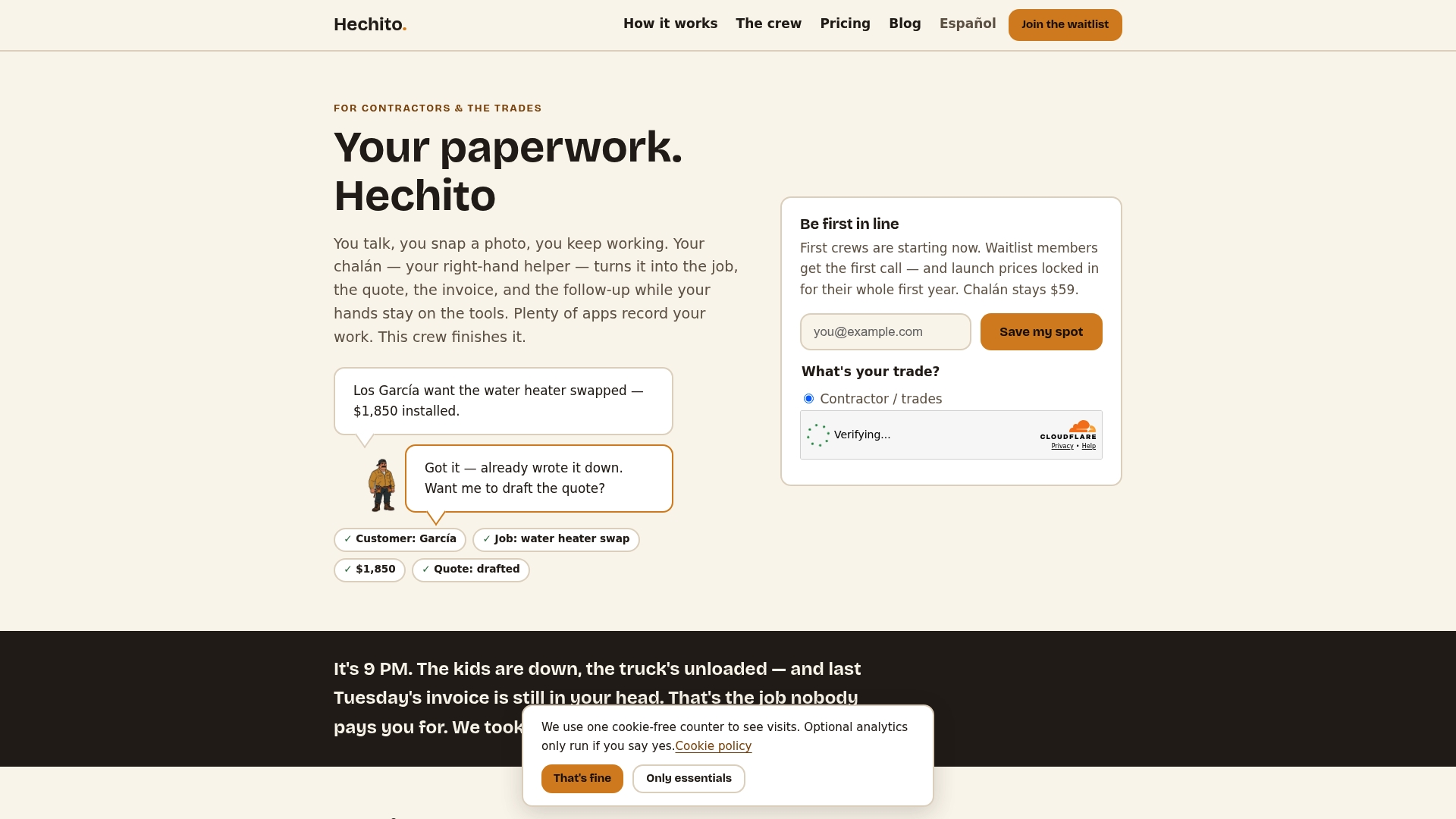
Hechito’s Chalán is built for exactly this moment. You describe the job out loud on site, it turns that into a quote and invoice, and you can send the estimate and the deposit request without sitting down at a desk later. It works in English and Spanish, so a customer or crew member who prefers one language gets documents in the language they need.
See how it works on our contractor invoicing page, or review the options on the pricing page.
Record the deposit and show it on the final invoice
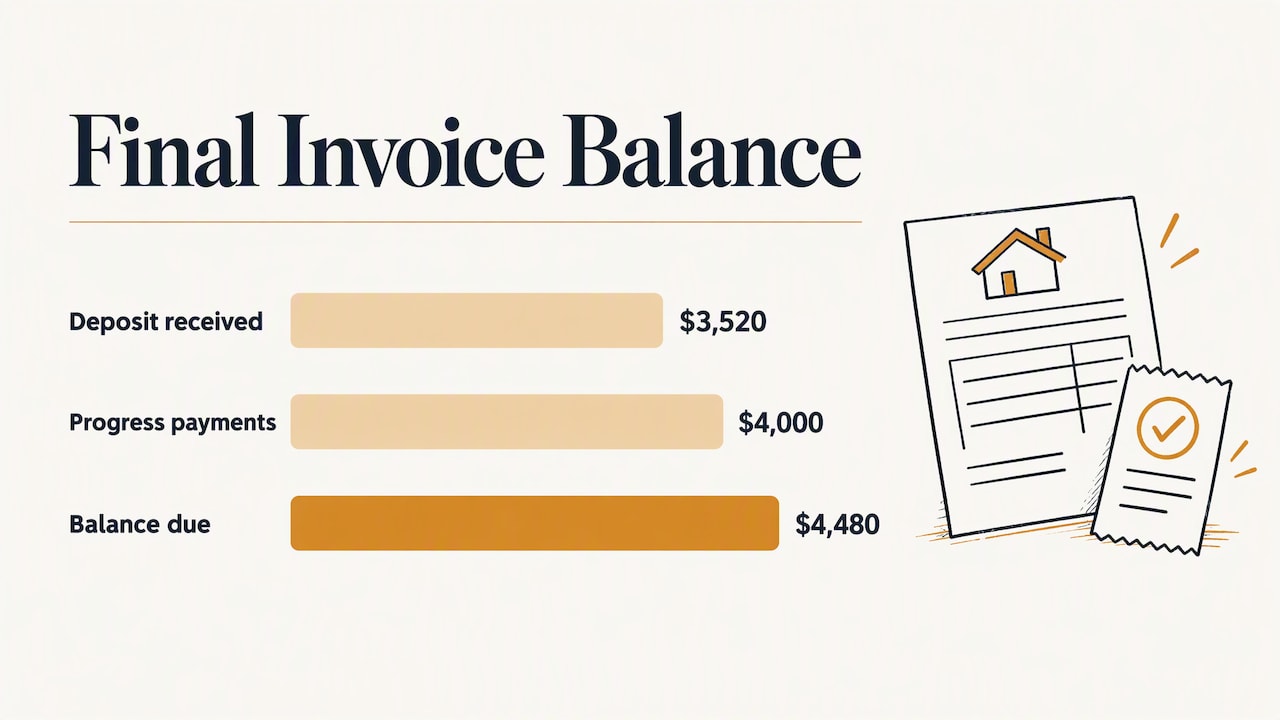
A deposit is a payment toward the job, so it must appear on the final invoice as a credit. Otherwise the customer is billed the full amount twice, which creates the exact dispute you were trying to avoid.
The cleanest layout of the final invoice:
| Line | Amount |
|---|---|
| Total contract price | $12,000.00 |
| Change orders (if any) | $0.00 |
| Deposit received (invoice #1042, paid on the date received) | -$3,520.00 |
| Progress payments received | -$4,000.00 |
| Balance due | $4,480.00 |
For your own books, treat the deposit as money received for work not yet done, and keep the paper trail. The IRS tells small businesses to use a system that clearly shows income and expenses and to keep supporting documents such as invoices, receipts, and proof of payment, in its guidance on what records to keep. How a deposit is reported for tax depends on your accounting method, so ask your accountant or tax preparer how to treat it.
A few habits that help:
- Number the deposit invoice and reference that number on every later bill.
- Keep the signed estimate, deposit invoice, and proof of payment together under the job.
- Match the payment to the bank deposit. Our guide to bookkeeping for contractors shows how to code jobs as they happen, and our cash flow guide explains why timing matters so much.
If the job changes or gets canceled
Your deposit terms decide most of this, and the law decides the rest.
Scope changes. If the job grows, issue a written change order and adjust the balance. Do not quietly raise the deposit after the fact. If it shrinks, credit the difference on the final invoice.
Cancellation after you have spent money. Your contract should say that costs already incurred, such as non-returnable special orders, are deducted before any refund. Keep the receipts so you can show them.
Statutory cancellation rights. Under the FTC’s Cooling-Off Rule, certain sales made away from the seller’s place of business give the buyer three business days to cancel. Sales made at the customer’s home can fall under it, and the rule requires disclosures about the right to cancel. State home improvement laws often add their own cancellation notices. If a customer cancels within that window, plan on refunding the deposit, and ask your state licensing board or an attorney how the rules apply to your contracts.
Do not hold the deposit as leverage. Unclear refund language is what leads to chargebacks and complaints. Write the terms once, in the contract and on the invoice, and follow them.
Chasing a deposit that has not arrived
If the due date passes, do not start work. Send a short, friendly reminder the next day with the invoice attached again: “Just checking that the deposit invoice reached you. Once it’s in, I’ll confirm your start date.” If a week goes by, call. Most late deposits are simply forgotten, not refused.
If the customer keeps stalling, release the calendar slot and tell them so in writing. For the broader process, see our step-by-step plan for overdue invoice collection.
FAQ
How do I invoice for a deposit?
Create an invoice labeled “Deposit Invoice” that references the approved estimate, shows the deposit amount and what it covers, and states a due date and refund terms. Send it right after the customer accepts. On the final invoice, list the deposit as a credit against the total.
Can a customer refuse to pay a deposit invoice?
They can, and if they do, you are not obligated to start. The invoice is enforceable only to the extent your signed estimate or contract requires it. Some states also prohibit collecting any payment before the contract is signed, so confirm the contract is in place first.
Is a deposit the same as a down payment or retainage?
A deposit and a down payment are usually the same thing: money paid before work begins. Retainage is the opposite, a portion of earned payments held back until the job is complete. Our guide to how retainage works covers that side.
How long should I give the customer to pay?
A few days is typical, as long as the due date falls before your scheduled start. Pick a specific date and write it on the invoice, rather than relying on loose terms like “soon”.
Do I need a deposit on every job?
No. Quick jobs with little material cost and trusted repeat customers can be billed on completion. Ask for one whenever you must buy materials, reserve substantial time, or work with a customer you have not worked with before.
Sources
- Business.com: When Should Businesses Require a Deposit?
- NADRA: How Much of a Deposit Should You Ask For?
- Markup: How Much Deposit Can a Contractor Ask For in Ontario?
- California CSLB: What should I look for in a contract
- Maryland Home Improvement Commission: Notice to Contractors
- FTC: How To Avoid a Home Improvement Scam
- FTC: Cooling-off Period for Sales Made at Home or Other Locations
- IRS: What kind of records should I keep
Recommended
This is the paperwork Hechito does for you — while you talk.