Invoice Numbering for Construction: Formats That Work
Invoice Numbering for Construction: Formats That Work
The best invoice numbering system for a contractor is one that is unique, predictable and tells you something at a glance, such as 2026-0047 for a simple sequence or RIVER-003 for a job-based count. No U.S. federal rule dictates the format. What matters is that every invoice has its own number, that you never reuse one, and that you can explain every number in the sequence.
This guide shows the formats contractors actually use, how to number progress billings and change orders, how to fix a wrong invoice without breaking your sequence, and what to keep for the IRS.
HechitoKeep Contractor Invoices OrganizedHechito captures job details through voice and images, helping contractors turn conversations into organized records without extra typing.Explore HechitoTL;DR
- Every invoice gets one unique number that is never reused, edited or deleted after it is sent.
- For most small contractors, a job code plus a running count (for example
HARRIS-002) is easier to track than one company-wide sequence. - Fix mistakes with a credit memo and a new invoice, not by overwriting the old number.
- The U.S. has no federal numbering rule, but the IRS expects records that clearly support your income and expenses, so write your system down and follow it.
- Use the same number everywhere: PDF file name, email subject, bookkeeping entry and payment reference.
Table of Contents
- What an invoice number does on a job
- Four invoice number formats contractors use
- Build your numbering rules in ten minutes
- Numbering progress billings, draws and change orders
- Fixing a wrong invoice without breaking your sequence
- What the IRS and the law expect
- Use one number everywhere
- Common numbering mistakes
- Let the paperwork happen on the job
- FAQ
- Sources
What an invoice number does on a job
An invoice number is the one reference that ties a request for payment to everything else: the quote, the photos, the payment and the ledger entry. When a customer calls and says “I’m looking at your invoice,” the number is how you find it in ten seconds instead of ten minutes.
On a construction job it does more work than on a retail sale. You may send several invoices to one customer over weeks or months: a deposit, progress billings, a change order, a final bill. The number is how you, your bookkeeper, the customer’s accounts payable clerk and sometimes a lender or architect keep those straight.
Three qualities make a numbering system good:
- Unique. No two invoices share a number.
- Consistent. Anyone on your team can guess what the next number will look like.
- Traceable. From the number alone you can find the job, the customer or the date.
If your system does those three things, it is a good system. Fancy beats nothing, but simple and followed beats fancy and abandoned.
Four invoice number formats contractors use
There is no single right answer. Here are the common patterns and where each fits.
| Format | Example | Best for | Watch out for |
|---|---|---|---|
| Simple sequence | 1001, 1002, 1003 | Solo operators with a few jobs a month | Tells you nothing about the job or customer |
| Year plus sequence | 2026-0047 | Contractors who want a clean annual count | Must restart the count each January, so keep the year in the number |
| Job or customer code plus sequence | HARRIS-002, RIVER-006 | Multi-invoice jobs, progress billing, remodelers | Codes need a short rule so two jobs don’t share one |
| Customer number plus invoice count | 5001 (customer 5, first invoice) | Repeat customers, service and maintenance work | Customer list must stay tidy |
The patterns are not exotic. Accounting vendors describe the same families: sequential, date-based, customer-based, project-based and hybrid systems. Whichever you choose, the format matters less than using it every time.
Which one should you pick?
Ask how you will look the invoice up later.
- You look things up by job. Use a job code plus a count. When the Harris kitchen has a deposit, three draws and a change order, you get HARRIS-001 through HARRIS-005 and the whole story sits together.
- You look things up by date. Use year plus sequence. It sorts naturally and your bookkeeper will like it at year end.
- You do mostly one-off service calls. A plain sequence is fine. Don’t over-engineer a plumbing repair invoice.
- You have many repeat customers. Give each customer a number, then add a count per customer.
A combined format is also common: year, job code and count, such as 26-HARRIS-003. Keep it short enough that a customer can read it over the phone. If you can’t say it out loud without confusion, shorten it.
Build your numbering rules in ten minutes
Write these decisions down once. A half page is enough.
- Format. For example:
[JOBCODE]-[3-digit count]. - Job codes. Use the customer’s last name or a street name, three to six letters, and add a digit if two jobs collide (HARRIS, HARRIS2).
- Starting number. Start at 001 for each job, or at 1001 for a company-wide sequence. Starting above 1 is purely cosmetic.
- Who assigns numbers. One person or one system. Two people numbering by hand is how duplicates are born.
- Special cases. Deposits, change orders, retainage releases, voids and credit memos. Decide the pattern now, because you will hit each one.
- Monthly check. Once a month, scan your list for gaps and duplicates and note why any number is missing.
That last step is a habit worth keeping. Gaps usually have innocent explanations: a draft you abandoned, a test invoice, a void. Problems start when you can’t say which one it was.
Numbering progress billings, draws and change orders
Construction billing is rarely one invoice per job, and that is where numbering systems fall apart.
Progress billing
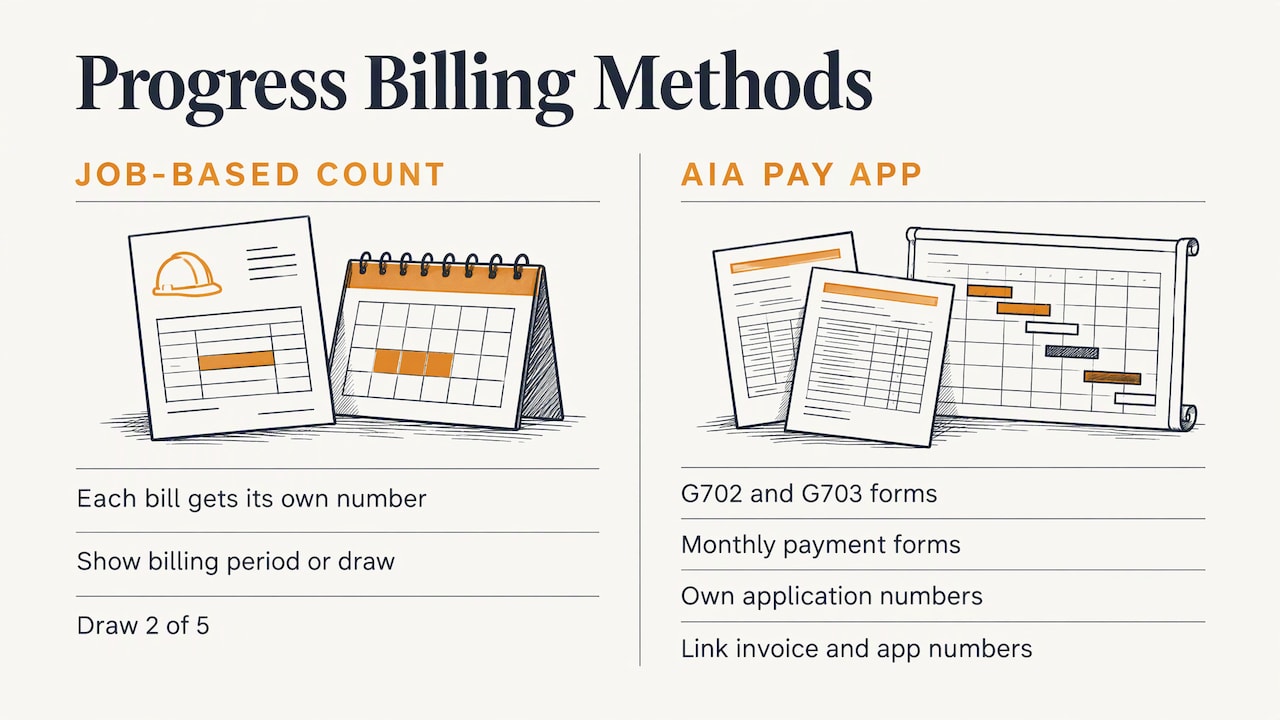
When you bill as work is completed, each bill needs its own number and should also show which billing period or draw it covers. A job-based count handles this well: HARRIS-002 is the second bill on the Harris job, and the invoice itself says “Draw 2 of 5, work through the end of the month.” Our guide to construction progress billing covers how to support each draw with field photos.
If you bill on larger commercial or public work, the customer may require the standard AIA pay application. The G702 and G703 forms are monthly payment forms tied to the schedule of values, percentage of completion, stored materials and retainage. Those forms carry their own application numbers. Keep your invoice number and the pay application number linked in your records so one can be found from the other, and ask the customer or architect which number they want on the payment reference.
Deposits and retainage
Give a deposit invoice a number like any other, then show it as a credit on later invoices rather than leaving it out of the sequence. For retainage, the invoice that releases held-back money gets its own number as well, which helps when you are chasing it months later. Here is how retainage works and how to get paid.
Change orders
Change orders are the classic source of billing confusion. Two clean approaches:
- Bill the change order on its own invoice with the next number in the job sequence, and reference the change order number in the description.
- Fold it into the next progress invoice, but list it as a separate line with its change order number.
Either works. Pick one and use it every time.
Final invoice
The last invoice on a job is the one you most want paid quickly, and it is the one most often questioned. A clear number, a clear reference to the contract and a clean summary of what has already been paid help it move. See how to collect final payment on a construction job.
Fixing a wrong invoice without breaking your sequence
You will eventually send an invoice with the wrong amount, wrong address or missing line. The rule is simple: once an invoice has been sent, its number is spent. Don’t edit it quietly, don’t delete it, and don’t give its number to another invoice.
Here is the clean way to handle each case.
- The invoice is unpaid and wrong. Void it in your system, issue a corrected invoice with the next number, and write “replaces HARRIS-003” on it. Tell the customer in the email so their payables department doesn’t pay both.
- The invoice was partly or fully paid and the amount was wrong. Issue a credit memo that references the original invoice number, states the amount and gives the reason. Then issue a new invoice if more is owed.
- The work was cancelled. Void or credit the invoice and keep the record. Leaving a numbered gap with no explanation is what makes reconciliation painful later.
- You never sent it. A draft that never left your system can be removed, and a note in your numbering log is enough.
Credit memos can share your invoice sequence or have their own series, such as CM-HARRIS-001. Either is fine if you decide once. The same logic applies to quotes: a customer who approved a numbered quote and later gets a numbered invoice leaves a trail you can follow end to end, and how customers sign quotes online is a good example of keeping that trail tidy from the first document.
What the IRS and the law expect
There is no federal law in the U.S. that requires invoice numbers to be sequential or to follow a particular format. One legal explainer on this points out that the IRS cares that your books clearly show all income, expenses and credits and does not dictate the format of your invoice numbers. The underlying rule is that you keep permanent books or records sufficient to establish income and deductions.
The IRS lists invoices among the supporting documents that contain the information you need to record entries in your books and on your tax return, and says to keep them in an orderly fashion and in a safe place. An orderly numbering system is exactly how you meet that expectation in practice.
How long to keep invoices
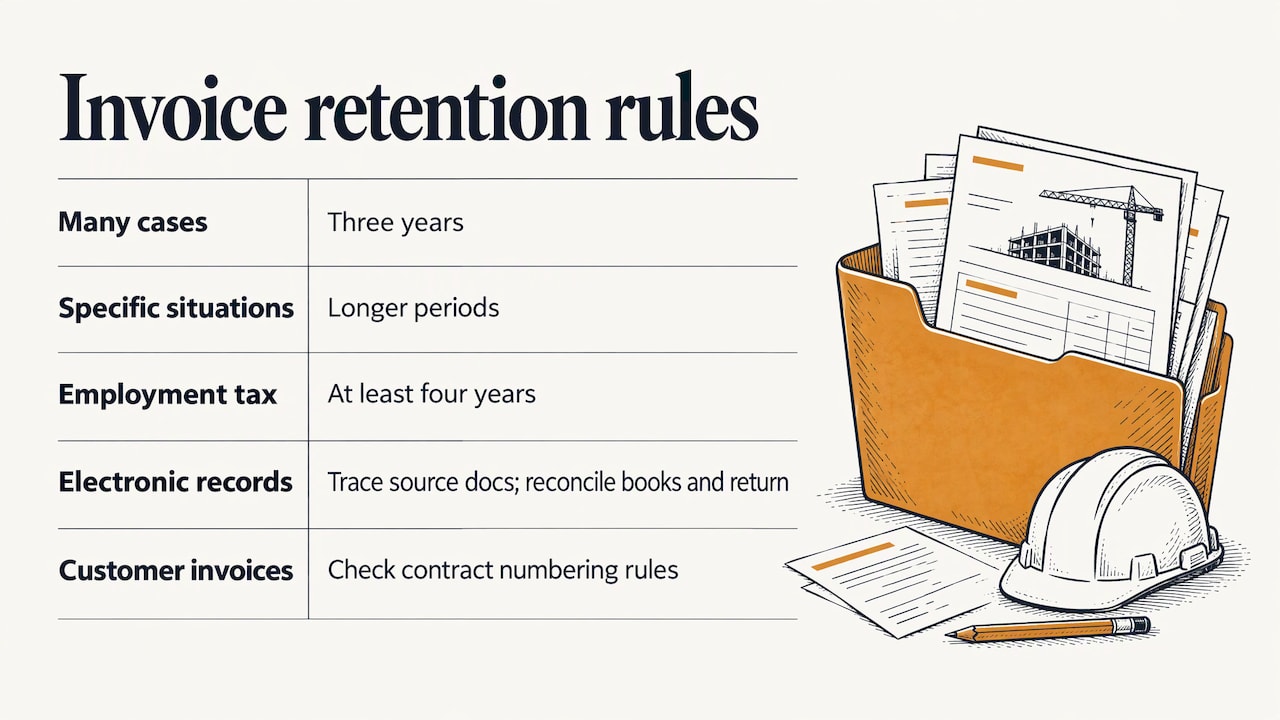
The IRS says the right retention period depends on the document, and that records supporting an item of income, a deduction or a credit should generally be kept until the period of limitations for that return runs out. The same page lists periods that range from three years in many cases to longer for specific situations, and at least four years for employment tax records. Your tax preparer can tell you which applies to your business.
If you keep records electronically, the IRS guidance on automated records says machine-readable records must have enough transaction-level detail to identify the underlying source documents and must reconcile with your books and return. A number that follows the invoice from the PDF to the ledger is what makes that possible.
Some customers, especially public agencies and general contractors, have their own invoice requirements, including a particular numbering or reference format. Check your contract or ask the customer’s payables contact before the first bill goes out.
Use one number everywhere
The habit that saves the most time is using the invoice number as the single reference for the whole billing cycle. Put it in:
- the PDF file name (
HARRIS-003.pdf) - the email subject line
- your bookkeeping entry
- the payment reference you ask the customer to use
- your receivables list and any follow-up message
When a check arrives with no stub, or a transfer shows up in the bank with only a number, you can match it right away. This is also why a clear number helps collections: a reminder that says “invoice HARRIS-003, $4,800, due the 15th” is hard to misread. If you are already chasing money, our overdue invoice collection plan walks through the steps, and our invoice checklist on payment terms covers what else belongs on the page.
A complete construction invoice carries more than a number, of course: your business name and contact details, the customer and job address, the invoice date, an exact due date, a description of the work, the amount and any payment instructions. The number is the part that holds the rest together.
Common numbering mistakes
- Reusing a number after a void. It makes two different documents look like one.
- Editing a sent invoice in place. The customer’s copy and your copy no longer match.
- Letting two people number by hand. Duplicates follow.
- Changing formats mid-year. If you must change, start the new format on a clean date and note it in your policy.
- Numbers that are too clever. If your crew can’t read it back, it won’t be used.
- Nothing connecting the invoice to the job. The number should lead to the job file, photos and notes. A daily log helps here, and these seven daily log fields show what to capture.
Our take: numbers should assign themselves
We built Hechito around a simple observation: tradespeople don’t skip good numbering because they don’t care. They skip it because it is the last thing they want to do at nine at night after a long day on the job.
A numbering system that depends on you remembering the last number, typing it correctly and keeping a spreadsheet in sync will drift. So our approach is to take the clerical work out of it. You talk through the job, send photos from the site, and the quote and invoice are built from what you captured, with the job’s records kept together so the paperwork and the work match.
We also think numbering should work in the language your customers and crew use. Hechito works in English and Spanish, and you can speak either or both, with documents generated in the language they need.
The goal is the same one this article is about: every invoice findable, every job traceable, no end-of-day paperwork pile. Pick a format, write it down, and let the system do the counting.
Francisco
Let the paperwork happen on the job
If numbering is one of many small admin tasks eating your evenings, Hechito’s job, quote and invoice app for contractors is designed to build quotes and invoices from your voice notes and photos as you work. Chalán handles voice quotes and invoices from the job site, and Godínez is built for bookkeeping that matches the bank to your jobs. You can see the crew and how it works on the pricing page.
For the bookkeeping side, see how to code jobs today using field capture, and for the bigger picture, how contractors keep cash moving and verify each draw against a construction payment schedule.
FAQ
Do invoice numbers have to be sequential?
Not by U.S. federal law. The IRS requires records that clearly show your income and expenses, but it does not prescribe a numbering format. Sequential numbering is still the easiest way to spot a missing invoice, and some customers require it, so most contractors use it within a job or year.
Should I start at 001 or at a higher number?
Either is fine. Starting at 1001 or higher only avoids an invoice that looks like your first. What counts is that the numbers never repeat and that you keep to the same format.
Can I reuse the number of a voided invoice?
No. Keep the voided invoice in your records with a note, and give the corrected invoice the next number, referencing the one it replaces. Reusing a number puts two different documents under one reference and makes reconciliation harder.
What is the difference between an invoice number and a job or PO number?
An invoice number identifies one request for payment. A job number identifies the project, and a purchase order number is the customer’s reference for authorizing the work. Include the job and PO numbers on the invoice, but give each invoice its own number.
Should I number deposit invoices and change orders?
Yes. A deposit invoice and each change order billed on its own are invoices like any other and take the next number in your system. Show the deposit as a credit on later invoices so the totals reconcile.
Sources
- Stripe: What is an invoice number?
- AIA Contract Documents: G702 and G703 pay applications
- LegalClarity: Do invoice numbers have to be sequential?
- IRS: What kind of records should I keep
- IRS: How long should I keep records?
- IRS: Automated records
- TallerIA: How customers sign quotes online
Recommended
This is the paperwork Hechito does for you — while you talk.

On iPhone? Coming very soon to the App Store.