How to Collect Deposits on Construction Jobs
How to Collect Deposits on Construction Jobs
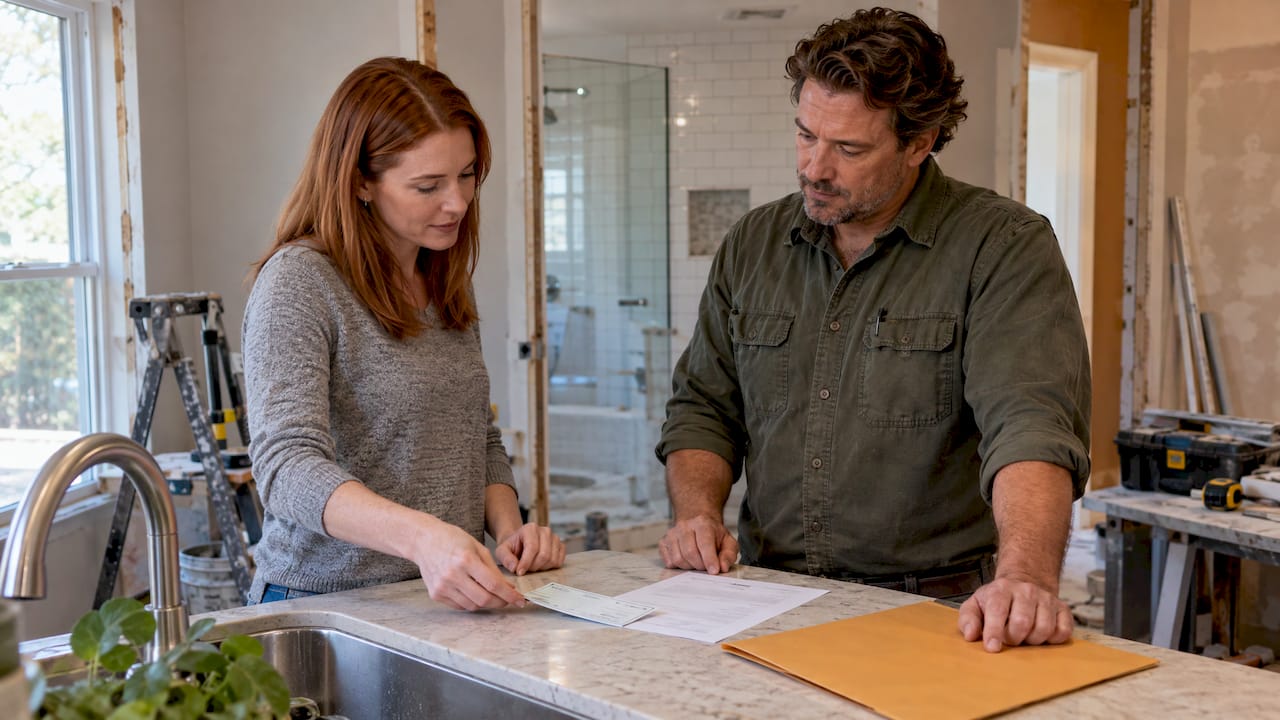
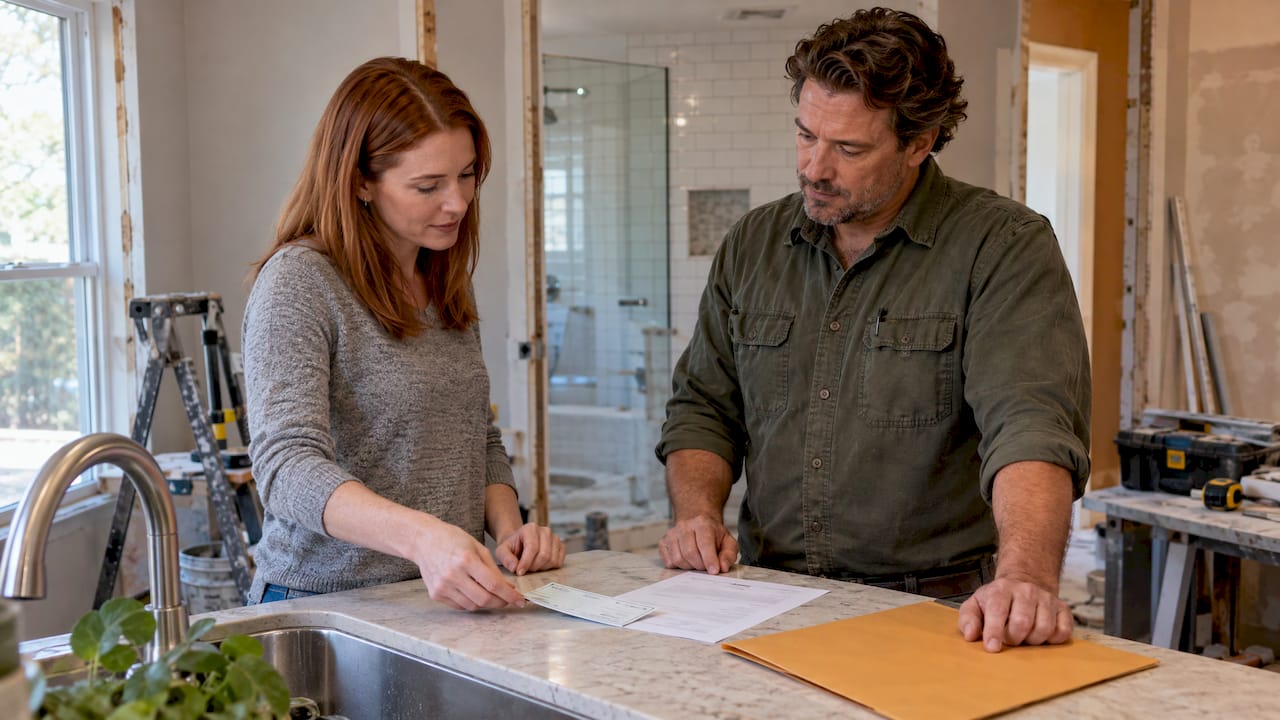
A construction deposit gets collected when it is written into the contract, tied to a stated purpose, and requested the moment the customer approves the estimate. It stalls when it is a verbal promise, a vague number, or an invoice you send three days after the handshake. This guide covers when to ask, how much your state lets you ask for, what the paperwork has to say, and what to do when a customer pushes back. We built Hechito so the quote, the deposit request and the record of what was agreed come out of the conversation you are already having on the job site, not out of your evenings.
HechitoSpend Less Time on Job PaperworkKeep job details and customer conversations organized while Hechito automates the paperwork from quoting through invoicing, in English and Spanish.VisitTL;DR
- Ask for the deposit at the moment the customer approves the estimate or signs the contract, and never rely on a verbal agreement.
- Check your state’s cap before you write a number. California limits a home improvement down payment to the lesser of 10% or $1,000, while other states allow up to a third.
- Tie the deposit to a stated purpose (materials, mobilization, a special order) and put the payment schedule in the contract.
- Issue a receipt that says it is a deposit, with the amount, date, job and remaining balance.
- Keep the call notes, photos and approvals together so a dispute can be settled from the record.
Table of Contents
- Why a deposit is not optional on most jobs
- When to ask: at approval, in writing
- How much to ask for
- What the contract has to say
- Requesting and receiving the deposit
- When a customer cancels, disputes or goes quiet
- Where Hechito fits
- Our view: the deposit is a documentation problem
- FAQ
- Sources
Why a deposit is not optional on most jobs
You pay for lumber, fixtures and a crew before the customer has paid you anything. A deposit is the cash that covers that gap. Business.com’s guidance on construction deposits says they should cover materials you must buy before work begins, so you are not borrowing and paying interest on someone else’s project.
A deposit also does a second job: it filters commitment. A customer who has put money down has made a decision, and the schedule you give your crew is more likely to hold.
The mistake small contractors make is treating the deposit as an awkward favor to request. It is a normal line in the contract. Customers who have hired contractors before expect it, and the ones who push back hardest are usually the ones whose invoices come late.
When to ask: at approval, in writing
The best moment is when the customer says yes to the estimate. The excitement is highest, the scope is fresh, and nothing has been spent yet. One payments guide notes that a deposit is typically collected when the customer approves the estimate or signs the contract, and that a verbal agreement is not a safe basis for taking an advance payment.
Some states make this a rule, not a habit. Maryland, for example, bars any payment before a written contract is signed, according to a state-by-state roofing deposit summary. Whatever your state, the habit is the same: contract first, deposit second.
In practice the delay comes from the paperwork. You agree on the job at the kitchen table, then the written quote waits until after dinner, then until the weekend. Every day of delay is a day the customer can cool off or get another bid. With Chalán, you talk through the job and take photos on site, and the estimate is built from that, so the customer can approve while you are still standing there. If you want the invoice side in detail, see our walkthrough on requesting a deposit invoice.
How much to ask for
There is no single national number. Residential home improvement deposits are regulated state by state, and the caps differ a lot. Here is what a few official sources say.
| State | What the official source says |
|---|---|
| California | Down payment may not exceed 10% of the contract price or $1,000, whichever is less, with an exception for contractors holding a Blanket Performance and Payment Bond on file |
| Virginia | Initial deposit of no more than 10% or $1,000, whichever is less; for custom-made or special-order items, a reasonable deposit could be as high as 30% |
| New York | Progress payments must bear a reasonable relationship to work performed or materials purchased, and pre-completion payments must go into escrow or be bonded |
California goes further: the contract has to print the down payment limit in at least 12-point boldface, and apart from the down payment a contractor cannot demand or accept payment for work until it is done or materials until delivered, per the CSLB’s Contracting for Success booklet.
Commercial and non-capped work
Where no cap applies, contractors commonly use a percentage of the contract. EB3 Construction’s 2026 guide says a mobilization deposit of 5 to 15% of contract value suits most commercial and residential projects, and that requests above 20 to 25% before work begins invite scrutiny. The same guide says deposits for long-lead materials should be tied to a vendor purchase order and order confirmation, not treated as general working capital.
That last point is a useful rule even where nothing forces it. If the customer can see exactly what the money bought, the conversation about the deposit is short.
A worked example
Say you quote a $24,000 bathroom remodel in a state with no cap. A 10% deposit is $2,400, enough to place the order for the vanity and tile. In California, the same job would allow a down payment of $1,000, since that is lower than 10%. The difference is not small, and it changes how you plan materials: in a capped state, you schedule the first progress payment around delivery of materials so cash flow does not depend on a large deposit.
Rules change, and your licensing board is the authority for your trade. Check its current page before you set your standard terms.
What the contract has to say
A deposit that is not in the contract is hard to defend. The California CSLB says a contract should detail the work, price, payment timing, permit responsibility and finish date, identify the contractor with address and license number, and include notices on cancellation, mechanics liens and allowable delays. Even outside California, that list is a good template.
For the deposit itself, put these in writing:
- The amount in dollars, and the percentage if you like.
- What it is for: materials, permit fees, scheduling and mobilization.
- How it is credited. Utah’s optional residential contract form credits the deposit toward the total and refunds any unused portion.
- The payment schedule that follows it.
- What happens if the customer cancels, including the statutory cancellation window where your state has one.
Write milestones a stranger could verify
The deposit is only the first payment. After it comes the schedule, and vague milestones are where cash stalls. EB3 Construction’s team points out that milestones should describe observable conditions, such as framing erected, sheathing installed and framing inspection approved, because terms like “substantial completion” create ambiguity that stalls payment.
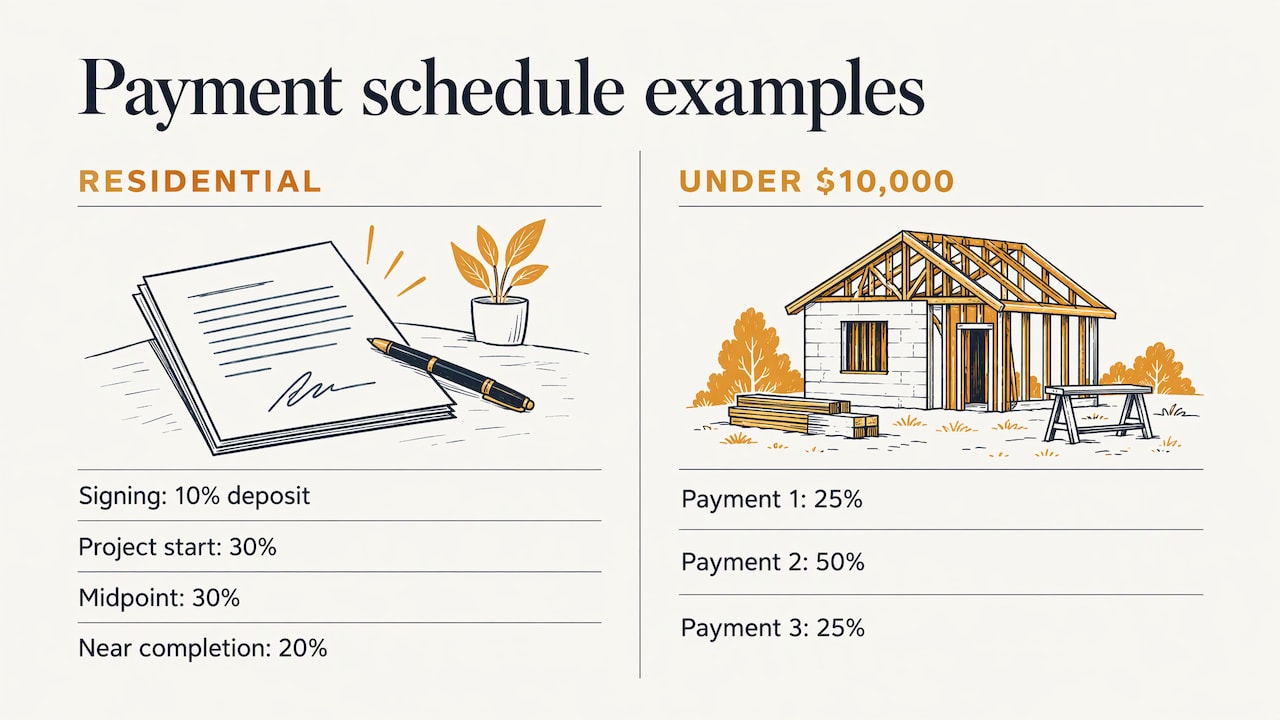
A common residential pattern is a 10-30-30-20-10 split: a deposit at signing, a payment at project start, one at the midpoint, one near completion and a final 10% held until the punch list is resolved, according to Blanchard Construction. The same source suggests a three-payment structure of 25%, 50% and 25% for projects under $10,000. IronNest Construction recommends a final holdback of 10 to 15% and milestone-based draws instead of date-based ones. Treat these as starting points and then fit them to your state’s rules.
Field photos make the milestones believable. Our guides on construction payment schedules and field photos and progress billing show how a dated photo turns “the framing is done” into something a customer can approve in a minute.
Requesting and receiving the deposit
Once the contract is signed, the request should be impossible to misread. A good deposit invoice has the job name and address, the amount, what it covers, the due date and how to pay. It should say “deposit” in plain words, not just “invoice.”
On payment methods, accept what your customers will actually use: card, check or bank transfer. Make it easy and the deposit arrives sooner. Our guide on accepting online payments in construction goes through the setup. Spell out payment terms too, because unclear terms are a common reason invoices get kicked back: see the contractor payment terms checklist.
Give a receipt that says deposit
A receipt protects you as much as the customer. Include the customer name, date, amount, job reference, service address, payment method, what the payment was for and the remaining balance. Label it a deposit, not paid in full, so nobody remembers it later as the final payment. If you ever have to show a licensing board or a mediator what you collected and why, this is the document they will ask for. File it with the job, not in a glovebox. We cover that in receipt management by job.
When a customer cancels, disputes or goes quiet
Most deposit disputes are really documentation disputes. Both sides remember the conversation differently, and nothing in writing settles it. Prevent that first.
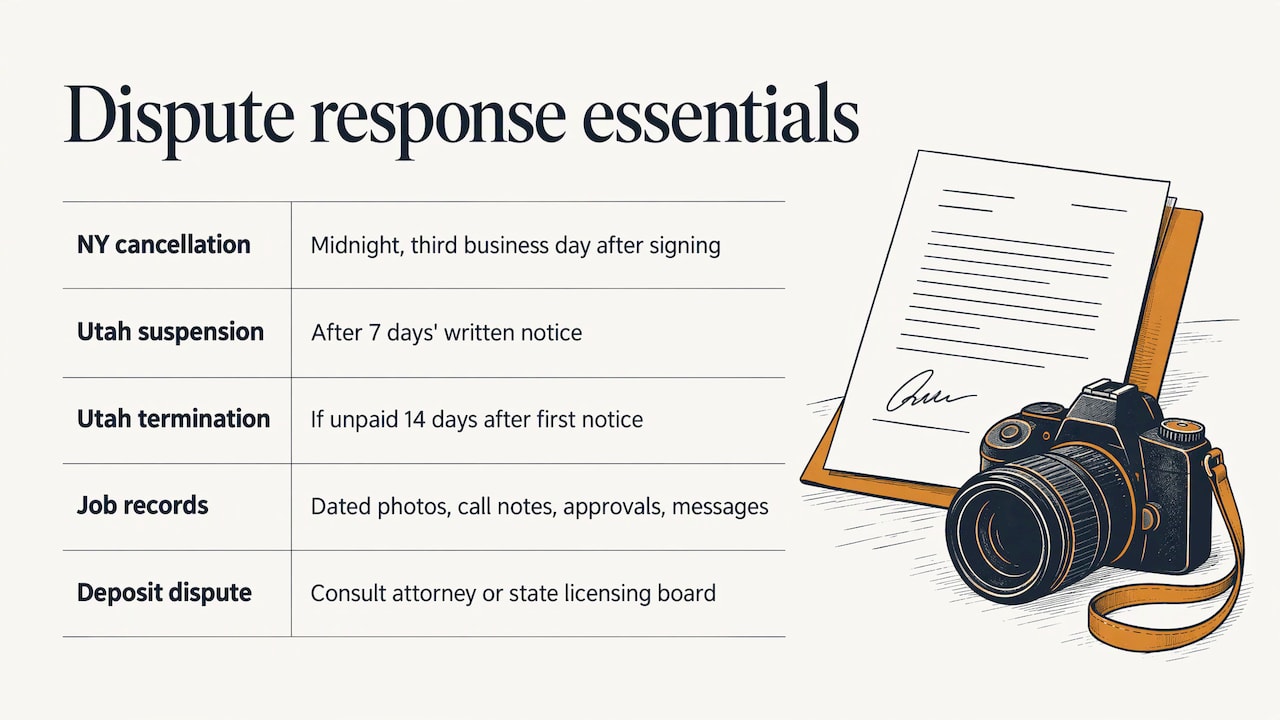
Know the cancellation window. Some states give the homeowner a right to cancel after signing. New York’s home improvement rules, for instance, give the owner the right to cancel until midnight of the third business day after signing. Do not order special materials inside that window if you can avoid it.
Use the contract’s nonpayment steps. Utah’s form is a good model of how specific these can be: it allows suspension of work after 7 days’ written notice of nonpayment and termination if payment remains unpaid 14 days after the first notice. Whatever periods you choose, put them in the contract and follow them in order.
Keep the record. Dated photos, call notes, change approvals and every message about the job are what let you show what was agreed and what was delivered. Our guides on client communication logs and daily construction logs list what to capture.
Talk to a lawyer before you keep or return a disputed deposit. Refund rules depend on your state and your contract, so a construction attorney or your state licensing board is the right call for a dispute that cannot be settled by the paperwork.
For the other end of the job, see how to collect final payment, and for the bigger picture, accounts receivable in construction.
Where Hechito fits
Collecting a deposit is a chain of small tasks: write the quote, send it, get the approval, request the deposit, receipt it, chase it if it is late, and reconcile it against the bank. Each step is easy. Doing them all after a ten-hour day is where they slip.
Hechito works as a crew you hire. Chalán captures the job from your voice and photos on site and turns it into quotes and invoices, sent to the customer, with payment chasing built in. Godínez handles bookkeeping, including receipts and matching bank deposits to your jobs. Lupita answers the phone for your business in English and Spanish, so a customer asking about the deposit gets a response while you are on a ladder. Documents come out in the language the customer needs, whether you speak English, Spanish or both.
See how Hechito works, meet the crew or look at pricing.
Our view: the deposit is a documentation problem
Contractors tell us they are not afraid of asking for money. They are tired of the paperwork that has to exist before they can ask. The quote is in your head, the approval is in a text, the photos are on your phone, and the invoice is a job for Sunday night.
We built Hechito so the talking you already do becomes the record. You describe the job, snap the photos, and the estimate, the deposit request and the invoice follow. A deposit asked for at the kitchen table, with a clear scope behind it, is a deposit customers pay.
We also think a tool should finish the task, not just store a note about it. That is why our crew sends, chases and files, and why it works in the language of the customer and the crew.
Francisco
FAQ
Can I ask for a deposit before I start any work?
Yes, in most places, and it is standard practice for covering materials. Get it in a written contract first, and check your state’s cap on home improvement down payments before you set the amount.
How much should a contractor charge as a deposit?
It depends on the state and the job. California and Virginia point to the lesser of 10% or $1,000 for home improvement work, with Virginia allowing up to 30% for custom or special-order items. Where no cap applies, guides commonly suggest 5 to 15% for mobilization, with materials deposits tied to a purchase order.
Is a deposit the same as the first progress payment?
No. The deposit is paid at signing and covers early costs. Progress payments follow, each tied to a defined milestone in the contract’s payment schedule.
What should a deposit receipt include?
The customer name, date, amount, job and address, payment method, the purpose of the payment, the remaining balance and your contact details. Mark it clearly as a deposit.
Sources
- Business.com: When Should Businesses Require a Deposit?
- Host Merchant Services: How Much Deposit Should a Contractor Ask For?
- Roof Observations: Residential Roofing Deposit Payment Regulations by State
- California CSLB: Contracts and Binding Agreements
- California CSLB: Contracting for Success
- Virginia DPOR: Before You Hire a Contractor
- New York: Required Home Improvement Contract Provisions
- Utah: Residential Construction Contract Form
- EB3 Construction: How to Structure a Payment Schedule
- IronNest Construction: Construction Payment Schedules
Recommended
This is the paperwork Hechito does for you — while you talk.