Site Diary in Construction: What to Record and Why

Site Diary in Construction: What to Record and Why

A construction site diary is a dated, factual record of what happened on a job: who was there, what got done, what the weather did, what was delayed and why. Kept the same day by someone who saw it, it is your best evidence in a payment or delay dispute. Written from memory a week later, it is close to worthless. This guide covers what to put in, what to leave out, and how to keep it up without giving away your evenings.
HechitoCapture Site Details as Work HappensHechito captures job details through voice and images, then organizes them into records without adding end-of-day typing.See how Hechito worksTL;DR
- A site diary is a daily, same-day record of labor, work done, conditions, deliveries, visitors, instructions and delays. On many public contracts it is mandatory, weekends and holidays included.
- Specific beats long: quantities, locations and reference numbers (RFIs, drawing numbers, spec sections) make an entry checkable.
- Record the quiet days and the things that did not happen, such as a late drawing or a work area not handed over.
- Stick to facts. Opinions and venting weaken the record. A diary entry does not replace OSHA forms.
- The easiest way to keep it contemporaneous is to capture it on site by voice and photo, then let software organize it.
Table of Contents
- What a site diary is, and who needs one
- Why the diary matters when money is on the line
- What to put in a site diary
- Write boring entries, and be specific
- Record what did not happen
- Keep opinions out, keep quiet days in
- Where the diary stops and OSHA starts
- Paper, spreadsheet or app?
- Our perspective: the diary fails at the end of the day, not on site
- A simple end-of-shift routine
- Making the diary pay for itself
- Where Hechito fits
- FAQ
- Sources
What a site diary is, and who needs one
You will also hear it called a daily log, daily report or project diary. The names vary by trade and region, and the purpose is the same: a chronological account of a single day on site.
Who keeps it depends on the job:
- Public work. State transportation departments treat the diary as an official record. TxDOT’s guidance says complete and accurate records are needed for contract administration and legal purposes. Georgia DOT’s construction manual makes the construction manager responsible for the daily project diary, covering activities, weather and instructions given or received. Oklahoma DOT uses a Diary window in its SiteManager system to authorize daily work reports and charge time to a contract.
- Private commercial work. Your contract may require daily reports to the owner or GC. Even when it does not, the diary is what you reach for when someone disputes time or money.
- Residential remodelers and specialty trades. Nobody may demand it, and that is exactly why a short daily record pays off. It settles the “you never told me” arguments and backs up change orders.
If you want the payroll and claims angle in more detail, we break down seven fields for daily construction logs in a separate guide.
Why the diary matters when money is on the line
The diary earns its keep in disputes. Guidance from the Construction Management Association of America says that the party with reliable, contemporaneous documentation tends to hold the stronger position in delay and disruption claims. Another practitioner write-up puts it plainly: a diary entry made on the day something happened is treated as far more reliable than a reconstructed account.
That is why the diary sits behind so many everyday money questions:
- Was the delay yours, the owner’s or the weather’s?
- Did the extra work get requested, and by whom?
- Were you on site the day the inspector says nobody showed?
- Does the draw request match what is actually built? (Our guide to verifying draws with field photos covers that side.)
None of this is legal advice. If you are already in a dispute, your construction attorney decides how your records get used. What you control is how good the records are before anyone asks.
What to put in a site diary
A sound daily entry covers the same core items every time. Use this as your checklist:
| Section | What to capture | Example of a useful entry |
|---|---|---|
| Date, project, author | Who wrote it, which job, which shift | 10/14, Maple St. kitchen remodel, entry by J. Ortiz |
| Weather and site conditions | Temperature, rain, wind, ground or access issues, with times | Rain 7:15 to 10:30 a.m., exterior framing stopped |
| Labor | Names or headcount by trade, hours, subs on site | 3 framers, 1 laborer, 8 hrs; electrician rough-in, 4 hrs |
| Equipment | What ran, what was idle or broken | Lift on site, idle 10:30 to noon, rain |
| Work performed | Quantity, location, reference | 14 wall sections framed, north elevation, per sheet A-201 |
| Materials and deliveries | What arrived, what was short, delivery ticket numbers | LVL beams delivered 9:40 a.m., ticket 88213, one beam damaged |
| Visitors and inspections | Inspector, owner, designer, with time and outcome | City framing inspection 2 p.m., passed |
| Instructions and decisions | Who told you what, verbal or written | Owner asked verbally to move outlet, change order requested |
| Delays and constraints | Cause, start and stop time, area affected, response | Window delivery late, second-floor work resequenced |
| Safety | Toolbox talk, near misses, injuries, basics only | Toolbox talk on ladder use, no incidents |
| Photos | Time-stamped, tied to the entry | 6 photos, north elevation and damaged beam |
A contractor-side checklist from Condoc singles out delays and constraints as the section that protects margin, and it suggests logging the start and stop time, the cause, the area affected and your response. That matches how disputes actually get argued.
Write boring entries, and be specific
The best diaries read dull. “Progressed blockwork, 12 men” tells an auditor nothing. A practitioner guide from Zepth says entries are far stronger with quantities and locations, such as 42 m² of blockwork on a named level and zone, because they can be checked against the schedule. In US units, that is “460 sq ft of CMU, Level 3, Zone B.”
Three habits make that easy:
- Name the place. Level, room, gridline, elevation or unit number.
- Give the number. Linear feet, square feet, cubic yards, count of fixtures, hours.
- Cite the paper. Drawing sheet, spec section, RFI number, change order number. The CMAA material notes that references like these make entries verifiable and more powerful as evidence.
The same discipline applies to scope. If your diary entries line up with a clear written scope, disagreements get short. We cover that in eight contractor checks for a scope of work.
Record what did not happen
Most logs list what got done. The ones that win claims also list what was missing. Condoc’s guidance points to notes like a work front not handed over, a drawing not received, or material missing from site as the context that disruption claims depend on, and the one most often left out.
Compare:
- Weak: “Slow day, waiting on info.”
- Strong: “No work on Unit 4 bathrooms, 7 a.m. to 3 p.m. Tile selection not received. Requested by email 10/6, still outstanding. Crew of 2 reassigned to punch list in Unit 2.”
The second version gives who, what, when, where and what you did about it. A construction-law-minded write-up gives the same advice for frustration: replace a complaint with a dated reference to the outstanding RFI and its response deadline, and the entry becomes evidence instead of a grumble.
For events that look like disruption, one forensic firm’s checklist says to log the event in the site diary the same day and capture time-stamped photos, delivery notes and access logs.
Keep opinions out, keep quiet days in
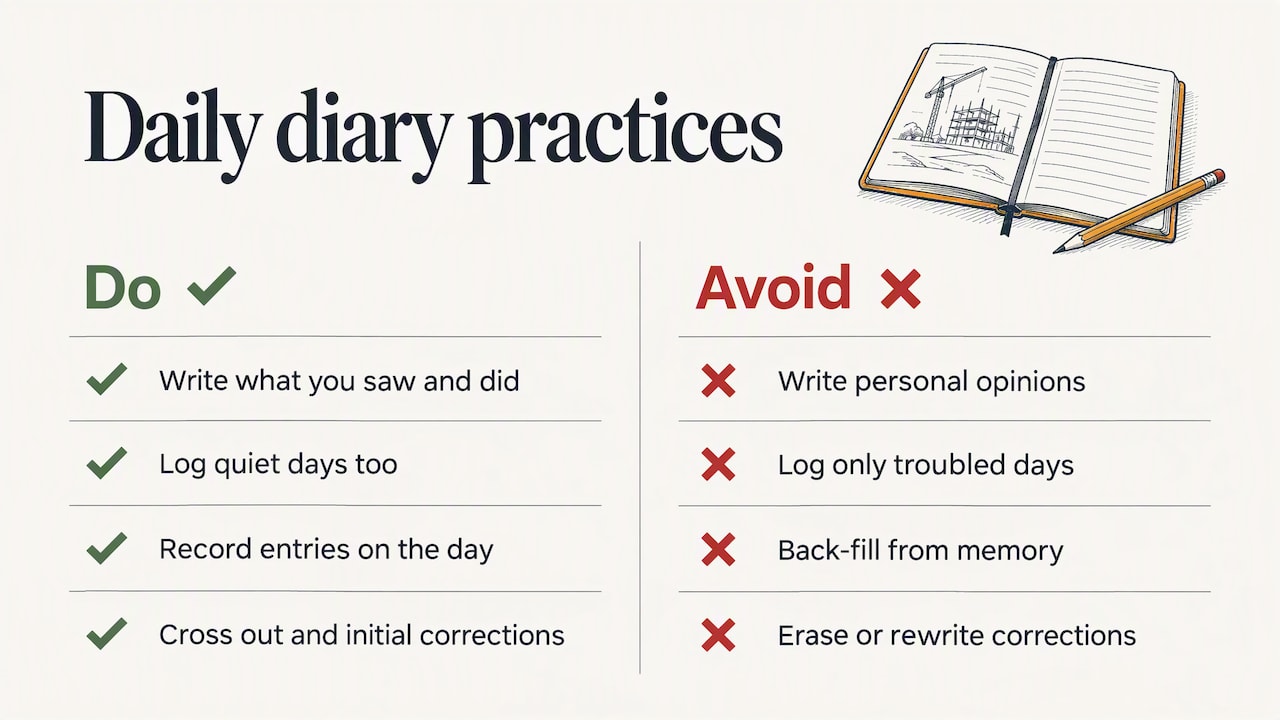
Facts only. “Owner’s designer is useless” is an opinion. “Revised detail for the stair stringer not received as of 3 p.m., requested 10/3” is a fact. Write what you saw and did, not what you feel about it.
Write on the quiet days too. A diary that only exists when there is trouble looks like it was built for a claim. The CMAA guidance warns that if only the bad days have entries, the other side will argue the record is biased. Ten seconds on an uneventful day builds the baseline that makes the bad days believable.
Do not back-fill. An entry written from memory at the end of the week tends to show flattened language, rounded times and thin detail. A LegalClarity guide on daily logs says such entries get little weight compared with ones recorded on the day, and that visible, initialed corrections can read as more honest than a spotless page. So cross out and initial, rather than erasing or rewriting.
Where the diary stops and OSHA starts
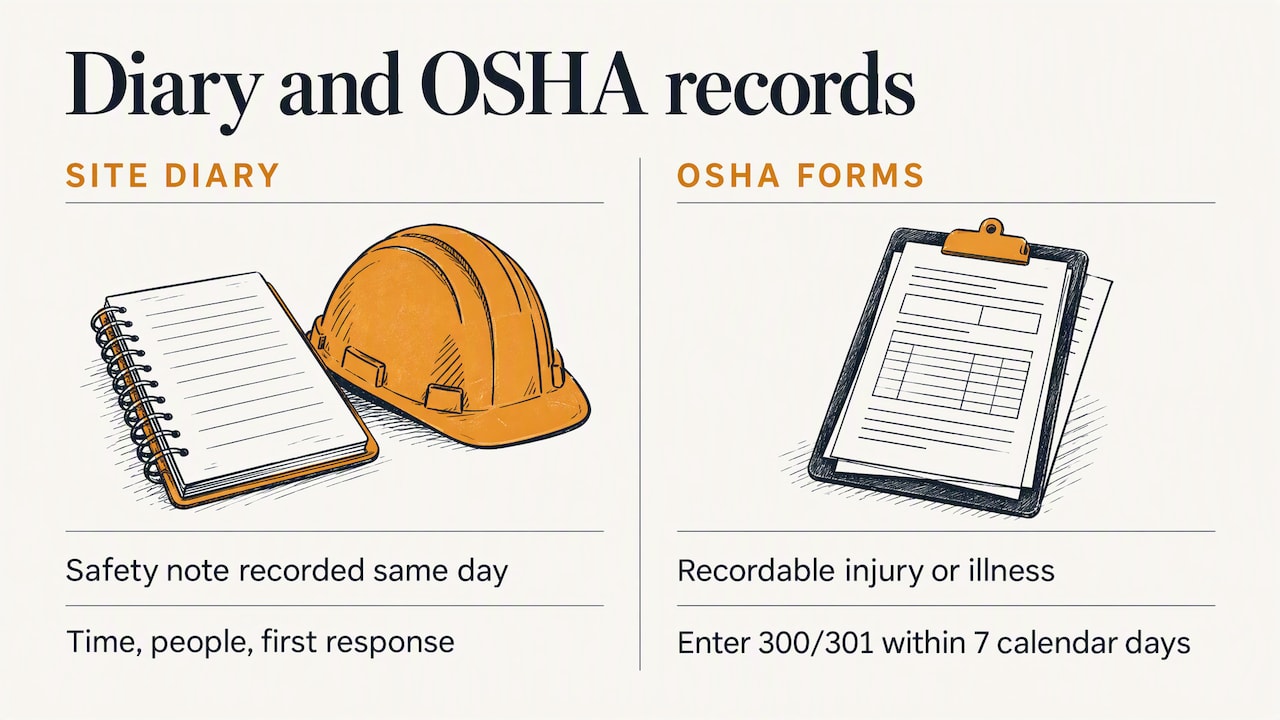
Safety notes belong in the diary: time, people involved, first response. But the entry does not satisfy your regulatory duties. Under OSHA’s recordkeeping rule, you must enter each recordable injury or illness on the OSHA 300 Log and 301 Incident Report within seven calendar days of receiving information that it occurred. If something happens on your site, the diary entry is the same-day note, and the forms are a separate job. For questions about whether a specific case is recordable, check OSHA’s recordkeeping pages or talk to your safety consultant or insurance carrier.
Paper, spreadsheet or app?
The format matters less than whether you actually fill it in on the day. Here is how the options compare in practice:
| Format | Strengths | Weak spots |
|---|---|---|
| Bound paper diary | Cheap, hard to alter silently, accepted everywhere | Illegible handwriting, lost books, photos live elsewhere, retyping for invoices |
| Spreadsheet or document template | Searchable, easy to share | Gets filled in at night from memory, no automatic timestamps |
| Daily report app with forms | Structured fields, photos attached | Lots of tapping and typing on site, still separate from quoting and billing |
| Voice and photo capture that builds the record for you | Fast enough to do on the spot, entry ties to the job, feeds invoices | Needs a quick review so nothing is mis-transcribed |
Pick whichever you will really use at 2 p.m. with dusty gloves. For many small crews that rules out anything involving a keyboard.
Residential and permit-heavy jobs
On home builds and additions, the diary often has to sit alongside permit paperwork, inspector visits and drawing revisions. Seeing how residential drawings and permit applications get packaged with full documentation in another market (this example is a Norwegian service, so the specifics differ from US permitting) shows how much of the paper trail starts before the first day on site. Your diary then picks up where those documents leave off, recording each inspection, revision and instruction against them.
Our perspective: the diary fails at the end of the day, not on site
We build Hechito for contractors and tradespeople, and the same story comes up again and again. The diary is not skipped because people do not care. It is skipped because the work finishes at 5 p.m., the truck ride home is the first quiet moment, and by then the details have blurred. Everything the research says about back-filling is true, and it is also what happens to a tired crew lead at 9 p.m. at the kitchen table.
So we think the answer is not more discipline, it is less typing. Customer conversations, instructions and job details are already being spoken out loud on site. If those get captured as they happen, by voice and photo, the record is contemporaneous by default. The software can turn a spoken note like “north wall framed, beam damaged, owner wants the outlet moved” into an organized entry, and the same information can flow into the estimate, the change order and the invoice instead of being retyped three times.
Two things we would tell any crew, with or without our product. First, decide on five or six fields and use them every day. Second, review the entry before you leave the site, while you can still fix a wrong number. Many of our users work in both English and Spanish on the same crew, so we built Hechito to take notes in either language, or a mix, and produce documents in the language the recipient needs.
— Francisco
A simple end-of-shift routine
You can set this up with any tool. The sequence is what counts:
- Morning, two minutes. Record weather, headcount and the day’s planned areas.
- During the day, as things happen. Speak or jot each delivery, instruction, inspection, delay and visitor with a time. Take a photo of anything that might be argued later.
- Before leaving, five minutes. Read the entry. Add quantities and locations. Add what was missing or not handed over. Fix errors with a visible correction, not a quiet edit.
- Weekly. Check the diary against the schedule and open RFIs. Anything outstanding gets its dated follow-up.
- At billing time. Pull the quantities and photos straight into the progress invoice. Our guides on progress billing with field photos and photo documentation rules go deeper on that step.
Making the diary pay for itself
A good diary is not just defensive. The same entries support:
- Faster invoicing. If quantities, hours and photos are already recorded, the invoice writes itself, and clear terms cut rejections. See our invoice checklist for contractor payment terms.
- Job costing. Daily labor and material notes show where a job is drifting before it is over. Our piece on job costing and WIP explains how field data supports the numbers.
- Bookkeeping. Receipts and costs coded to the right job on the day are far easier than a month-end pile. More in bookkeeping for contractors using field capture.
- Estimates. Knowing real production rates from past diaries makes the next quote tighter. And a clean estimate versus quote avoids a different kind of dispute.
Where Hechito fits
Hechito turns what you say and photograph on the job into organized records, estimates and invoices, in English or Spanish. Chalán handles voice quotes and invoices from the job site, Lupita answers your phone bilingually, and Godínez matches your bank activity to your jobs. You can see how it all works for trades on our contractors page and check current plans on the pricing page.
FAQ
What is a site diary in construction?
It is a daily, factual record of what happened on a project: labor, equipment, work completed, weather, deliveries, visitors, instructions and delays. On many public contracts it is an official required record. On private jobs it is the evidence you use to support time and payment claims.
What should be in a site diary?
Include the date, author, weather, headcount by trade, equipment, work done with quantities and locations, deliveries, inspections, visitors, instructions received, delays with their causes, and safety basics. Add time-stamped photos and reference numbers such as RFIs, drawing sheets and change orders.
How do I maintain a construction site diary?
Write it the same day, as things happen, and review it before you leave site. Stay factual, record quiet days as well as problem days, and correct mistakes with a visible initialed change. Voice and photo capture makes this practical when you are working with your hands.
Why is it important to keep a site diary?
It is your contemporaneous record when someone disputes delays, extra work or payment. Reliable same-day documentation carries more weight than memory or a reconstructed story. It also speeds up invoicing and job costing, because the numbers are already captured.
Sources
- TxDOT: Importance of Accurate Records
- Georgia DOT: Construction manual, daily project diary
- Oklahoma DOT: SiteManager Policy, Diary
- CMAA: What’s in Your Daily Report?
- Construction AI: Site Diaries, What to Record and Why It Matters Legally
- Zepth: Construction Records Playbook
- Condoc: Daily Reports That Actually Protect Margin
- LegalClarity: How to Fill Out and Submit a Construction Daily Log Form
- Rimkus: Disruption and How To Handle It
- OSHA: 29 CFR 1904.29, Forms
Recommended
This is the paperwork Hechito does for you — while you talk.